
When to Start GRE Prep: Timing Your Study for Maximum Impact
5 min read
Dec 16, 2025
Your brain has an optimal learning window. Here's how to find it.
Most GRE advice tells you how to study. Few explain when to start—and why that timing might matter more than the study method itself.
Here's what the research actually shows: spacing your GRE preparation across months instead of weeks can nearly double your retention of key concepts. A landmark study by Cepeda et al. in Psychological Science found that the optimal gap between study sessions depends directly on how long you need to remember the material. For a test 3-6 months away, spreading your prep over 3-4 months dramatically outperforms a compressed 4-week cram.
This isn't productivity advice. It's neuroscience.
The Backward Planning Method (That Actually Works)
Start with your application deadlines, then work backward:
Step 1: Identify your earliest deadline. Most graduate programs have deadlines between December and February for fall admission. Business schools often have rolling deadlines or multiple rounds.
Step 2: Build in a score-delivery buffer. Official GRE scores take 8-10 days to arrive. If you're sending scores to multiple schools after test day, add another 5 business days for processing.
Step 3: Account for a possible retake. ETS requires a 21-day gap between GRE attempts. If your first score disappoints, you'll want time for a second shot.
Step 4: Calculate your target test date. For a December 15th deadline, aim to take the GRE by late October—giving you a retake window in late November if needed.
Step 5: Determine your study start date. This depends on your score gap, but most students benefit from 3-4 months of preparation.
How Long Should You Actually Study?
The honest answer: it depends on the gap between your current score and your target score.
Take a free ETS PowerPrep practice test before planning anything. Compare your baseline to the average scores at your target programs. Then use this general framework:
A 5-10 point improvement typically requires 6-8 weeks of consistent study. A 10-20 point improvement often demands 10-16 weeks. Larger gaps may require 4-6 months of dedicated preparation.
These estimates assume roughly 10-15 hours of weekly study. Working professionals juggling demanding schedules may need to extend their timeline while reducing weekly hours—and that's actually fine. Research on the spacing effect suggests that spreading study across more weeks (with fewer hours per week) often produces better retention than condensed intensive periods.
Why Cramming Fails (The Science)
That 4-week intensive study plan might feel productive. Your brain disagrees.
Memory consolidation—the process of converting short-term learning into long-term knowledge—requires time between study sessions. When you cram information, you're essentially overwriting unstable memory traces before they've solidified.
The spacing effect, documented in hundreds of studies, shows that distributed practice outperforms massed practice for virtually every type of learning. For complex reasoning skills like those tested on the GRE, this effect is even more pronounced. Your brain needs gaps between exposure to information to process, connect, and strengthen neural pathways.
What does this mean practically? A student who studies vocabulary for 30 minutes daily over 12 weeks will retain significantly more words than someone who studies for 2 hours daily over 3 weeks—even with identical total study time.
The Strategic Timeline for Different Situations
If you're still in college: Consider taking the GRE in the spring or summer after your junior year. You're still in "study mode," and scoring well early means one less thing competing for attention during senior year applications. GRE scores remain valid for 5 years.
If you're working full-time: Start earlier than you think necessary. A 4-month timeline with moderate daily study (45-60 minutes) is often more sustainable—and effective—than attempting intensive weekends for 6 weeks.
If your deadline is approaching: Be realistic. If you have less than 6 weeks, focus on high-yield areas where you can make quick gains (typically vocabulary and math fundamentals) rather than attempting comprehensive coverage. Consider whether delaying your application by one cycle might produce better outcomes.
The Application Juggling Problem
Here's what most timing guides miss: GRE prep doesn't happen in isolation.
Graduate applications require personal statements, recommendation letters, transcripts, and often supplementary materials. If you're finishing GRE prep the same week you're drafting your statement of purpose, something will suffer.
The strategic approach separates these phases. Complete your GRE 2-3 months before applications are due, freeing mental bandwidth for the writing and reflection that strong applications require. Students who treat the GRE as one component of a larger timeline—rather than an isolated test to "get through"—consistently report less stress and better outcomes.
When NOT to Start GRE Prep
During major life transitions. Starting a new job, moving cities, or navigating personal challenges? Your cognitive resources are already stretched. Delay if possible.
Without a target score in mind. "As high as possible" isn't a goal—it's a recipe for endless studying. Research actual score ranges at your target programs before beginning prep.
Before you've committed to graduate school. The GRE is mentally demanding. If you're uncertain about pursuing graduate education, resolve that question first.
Putting It Together: A Sample Timeline
For a student with application deadlines in mid-December:
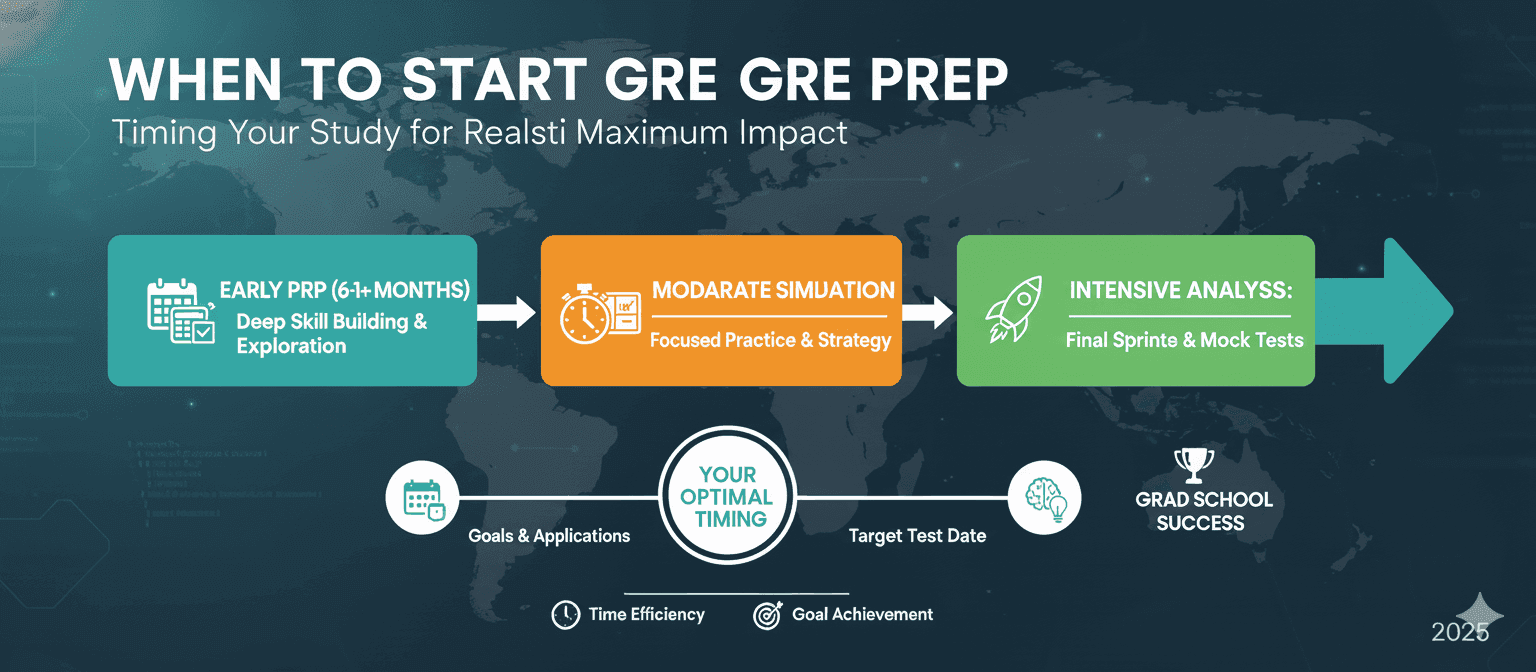
May-June: Take diagnostic practice test. Research target scores. Begin light content review—particularly areas of weakness.
July-August: Core content phase. Systematic review of GRE math concepts and vocabulary. Regular untimed practice.
September-October: Test simulation phase. Full-length practice tests under realistic conditions. Targeted review of persistent weak areas.
Late October: Take GRE. Scores arrive by early November.
November (if needed): Retake GRE. Scores arrive by late November.
November-December: Focus exclusively on application materials.
This timeline provides breathing room, accommodates setbacks, and—critically—leverages the spacing effect for better retention.
The Bottom Line
When you start GRE prep shapes how well you retain what you learn. Beginning 3-4 months before your ideal test date allows your brain to consolidate knowledge effectively, provides buffer for life's inevitable disruptions, and separates GRE stress from application stress.
The students who score highest aren't always the ones who study longest. They're the ones who study strategically—and that strategy starts with choosing the right moment to begin.
Frequently Asked Questions
How far in advance should I schedule my GRE test date?
Schedule your test 2-3 months before your earliest application deadline. This provides buffer for receiving scores (8-10 days) and potentially retaking the test (21-day minimum gap). For testing center appointments, book 2-3 months ahead to secure your preferred date and location.
Can I prepare for the GRE in one month?
While possible, a one-month timeline significantly limits your score improvement potential. Research on the spacing effect shows that distributed study over 3-4 months produces better retention than compressed preparation. If constrained to one month, focus on high-yield areas and set realistic score expectations.
When is the best time of year to take the GRE?
There's no "best" time universally—the right time depends on your application deadlines and personal schedule. However, taking the GRE during summer (for fall deadlines) or fall (for spring deadlines) allows ample time for retakes and keeps test prep separate from the application writing phase.
How do I know if I've studied enough to take the GRE?
You're ready when your practice test scores consistently hit your target range under realistic conditions. If you're scoring within 2-3 points of your goal on multiple official ETS practice tests, you're prepared. If not, consider delaying your test date.
PrepAiro's adaptive platform uses spaced repetition science to optimize your study timing automatically—so you focus on learning while the algorithm handles the scheduling.