
UPSC Interview Psychology: Understanding Board Dynamics & Response Strategies
5 min read
Dec 16, 2025
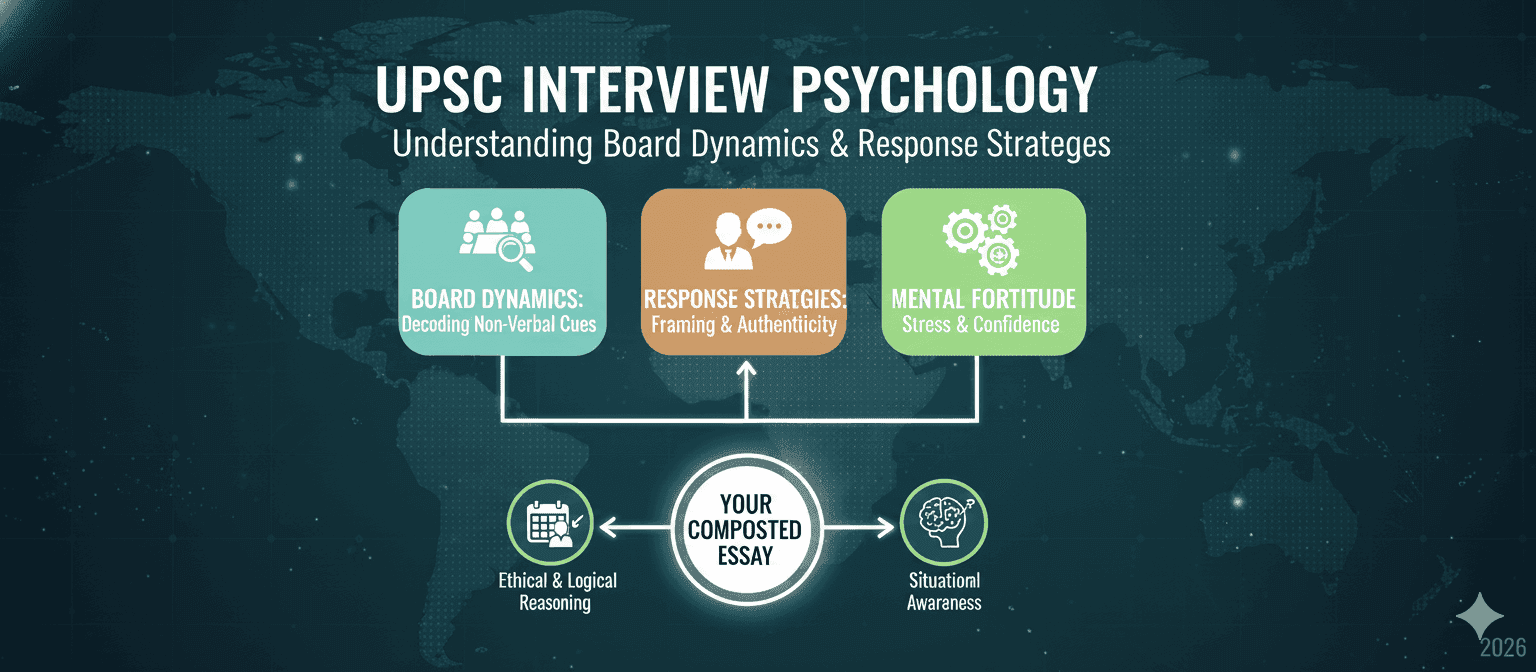
The UPSC Personality Test carries 275 marks and represents far more than a formal evaluation—it is a conversation designed to reveal who you are beyond your written answers. Understanding the psychology behind this final stage can transform your approach from anxious performance to authentic engagement.
Decoding Board Composition and Dynamics
The UPSC interview board typically consists of a Chairman and four to five members, each bringing distinct expertise. The Chairman—often a retired civil servant or academic—sets the conversational tone, while members may include subject experts, former diplomats, or specialists aligned with your optional subject and background.
What candidates often miss is that each member evaluates different dimensions. One may focus on your DAF details, another on current affairs, and yet another on situational judgment. This distributed assessment means consistency across varied question types matters more than brilliance in any single area.
Board dynamics also shift based on preceding candidates. A panel fatigued by rehearsed answers will respond positively to genuine, thoughtful responses. Anudeep Durishetty, AIR-1 in 2017, captured this insight well when he described the interview as requiring present-moment awareness rather than predetermined scripts.
Handling Stress Questions with Composure
Stress questions serve a specific purpose—they test your temperament under pressure, not your knowledge. When a board member challenges your statement, interrupts mid-sentence, or poses an uncomfortable personal question, they are observing your reaction mechanism.
The effective response framework involves three elements. First, pause briefly before responding. This two-second gap signals thoughtfulness rather than defensiveness. Second, acknowledge the validity in the challenge before presenting your perspective. Third, maintain steady eye contact and measured tone regardless of internal anxiety.
Common stress triggers include questions about failed attempts, controversial opinions in your DAF, or hypothetical scenarios with no correct answer. The board is less interested in what you conclude than how you navigate uncertainty. Admitting limitations while demonstrating willingness to learn often scores higher than defensive justifications.
Balancing Opinion Questions Strategically
Opinion-based questions reveal your analytical framework and governance mindset. Questions like "Should India increase defense spending over welfare?" or "Is Indian democracy becoming excessively populist?" require structured thinking rather than binary positions.
The recommended approach follows a clear sequence: define the issue precisely, acknowledge competing perspectives, present your reasoned position, and support it with specific examples. This structure demonstrates that you can hold complexity without either rigid ideology or evasive neutrality.
Avoid two extremes—passionate advocacy that ignores counterarguments, and diplomatic non-answers that reveal nothing about your thinking. The board seeks candidates who can form positions while remaining open to evidence. Your opinion itself matters less than the reasoning behind it.
For politically sensitive topics, ground your response in constitutional values, development indicators, or administrative feasibility rather than partisan frameworks. This approach demonstrates the balanced judgment expected of civil servants who must implement policies across ideological governments.
Integrating Current Affairs Naturally
Current affairs questions test whether your preparation remains connected to real-world governance. The board may ask about recent policy developments, international events affecting India, or local issues from your home state.
Effective integration requires understanding why events matter, not just what happened. When discussing a policy, connect it to administrative challenges, stakeholder impacts, and implementation constraints. This perspective distinguishes candidates who think like administrators from those who merely consume news.
Prepare current affairs through the lens of your DAF—your home district's development challenges, your educational institution's recent achievements, or your work sector's regulatory changes. The board frequently bridges current events with personal background, testing your ability to connect abstract policy with lived experience.
Building Authentic Confidence
Interview confidence differs from examination confidence. Written tests reward comprehensive knowledge; interviews reward comfortable self-presentation. Many candidates who excelled in Mains struggle because they approach the Personality Test as another knowledge evaluation.
Genuine confidence emerges from three sources: thorough DAF preparation, comfort with uncertainty, and authentic self-knowledge. Prepare at least fifty potential questions from your DAF, but avoid memorizing answers. Instead, clarify your thinking on each topic so responses emerge naturally.
Physical preparation also influences psychological state. Mock interviews under realistic conditions reduce novelty anxiety. Practice maintaining open body posture, appropriate eye contact rotation among panel members, and steady breathing during challenging moments.
Finally, reframe the interview's purpose. You are not proving worthiness—you have already demonstrated capability through Prelims and Mains. The Personality Test assesses fit for public service, and your task is simply to present your authentic self clearly.
Key Takeaways
The UPSC interview rewards candidates who combine preparation with presence. Understanding board dynamics helps you respond appropriately to different question types. Stress questions test temperament rather than knowledge. Opinion questions require structured reasoning more than correct conclusions. Current affairs integration should connect policy to administrative reality. Authentic confidence comes from thorough preparation combined with acceptance of uncertainty.
Approach the Personality Test as a professional conversation rather than an examination. The board members have selected you for this stage—they want to confirm that the person matches the potential shown in written work.
Frequently Asked Questions
Q1: How should I handle a question I genuinely don't know?
Acknowledge honestly that you lack specific knowledge on that point. You might say you are not fully certain but can share related understanding. UPSC values integrity over attempted bluffing, and honest acknowledgment often leads to follow-up questions in areas you can address better.
Q2: What if the board seems uninterested or dismissive?
Maintain your composure and response quality regardless of perceived board reception. Panel members may appear disengaged while actually listening carefully. Your consistency under varied conditions itself demonstrates the temperament required for civil services.
Q3: How many mock interviews should I attempt before the actual test?
Quality matters more than quantity. Three to five well-structured mocks with varied panels provide sufficient exposure. Ensure at least one mock simulates realistic pressure conditions. Post-mock analysis and improvement matter more than accumulating mock experiences.
Q4: Should I mention my failures or weaknesses if asked?
Address such questions with honest reflection rather than either defensive justification or excessive self-criticism. Frame challenges as learning experiences and demonstrate growth. The board assesses self-awareness and resilience, not perfection.