UPSC Interview Preparation: From DAF to Mock Interview Strategy 2026
5 min read
Dec 12, 2025
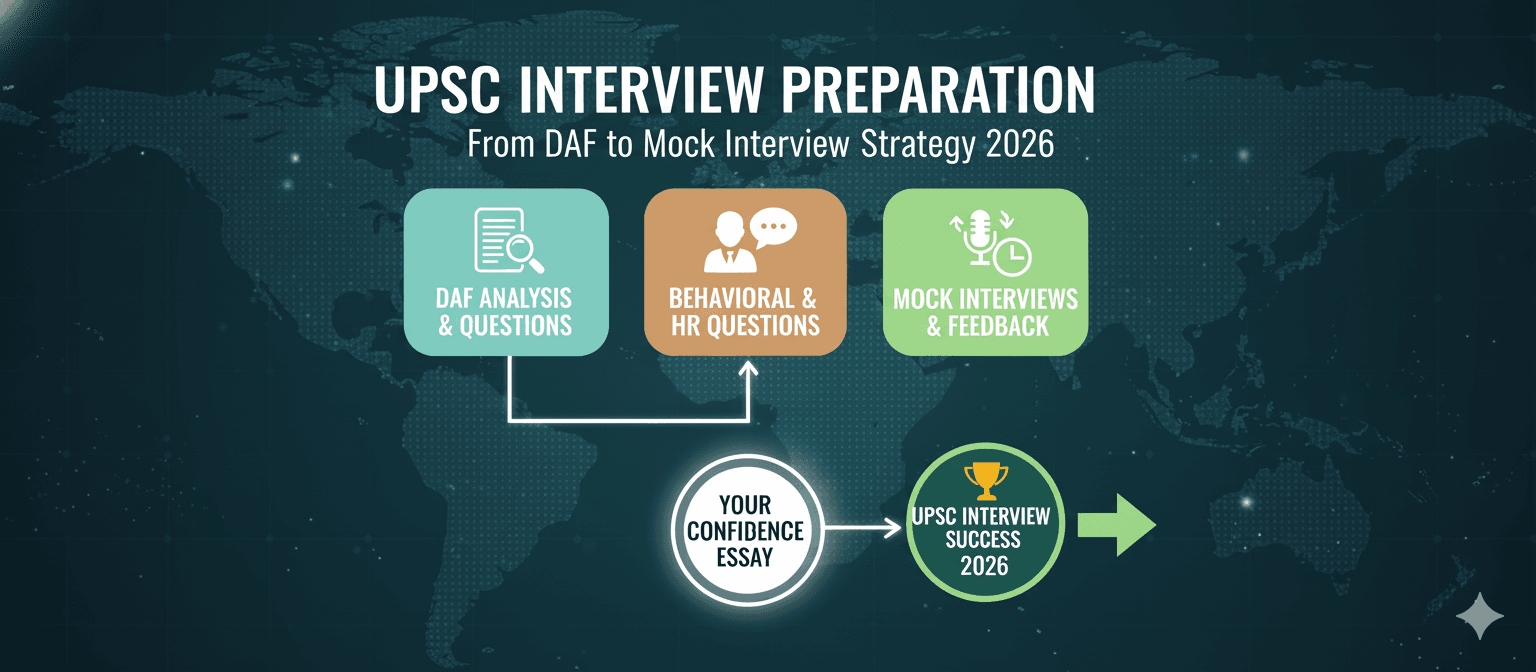
The UPSC Personality Test carries 275 marks and can make or break your final rank. Unlike Prelims and Mains, the Interview tests who you are beyond the answer sheet—your personality, presence of mind, and suitability for civil services. This guide covers everything from DAF optimization to mock interview strategy for UPSC CSE 2026.
Understanding the UPSC Personality Test
The UPSC Interview is not a knowledge test—UPSC has already assessed your knowledge through Mains. The Personality Test evaluates your mental alertness, critical thinking, balance of judgment, social cohesion, intellectual depth, and integrity. Boards typically consist of a Chairman and four members who assess candidates across 30-45 minutes.
Average marks hover between 140-180, with exceptional performers scoring 200+. The key differentiator is not just what you know, but how you present it.
DAF Optimization: Your Interview Blueprint
Your Detailed Application Form (DAF-II) is essentially the question bank for your interview. Every entry—from your hometown to hobbies—becomes fair game for questioning.
Strategic DAF Filling Tips:
The educational qualifications section should highlight not just degrees but any specializations, projects, or research work. If you studied Economics, expect questions on current economic policies. Engineering graduates often face questions connecting their technical background to governance challenges.
For the home state section, prepare comprehensively on your district's history, geography, administrative setup, developmental challenges, and notable personalities. A candidate from Rajasthan should know about water scarcity solutions, while someone from Kerala should understand the decentralization model.
Service preferences require genuine reflection. If you rank IPS above IAS, be prepared to justify why. The board often probes the reasoning behind preference rankings.
Hobby Selection Strategy:
Choose hobbies you genuinely practice and can discuss in depth. The PCSE framework helps—Political (following parliamentary debates), Cultural (classical music, literature), Social (volunteering, community work), and Environmental (sustainable practices, wildlife interest).
Avoid generic hobbies like "reading" or "travelling." Instead, be specific: "reading political biographies of Indian freedom fighters" or "studying tribal art forms of Central India." For every hobby, prepare to answer: Why this hobby? What have you learned? How does it connect to public service?
Current Affairs Preparation for Interview
Unlike Mains current affairs, Interview current affairs requires opinion formation. The board wants to know your stance on contemporary issues, backed by logical reasoning.
6-Month Current Affairs Focus:
Track major policy decisions, diplomatic developments, Supreme Court judgments, and governance innovations. Create a personal opinion document covering: What happened? Why does it matter? What is your view? What are counter-arguments?
Practice articulating views on sensitive topics like reservation policy, federalism disputes, or judicial appointments. The key is demonstrating balanced thinking—acknowledge multiple perspectives before presenting your reasoned position.
Connecting Current Affairs to DAF:
If your optional subject is Geography, expect questions linking current environmental issues to your academic background. A Public Administration optional holder should be prepared for questions on recent administrative reforms or governance failures.
Body Language and Communication
Non-verbal communication contributes significantly to first impressions. The first 30 seconds—from entering the room to sitting down—set the tone for your interview.
Entry and Seating:
Knock twice, wait for acknowledgment, enter with confidence, wish all members with eye contact, and sit only when offered. Maintain an upright but relaxed posture—leaning slightly forward shows engagement without appearing aggressive.
During the Interview:
Maintain eye contact with the questioner while answering, briefly glancing at other members. Avoid fidgeting, excessive hand movements, or touching your face. When thinking, a brief pause with maintained eye contact appears more confident than rushed, incomplete answers.
Voice Modulation:
Speak clearly at a moderate pace. Monotonous delivery suggests mechanical preparation. Vary your tone to emphasize key points. If you don't know something, admit it gracefully rather than attempting to bluff—boards appreciate honesty.
Mock Interview Strategy
Mock interviews are indispensable for Interview preparation. They simulate actual conditions, expose blind spots, and build confidence through repetition.
When to Start:
Begin mock interviews 45-60 days before your scheduled date. This allows time to incorporate feedback while keeping momentum. Earlier mocks risk forgetting improvements; later ones don't provide sufficient correction time.
Choosing Mock Interview Panels:
Diversify your mock sources. Institute-based mocks (Vajiram, Vision, Forum) offer structured feedback. Retired bureaucrat panels provide insider perspectives on what boards actually seek. Peer mocks help with basic preparation and reduce nervousness.
Aim for 8-12 mock interviews before your actual date. Space them to allow reflection and improvement between sessions.
Feedback Integration:
After each mock, document specific feedback: content gaps, presentation issues, recurring questions you struggled with. Create an improvement tracker and address weaknesses systematically before the next mock.
Common feedback areas include: speaking too fast, providing textbook answers without personal opinion, poor handling of stress questions, and inability to admit knowledge gaps gracefully.
Handling Difficult Questions
Stress questions test your composure. When asked something provocative or seemingly unfair, pause, take a breath, and respond calmly. The content matters less than demonstrating emotional stability.
For questions you don't know, responses like "I'm not fully informed about this, Sir/Ma'am, but based on my understanding..." show intellectual honesty while still attempting engagement.
Controversial topics require balanced articulation. Present multiple perspectives, acknowledge complexity, and then share your reasoned view. Avoid extreme positions unless you can defend them rigorously.
Final Week Preparation
In the last week, focus on consolidation rather than new learning. Review your DAF thoroughly—every entry should have prepared talking points. Revisit major current affairs developments from the past six months.
Conduct 2-3 light mock interviews to maintain rhythm without exhausting yourself. Prepare your interview attire, documents, and travel logistics well in advance.
On the interview day, arrive early, stay calm, and remember—the board wants to select you. Your job is simply to show them why you deserve selection.
