
First Attempt Success Stories: Common Patterns Among UPSC Toppers 2024
5 min read
Dec 12, 2025
Introduction
Every year, thousands of aspirants wonder what separates those who clear UPSC in their first attempt from those who take multiple tries. While the UPSC Civil Services Examination remains one of India's toughest competitive exams, a significant number of candidates continue to crack it on their very first attempt.
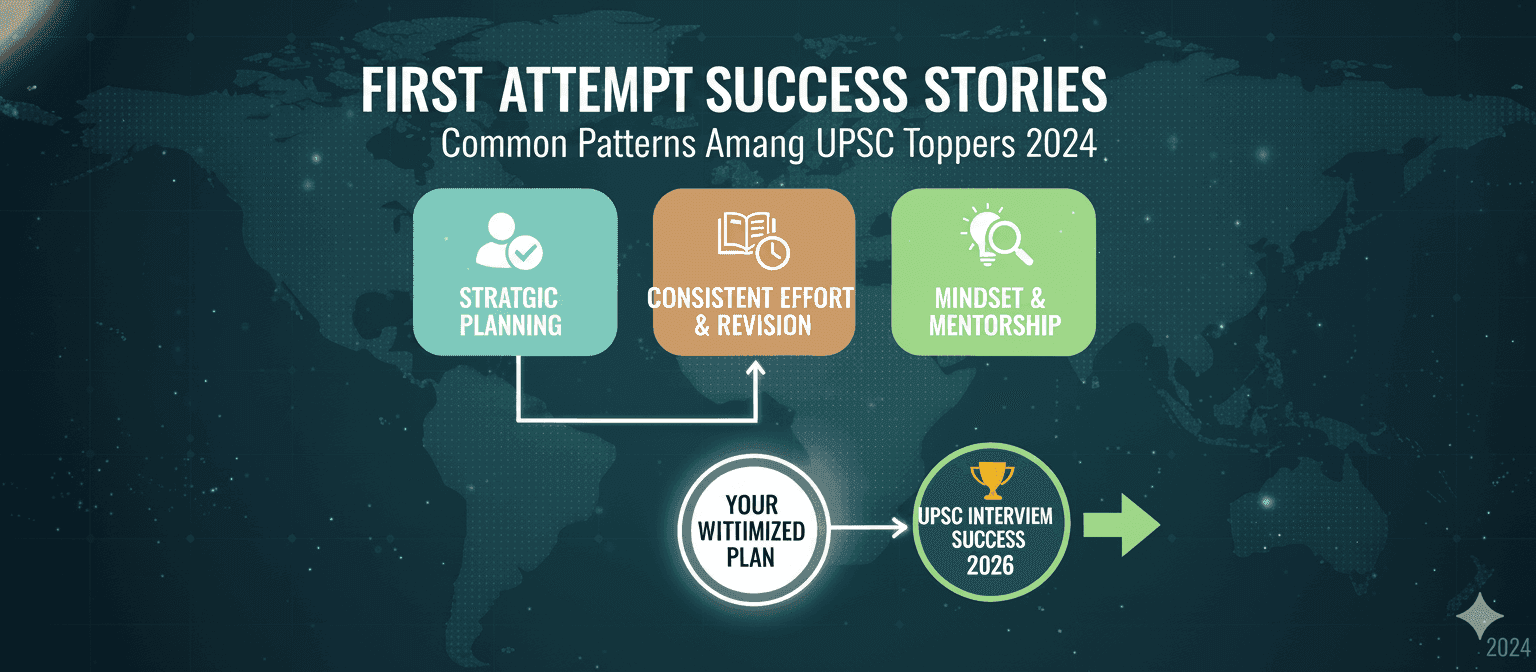
From Donuru Ananya Reddy (AIR 3, CSE 2023) who cleared at just 22 years old in her first attempt, to Tina Dabi's legendary AIR 1 in 2016, these success stories reveal consistent patterns that every serious aspirant can learn from. This analysis decodes the preparation duration, resource selection, time management approach, and mental frameworks that first-attempt toppers commonly share.
Pattern 1: Strategic Preparation Duration
First-attempt success stories consistently show that quality preparation matters more than extended timelines. Most first-attempters dedicate 12 to 18 months of focused preparation rather than stretching over multiple years.
Donuru Ananya Reddy began her preparation immediately after completing graduation from Miranda House, Delhi University in 2021. She maintained discipline by studying 12-14 hours daily during peak preparation months. Similarly, Srushti Jayant Deshmukh, who secured AIR 5 in 2018 at age 23, strategically divided her preparation between Prelims and Mains while working with online resources.
The key insight here is that first-attempters treat preparation as a defined project with clear milestones rather than an open-ended journey. They typically spend the first six months building foundational knowledge through NCERTs and standard references, followed by intensive revision and mock test practice in the remaining months.
Pattern 2: Minimal Resources, Maximum Revision
One striking pattern among first-attempt toppers is their restraint with study materials. Rather than accumulating dozens of books and sources, they follow what experts call the "Minimum Sources, Maximum Revision" strategy.
Toppers consistently recommend limiting resources to one or two authoritative books per subject. For Polity, Laxmikant remains the gold standard. For Modern History, Spectrum or Bipan Chandra suffice. For Geography, GC Leong provides comprehensive coverage. The critical differentiator is how many times candidates revise these materials rather than how many sources they consult.
Ananya Reddy combined coaching for her optional subject (Anthropology) with self-study for General Studies. She emphasized that cramming multiple sources creates confusion during revision and exam pressure. First-attempters typically complete 4-5 complete revisions of core material before Prelims.
Pattern 3: Structured Time Management
First-attempt toppers do not necessarily study more hours than others. Analysis of topper timetables reveals that productive study hours range between 8-12 daily, with consistent routines being more valuable than marathon sessions.
Tina Dabi, who achieved AIR 1 in 2016 in her first attempt, maintained a disciplined 11-hour daily schedule. Her approach divided time between static subjects in the morning, current affairs in the afternoon, and revision with answer writing practice in the evening. She emphasized adequate sleep and strategic breaks as non-negotiable elements.
The common time allocation pattern among successful first-attempters includes dedicating 1-2 hours daily to newspaper reading and current affairs notes, 4-6 hours for syllabus subjects with integrated PYQ analysis, and 1-2 hours for revision or answer writing practice. Weekends typically involve full-length mock tests followed by thorough error analysis.
Pattern 4: Early Answer Writing and Mock Test Integration
First-attempt toppers begin answer writing practice from the early stages of preparation rather than waiting until completing the syllabus. This habit develops articulation skills and reveals knowledge gaps early enough to address them.
Mock test participation follows a structured pattern. Successful first-attempters typically complete 30-35 full-length mock tests before Prelims. More importantly, they spend significant time analyzing each mock, identifying patterns in their errors, and adjusting their preparation accordingly.
The five-pillar analysis framework used by many toppers includes examining attempt count (below 75 questions indicates knowledge gaps), categorizing questions by difficulty level, tracking guesswork accuracy, analyzing topic-wise performance, and classifying error types to prevent repetition.
Pattern 5: Mental Preparation and Stress Management
Perhaps the most underrated pattern among first-attempt toppers is their approach to mental preparation. These candidates treat emotional resilience as a preparation subject itself.
Ananya Reddy mentioned in interviews that watching cricket matches helped her manage stress, while regular conversations with family and friends provided emotional support. She credited her parents for providing complete freedom in choosing her career path, which reduced external pressure significantly.
Common mental preparation strategies include maintaining one hobby or physical activity throughout preparation, building a support system of family, friends, or fellow aspirants, treating setbacks as diagnostic information rather than failures, and setting realistic daily and weekly targets with small rewards for achieving them.
First-attempters also display a notably positive relationship with uncertainty. Rather than being paralyzed by the competitive nature of the exam, they focus on controllable factors—their own preparation quality, health, and consistency.
Pattern 6: Optional Subject Selection and Backup Planning
Successful first-attempt candidates choose their optional subject based on genuine interest and scoring potential rather than peer pressure or market trends. This reduces preparation burden since interest-driven study requires less forcing.
Ananya Reddy chose Anthropology despite having a Geography undergraduate background, demonstrating that alignment with personal aptitude matters more than academic background. Her preparation combined coaching support for the optional with independent study for General Studies papers.
Regarding backup preparation, first-attempters maintain realistic expectations without becoming pessimistic. Many continue exploring alternative career paths or competitive exams as safety nets, which paradoxically reduces exam anxiety and improves performance.
Key Takeaways for Aspirants
The common thread running through first-attempt success stories is strategic efficiency over brute-force preparation. These candidates make deliberate choices about what to study, how long to study, and when to prioritize revision over new content.
For aspirants targeting first-attempt success, the actionable framework includes committing to 12-18 months of focused preparation with clear phase-wise goals, limiting sources to proven standard books with multiple revision cycles, establishing consistent daily routines between 8-12 productive hours, beginning answer writing practice within the first three months, building systematic mock test practice with thorough error analysis, and investing in mental health through physical activity, hobbies, and support systems.
Success in UPSC is not reserved for geniuses or those with unlimited resources. The patterns reveal that disciplined consistency, strategic resource management, and emotional resilience create the conditions for first-attempt success. Every topper's journey is unique in its details, but the underlying principles remain remarkably consistent.
FAQs
Is it really possible to clear UPSC in the first attempt?
Yes, many toppers including Donuru Ananya Reddy (AIR 3, 2023), Tina Dabi (AIR 1, 2016), and Srushti Jayant Deshmukh (AIR 5, 2018) cleared UPSC in their first attempt. It requires strategic preparation, consistency, and the right approach.
How many hours should I study daily to clear UPSC in the first attempt?
First-attempt toppers typically study 8-12 productive hours daily. Quality matters more than quantity. Some toppers like Tina Dabi studied 11 hours daily, while others succeeded with 6-8 focused hours.
What is the ideal preparation duration for first-attempt success?
Most first-attempt toppers prepare for 12-18 months. Starting during final year of graduation or immediately after gives adequate time for comprehensive syllabus coverage and multiple revisions.
Can I clear UPSC without coaching in the first attempt?
Yes, self-study success stories prove that coaching is not mandatory. Srushti Jayant Deshmukh and several other toppers relied heavily on online resources and self-study. The key is having the right strategy and discipline.
How many mock tests should I attempt before Prelims?
First-attempt toppers typically complete 30-35 full-length mock tests before Prelims, along with topic-wise tests. More importantly, thorough analysis of each mock test helps identify and address weak areas.