
Sentence Equivalence Practice: The GRE Strategy Most Students Miss
8 min read
Jan 19, 2026
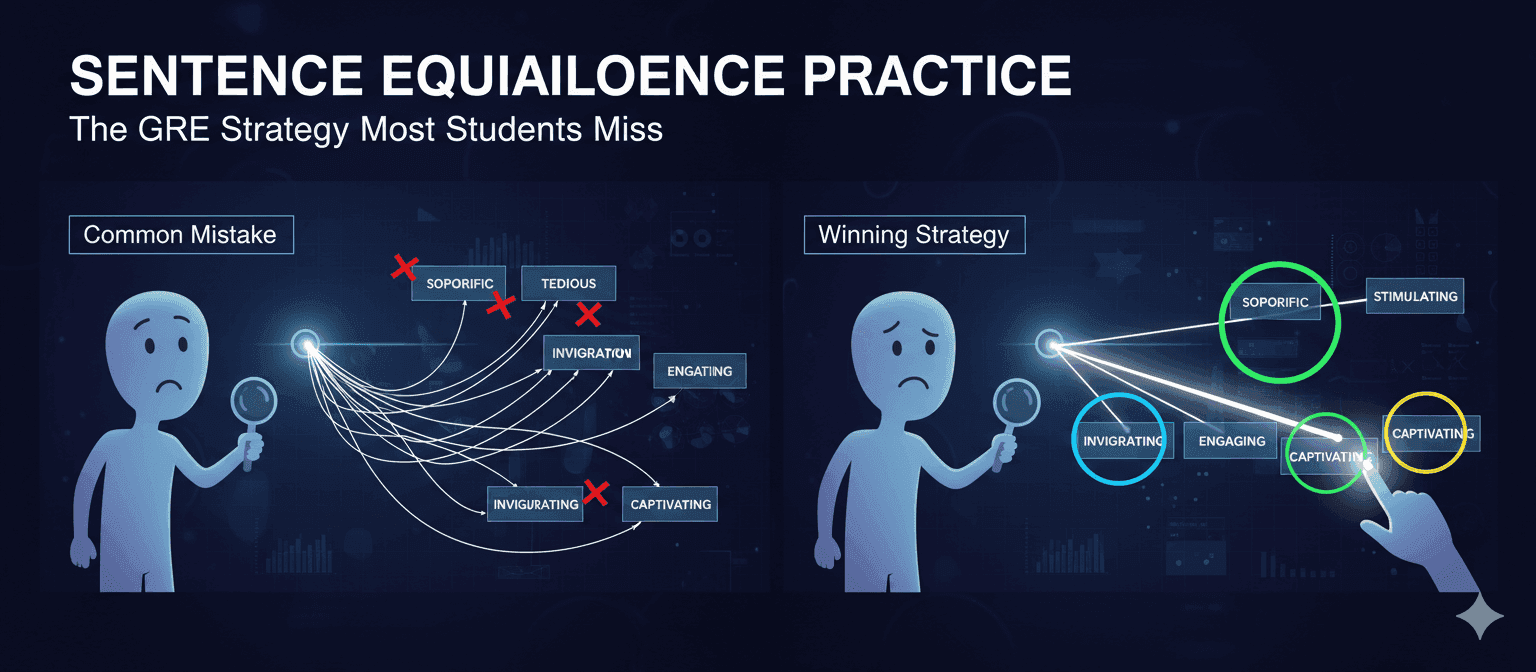
Most GRE prep advice tells you the same thing about Sentence Equivalence: find two synonyms, plug them in, move on. If that strategy worked reliably, you wouldn't be reading this article—and test prep companies wouldn't exist.
Here's what that generic advice misses: Sentence Equivalence isn't primarily a vocabulary test. It's a reading comprehension test disguised as a vocabulary exercise. Understanding this distinction separates students who consistently score in the 160+ range from those stuck in the 150s.
The GRE Verbal Reasoning section dedicates approximately 20% of its questions to Sentence Equivalence—roughly 8 questions across both sections. With no partial credit available and each correct answer requiring two matching choices, the margin for error is razor-thin.
What Makes Sentence Equivalence Different from Text Completion
Both question types test vocabulary. Both require filling in blanks. But the cognitive demands are fundamentally different.
Text Completion asks you to find words that fit. Sentence Equivalence asks you to find two words that create sentences with identical meaning—a much higher bar. You're not just looking for words that work; you're looking for words that work the same way.
Research in cognitive linguistics reveals that synonym recognition operates through multiple mental pathways. When you encounter a word like "ameliorate," your brain doesn't just retrieve its definition—it activates a network of related concepts, usage contexts, and emotional associations. Sentence Equivalence exploits this complexity by presenting answer choices that seem similar but create subtly different sentence meanings.
This is why students with strong vocabularies still struggle. Knowing what words mean isn't enough; you need to understand how words function within specific sentence structures.
The Three Traps ETS Uses (And How to Avoid Them)
ETS, the organization behind the GRE, designs Sentence Equivalence questions with predictable trap patterns. Once you recognize them, you'll stop falling for them.
Trap 1: The Theme Trap
Consider a sentence about dancers. The word "lithe" might appear as an answer choice. It's a word commonly associated with dancers—flexible, graceful. But if the sentence context doesn't specifically call for that meaning, "lithe" becomes a trap. You selected it because it felt right for the topic, not because it was right for the sentence.
The fix? Ignore thematic associations. Read what the sentence actually says, not what you expect it to say.
Trap 2: The Orphan Synonym
You find a word that perfectly fits the blank. Problem: no other answer choice creates an equivalent meaning. Remember, Sentence Equivalence requires two correct answers that produce the same sentence meaning. A perfect-fit word without a matching pair is automatically wrong.
Before committing to any answer, verify that you have two options that work together. If you can only find one word that fits, reassess.
Trap 3: The False Pair
Two answer choices might be synonyms in general usage but create different meanings in the specific sentence context. "Cautious" and "wary" are often interchangeable, but in certain sentences, one might suggest passive hesitation while the other implies active suspicion.
Test both words by reading them into the complete sentence. Do both versions communicate the same idea? If you detect even a subtle difference in meaning, you've found a false pair.
Why Flashcard Cramming Fails for Sentence Equivalence
Here's an uncomfortable truth: traditional vocabulary memorization produces poor results on Sentence Equivalence questions. Studies in cognitive psychology consistently demonstrate that learning vocabulary through visual repetition—staring at flashcards until definitions stick—creates shallow knowledge that fails under test conditions.
Research published in the Journal of Modern Learning Development found that learners using spaced-repetition tasks retained approximately 79.77% of vocabulary after 10 days, compared to significantly lower retention rates for those using massed practice (cramming). More importantly, the type of knowledge retained differed. Spaced-repetition learners demonstrated better contextual understanding—exactly what Sentence Equivalence demands.
The spacing effect works because it forces retrieval practice at optimal intervals. Each time you successfully recall a word just before forgetting it, the memory consolidates more deeply. Over time, you don't just remember definitions; you internalize how words function.
This is precisely why PrepAiro built its vocabulary system around AI-powered spaced repetition. Instead of showing you the same words repeatedly until you recognize them, the adaptive algorithm calculates when you're about to forget each word and surfaces it at that exact moment. The result isn't just better retention—it's the kind of deep, contextual vocabulary knowledge that Sentence Equivalence actually tests.
A Step-by-Step Approach That Actually Works
Forget the advice to "find synonym pairs first." That approach puts the cart before the horse. Here's a more reliable method:
Step 1: Read for meaning, not for blanks. Cover the answer choices (yes, physically cover them if you're using scratch paper) and read the sentence as if you're trying to understand an author's argument. What point is being made? What evidence supports it?
Step 2: Identify the blank's function. Does the blank describe something? Contrast with another idea? Extend a concept? The blank has a role in the sentence's logic. Define that role before considering specific words.
Step 3: Predict before you peek. Generate your own word—it doesn't need to be sophisticated. If the sentence describes someone who doesn't listen to feedback, your prediction might simply be "stubborn." This prediction becomes your filter for evaluating answer choices.
Step 4: Eliminate by function, not by definition. Don't ask "what does this word mean?" Ask "does this word perform the function I identified?" Many trap answers are words with accurate definitions that don't serve the required function.
Step 5: Verify equivalence. Once you have two candidate answers, read the complete sentence with each word. Do both versions say the same thing? If there's any difference in meaning, emphasis, or implication, you need to reconsider.
The Context Clue Categories You're Probably Missing
Most students recognize obvious context clues like "however" (signals contrast) or "therefore" (signals cause-effect). But Sentence Equivalence often uses subtler indicators.
Tone shifts appear through punctuation and clause structure. A semicolon followed by "indeed" typically reinforces the preceding claim. A colon often introduces an explanation or elaboration. These structural elements tell you whether the blank should match or contrast with surrounding content.
Degree markers indicate intensity. Words like "somewhat," "extremely," or "merely" modify how strong your answer should be. If a sentence says someone was "merely" annoyed, an answer suggesting intense anger would be wrong even if it fits the general sentiment.
Specificity cues reveal whether you need a general or precise term. A sentence explaining a scientific process typically requires technical vocabulary, while one describing everyday situations needs accessible language.
For students preparing in Hindi or transitioning from Hindi-medium education, these nuances can be particularly challenging. English prepositions, articles, and sentence structures don't map directly to Hindi equivalents. PrepAiro's Hindi explanations break down these structural differences, helping you understand why certain English constructions carry specific meanings—not just memorize patterns.
Building Sentence Equivalence Skills: A 4-Week Framework
Week 1: Vocabulary Foundation Focus on learning words with their synonyms, not in isolation. When you study "ameliorate," learn it alongside "improve," "enhance," and "mitigate." Understand the subtle differences: "ameliorate" suggests making a bad situation better, while "enhance" suggests improving something already good.
Week 2: Sentence Analysis Practice identifying sentence logic without filling in blanks. Take Sentence Equivalence questions, ignore the answer choices, and write out what the blank should accomplish. This builds the analytical muscle that distinguishes strong test-takers.
Week 3: Trap Recognition Work through practice questions specifically looking for traps. When you get a question wrong, categorize the trap type. Are you falling for theme traps? False pairs? Orphan synonyms? Awareness of your personal weakness patterns allows targeted improvement.
Week 4: Timed Integration Simulate test conditions. Aim for about one minute per Sentence Equivalence question. If you're spending longer, you're probably overthinking—which usually leads to changing correct answers to incorrect ones.
Throughout this process, the consistency of practice matters more than the duration of any single session. Cognitive research demonstrates that distributed practice—short sessions over many days—produces substantially better retention than concentrated cramming. This aligns with how PrepAiro's adaptive algorithm schedules reviews: frequent, brief encounters calibrated to your individual learning curve.
Common Mistakes to Eliminate
Mistake 1: Focusing only on words near the blank. The crucial context often appears at the beginning or end of the sentence. Read everything.
Mistake 2: Letting real-world knowledge override sentence content. If a sentence claims that artists are typically methodical, you need words supporting that claim—even if you personally believe artists are spontaneous. Answer what the sentence says, not what you know.
Mistake 3: Selecting answers that "sound GRE-ish." Obscure vocabulary isn't automatically correct. Simple words like "support" or "change" frequently appear in correct answer pairs.
Mistake 4: Rushing the verification step. After selecting two answers, always read both completed sentences. This 10-second check catches errors that cost points.
What High Scorers Do Differently
Analysis of student performance patterns reveals that high scorers approach Sentence Equivalence with specific habits:
They read slowly. Top performers spend more time understanding the sentence and less time deliberating between answer choices. By the time they look at answers, they already know what they need.
They embrace uncertainty. When encountering unfamiliar words, high scorers don't panic. They use process of elimination, sentence logic, and partial knowledge to narrow possibilities. Getting questions right despite vocabulary gaps is a learnable skill.
They learn from mistakes analytically. After every practice session, strong students review errors not to memorize correct answers but to understand why they chose wrong. This reflective practice builds pattern recognition over time.
Making Practice Count
Effective Sentence Equivalence practice requires official materials. Third-party questions often have subtle flaws in construction that create bad habits. ETS publishes limited practice questions, so use them wisely—don't burn through your entire supply in a single weekend.
When working through questions, maintain an error log. Document the trap type, the reasoning that led you astray, and the correct approach. Reviewing this log weekly accelerates improvement more than simply doing additional questions.
And remember: sporadic marathon sessions produce worse results than consistent daily practice. Ten minutes of focused Sentence Equivalence work six days a week beats a single two-hour session. Your brain needs time between exposures to consolidate learning—which is exactly the principle behind spaced repetition systems.
FAQs
How many Sentence Equivalence questions are on the GRE? You'll encounter approximately 8 Sentence Equivalence questions total—4 per Verbal section. These questions account for roughly 20% of your Verbal Reasoning score.
Do both answers need to be synonyms for Sentence Equivalence? Not necessarily perfect synonyms, but both answers must create sentences with the same overall meaning. Two words can have slightly different definitions yet be correct if they function identically within the specific sentence context.
How long should I spend on each Sentence Equivalence question? Aim for approximately one minute per question. If you're consistently exceeding this, practice the prediction technique to reduce deliberation time.
Is vocabulary memorization enough to master Sentence Equivalence? No. Research shows that contextual understanding—knowing how words function in sentences—matters more than raw vocabulary size. Focus on learning words with their synonyms and usage examples, not isolated definitions.
What's the best way to practice Sentence Equivalence? Use official ETS materials, analyze errors by trap type, and space your practice sessions across multiple days rather than cramming. Spaced repetition produces significantly better retention than massed practice.