
Prelims Week Psychology: Managing Anxiety & Peak Performance Strategies
9 min read
Dec 27, 2025
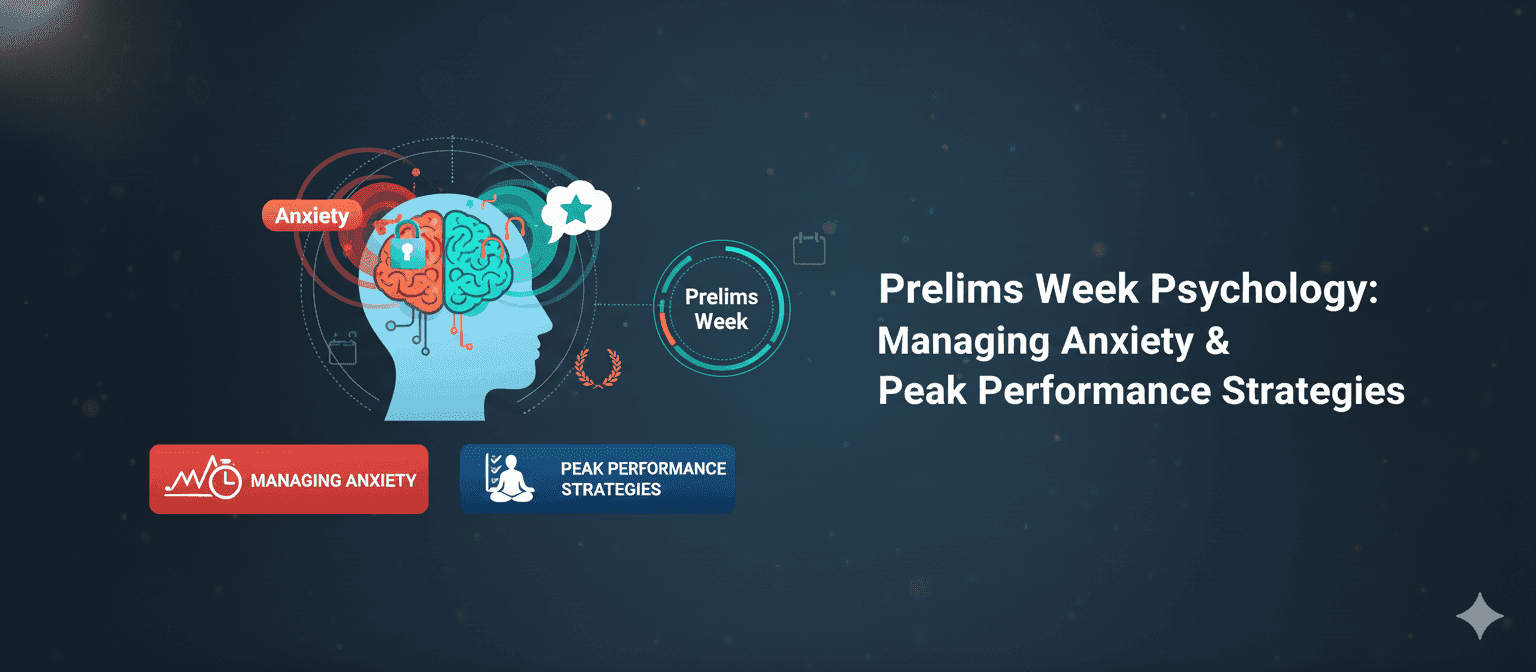
Introduction: The Battle Inside Your Mind
The week before UPSC Prelims isn't just about revising Polity articles or memorizing geographic features. For most aspirants, it's a silent psychological battlefield where anxiety, self-doubt, and performance pressure wage war against confidence and clarity.
Consider this: You've spent 12 months—perhaps multiple attempts—absorbing facts, analyzing PYQs, and taking countless mocks. Your preparation is done. Yet, as exam day approaches, a familiar pattern emerges. Sleep becomes elusive. Every mock score is dissected obsessively. Social media feeds fill with last-minute panic posts. That knot in your stomach tightens with each passing day.
This isn't weakness. This is your brain's natural response to high-stakes performance situations. The difference between clearing Prelims and missing the cutoff by 3-4 marks often lies not in what you know, but in how you manage what's happening inside your head during those final seven days.
This guide addresses the psychological dimension that most preparation strategies ignore—the mental infrastructure that determines whether you walk into the exam hall as a composed strategist or an anxious test-taker.
The Science Behind Prelims Anxiety
Why Your Brain Goes Into Overdrive
Your amygdala—the brain's threat-detection system—cannot distinguish between a charging lion and a UPSC question paper. Both trigger the same fight-or-flight response: elevated cortisol, racing heartbeat, tunnel vision, and impaired decision-making.
During Prelims week, this response intensifies because:
- Outcome uncertainty: Unlike classroom tests with predictable patterns, UPSC's shifting difficulty creates genuine ambiguity
- Investment magnitude: Months (or years) of effort condensed into one 2-hour window
- Negative marking psychology: Every question carries dual risk—losing points for wrong attempts
- Social pressure: Family expectations, peer comparisons, and the "what-if-I-fail" narrative
The irony? Anxiety exists to protect you. But left unmanaged, it becomes the very thing that sabotages performance.
The Performance-Anxiety Curve
Psychological research reveals an inverted-U relationship between anxiety and performance:
- Too little anxiety: Complacency, lack of alertness, casual mistakes
- Optimal anxiety: Sharp focus, quick recall, calculated risk-taking
- Excessive anxiety: Mental blocks, overthinking, impulsive errors
Your goal isn't to eliminate anxiety—it's to keep it in the productive middle zone.
Week-Before Mental Preparation Framework
Days 7-5: Building Psychological Reserves
1. Reframe Your Self-Talk
Most aspirants run a negative internal monologue without realizing it. Phrases like "I haven't covered enough," "Everyone else seems better prepared," or "What if I blank out?" become self-fulfilling prophecies.
Shift the narrative:
| Instead of Saying | Reframe To | |------------------|------------| | "I'm so behind on current affairs" | "I've covered the high-yield topics that appear most frequently" | | "This mock score proves I'll fail" | "This mock identified 5 concept gaps I can now fix" | | "Everyone's more confident than me" | "Confidence and competence aren't the same; I focus on execution" |
2. Implement the 3-3-3 Grounding Technique
When anxiety spikes during revision:
- Name 3 things you can see (your study table, a water bottle, a book)
- Identify 3 sounds (traffic outside, fan noise, your breathing)
- Move 3 body parts (wiggle your toes, roll your shoulders, stretch your fingers)
This interrupts the anxiety loop by shifting attention from abstract worry to concrete sensory input.
3. Conduct a "Worst-Case Scenario" Audit
Paradoxically, facing your biggest fear head-on reduces its power. Ask yourself:
"If I don't clear Prelims this time, what actually happens?"
Write down the honest answer. For most, it's: "I attempt again next year, armed with better insights." Not ideal, but survivable. This reality check prevents catastrophic thinking from hijacking your week.
Days 4-3: Stabilizing Cognitive Load
1. Implement Strategic Ignorance
The week before Prelims isn't when you'll suddenly master Environmental Impact Assessment procedures or memorize 50 new schemes. Trying to do so creates cognitive overload.
Practice strategic ignorance:
- Close WhatsApp groups discussing "most important topics"
- Avoid browsing coaching institute "crash course" videos
- Stop comparing your preparation checklist with others
Some aspirants find it easier to stay consistent using structured practice tools like PrepAiro, which offers targeted last-minute revision modules—but the key is sticking to one source, not hopping between multiple platforms.
2. Micro-Journaling for Mental Clarity
Spend 5 minutes each evening writing:
- One thing that went well in today's revision
- One anxiety thought that surfaced (acknowledgment, not judgment)
- One strategy for tomorrow's study block
This externalizes worry, preventing it from cycling endlessly in your mind overnight.
3. Visualization Practice
Before sleeping, spend 3 minutes visualizing:
- Walking into the exam hall calmly
- Reading the first question with clarity
- Making a confident decision (attempt/skip)
- Bubbling the OMR carefully
- Leaving the hall satisfied with your effort
Athletic psychologists use this technique because the brain encodes visualization similarly to actual experience. You're mentally rehearsing composure.
Sleep Optimization: The Most Underrated Strategy
The Cortisol-Sleep Trap
Late-night cramming spikes cortisol, which suppresses melatonin production. The result? You lie awake at 2 a.m. mentally reviewing Constitutional amendments instead of sleeping.
The cost is brutal:
- Even one night of poor sleep reduces recall accuracy by 30%
- Sleep deprivation impairs judgment—exactly what negative marking punishes
- Cumulative sleep debt over a week creates exam-day mental fog
The 7-Day Sleep Reset Protocol
Days 7-5:
- Fixed bedtime: 10:30 p.m.
- Screen cutoff: 9:30 p.m.
- Wind-down ritual: 9:00-9:30 p.m.
- Room environment: 18-20°C, dark, quiet
Days 4-2:
- Same routine
- No caffeine post 3 p.m.
- Light dinner by 7:30 p.m.
Day 1 (Exam Eve):
- Sleep at 10 p.m., wake at 6 a.m.
- Avoid late-night studying
- If anxious: practice 4-7-8 breathing
What If You Still Can't Sleep?
Don't panic. One suboptimal night won't destroy performance.
If awake past midnight:
- Get up, relocate briefly
- Stretch or journal
- Return only when drowsy
- Trust adrenaline will compensate
Exam Day Psychological Routines
The First 90 Minutes (Wake-Up to Leaving Home)
6:00 a.m. - Wake
6:05-6:20 a.m. - Physiological activation
6:20-7:00 a.m. - Breakfast: complex carbs + protein, avoid sugar/fried food
7:00-7:30 a.m. - Light revision (optional)
7:30-8:00 a.m. - Checklist: admit card, ID, pens, watch, water, chocolate
The Journey to Exam Center
Arrive by 8:15 a.m.
During commute:
- Avoid discussing topics
- Listen to instrumental music
- Practice box breathing (4-4-4-4)
The Waiting Period (8:15-9:00 a.m.)
This is when anxiety peaks.
Strategies:
- Sit away from anxious groups
- Progressive muscle relaxation
- Positive memory anchoring
- Repeat: "I've done the work. Now I execute."
The Final 5 Minutes
- Bathroom
- Sip water
- Power pose
- Mantra: "One question at a time."
Negative Marking Psychology: The Hidden Mental Game
Why Negative Marking Triggers Anxiety
Every question becomes a risk calculation, draining mental bandwidth.
The Elimination vs. Confirmation Trap
Most aspirants seek confirmation.
Better approach: eliminate what's wrong first.
Example: Finance Commission
Instead of: Which is correct?
Think: 2 and 4 are wrong → choose between 1 and 3.
The 3-Tier Attempt Strategy
| Tier | Confidence Level | Action | Rationale | |------|------------------|--------|-----------| | 1 | 90-100% | Attempt immediately | Builds momentum | | 2 | Can eliminate 2-3 | Mark for second round | Saves energy | | 3 | Guess / 50-50 | Skip (unless <5 mins left) | Protects score |
Managing "I'm Skipping Too Many" Panic
Toppers attempt 75-85, not 100.
If panic hits:
- Pause 30 seconds
- Breathe
- Reaffirm: quality over quantity
Maintaining Composure During Uncertainty
When the Paper Feels "Different"
Reframe:
- Everyone is struggling
- Cutoffs adjust
- Your job is to maximize what you know
Strategy: Move to Q25–40, then return.
The "Neighbor is Filling Faster" Anxiety
They may be guessing.
Shift gaze back.
Say: "I'm playing my own game."
The Post-Paper 1 Spiral
Avoid:
- Answer keys
- Discussions
- Score calculations
Protect CSAT energy.
CSAT Afternoon Mindset
Reset mentally:
- Nap 10–15 mins
- Walk
- Mantra: "Fresh paper, fresh start."
Handling Exam Day Emotional Surges
When Doubt Floods Mid-Paper
Intervention:
- Physical grounding
- Cognitive interrupt: silently say STOP
- Redirect: Next question
Final 15 Minutes Time Pressure
Avoid random bubbling.
Do:
- Scan → solve 5–7 fastest
- Bubble last 3 mins
Reframe:
Leaving 10 unattempted is fine. Incorrect attempts cost marks.
The 48-Hour Post-Exam Recovery
Why Crash Happens
Your brain returns from survival mode → emotional vacuum
2-Day Protocol
Do:
- Sleep
- Eat well
- Journal
- Enjoy real life
Don't:
- Obsess scores
- Rush into Mains prep
- Make drastic decisions
When to Resume Prep
- Confident: 4-5 days
- Unsure: 7-10 days (read optional subject)
Frequently Asked Questions
Q1: What if I can't control anxiety?
Some anxiety is adaptive.
If debilitating → consider therapy.
Practice box breathing early.
Q2: How to stop comparison on social media?
Deactivate/mute.
You're comparing internal chaos to others' curated highlights.
Q3: I wake up at 3 a.m. anxious.
Don't force sleep.
Move → journal → stretch → return.
Q4: What if I blank out in hall?
Look away → breathe → re-read.
Skip if frozen.
Q5: Negative thoughts like "I'm going to fail"
Label them: "I'm having the thought I'm going to fail."
Then: What do I do with the next question?
Q6: Supplements for anxiety?
Avoid new substances.
Continue only prescribed meds.
Q7: Exam pattern unexpected?
Everyone is shocked.
Cutoffs move.
Stay calm → maximize known areas.
Q8: Family pressure?
Talk before exam week.
Set boundaries.
Q9: Feeling like you've forgotten everything?
Retrieval anxiety.
Knowledge is still there.
Mini revision reassures.
Q10: Mis-bubbled OMR?
Verify first.
If correctable, fix.
Otherwise → cut losses.
Final Reflection: The Psychological Edge
UPSC Prelims tests knowledge and composure.
Stress hormones impair the very brain functions required to think clearly.
These tools work only with practice.
Start sleep reset now.
Practice breathing.
Use 3-tier strategy in mocks.
On exam day, you won't be anxiety-free.
But you'll be functional.
Protect your psychology as fiercely as your study schedule.
The composed mind outperforms the anxious one.
You've done the work.
Now—manage your mind.
Execute your strategy.
That is the equation that matters.