
Philosophical Essays for UPSC: Master Abstract Topics Easily
5 min read
Dec 12, 2025
Introduction
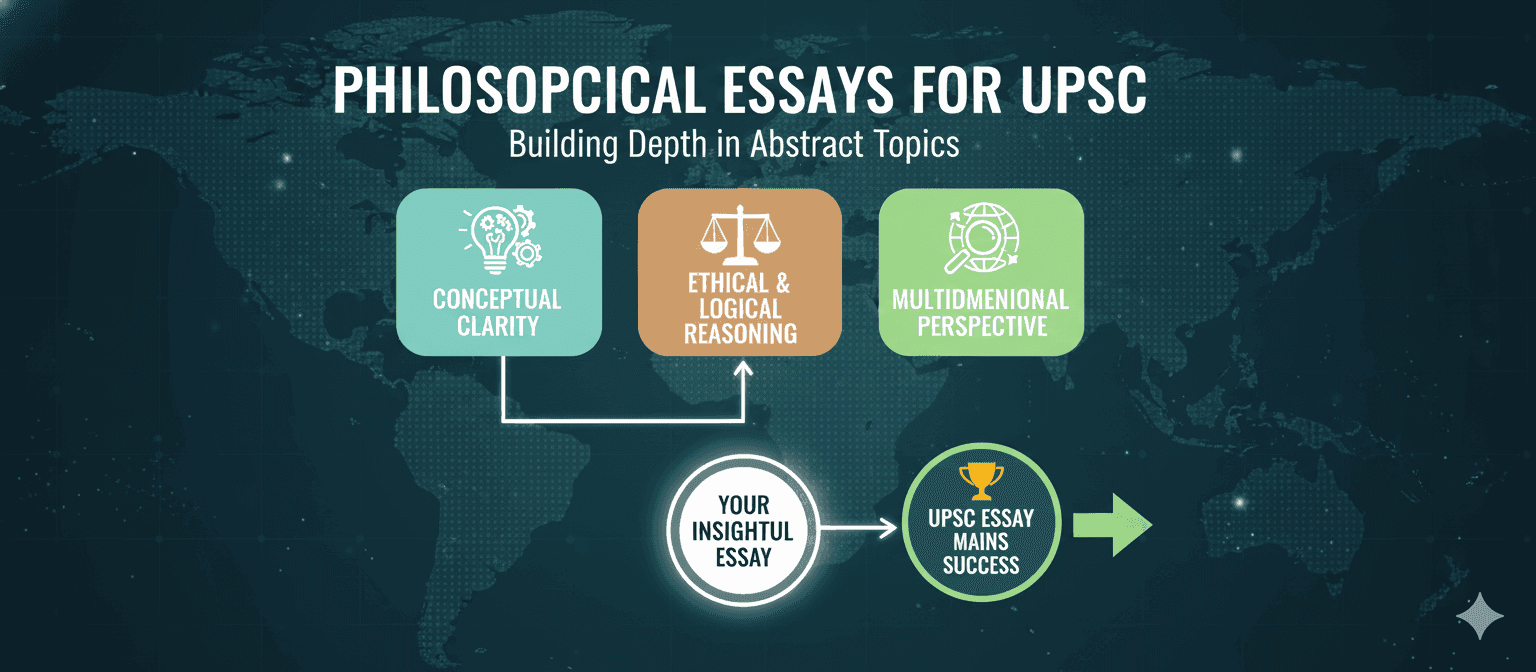
Philosophical essays consistently appear in Section A of the UPSC Essay Paper, often as abstract quotes or metaphorical statements. Topics like "There is no path to happiness; happiness is the path" (2024) or "The process of self-discovery has been technologically outsourced" (2021) demand more than surface-level interpretation—they require conceptual depth, cross-cultural synthesis, and contemporary relevance.
Many aspirants avoid philosophical topics, perceiving them as risky. However, toppers consistently report that well-structured philosophical essays score higher than generic socio-economic ones because fewer candidates attempt them competently. The key lies in building a systematic approach rather than relying on inspiration during the exam.
Building a Conceptual Framework
Abstract philosophical topics require a structured interpretation methodology before writing begins. The 3-Layer Deconstruction Framework helps decode any philosophical prompt systematically.
The first layer involves literal interpretation—understanding what the statement says at face value. For "Doubt is the beginning of wisdom," this means acknowledging that questioning precedes knowledge.
The second layer explores philosophical implications—connecting the statement to broader schools of thought. The same quote relates to Socratic questioning in Western philosophy and the Nyaya school's emphasis on pramana (valid knowledge) in Indian tradition.
The third layer establishes contemporary relevance—linking abstract concepts to current realities. Doubt as wisdom connects to scientific temper (Article 51A), media literacy in the post-truth era, and evidence-based policymaking.
This framework ensures your essay moves beyond stating the obvious toward demonstrating analytical depth. Spend 10-15 minutes during the exam mapping these three layers before writing.
Integrating Indian Philosophy
Indian philosophical traditions offer rich material that distinguishes your essay from generic responses. The six orthodox schools (Astika) and three heterodox schools (Nastika) provide diverse perspectives applicable to almost any abstract topic.
For essays on knowledge and truth, the Nyaya school's logical methodology and Vedantic concepts of maya (illusion) versus satya (truth) provide excellent frameworks. The Charvaka school's materialism offers counterpoints that demonstrate balanced thinking.
For essays on action and duty, the Bhagavad Gita's Nishkama Karma (action without attachment to results) and the Karma Yoga principle apply universally. Buddhist concepts of the Middle Path and Jain emphasis on Anekantavada (many-sidedness of truth) add depth to discussions on balance and perspective.
For essays on suffering and human condition, Buddhist Dukkha and the Four Noble Truths, along with Upanishadic concepts of Atman and self-realization, provide profound insights. These connect naturally to contemporary discussions on mental health, materialism, and the pursuit of meaning.
When using Indian philosophy, avoid merely name-dropping concepts. Instead, explain the concept briefly, apply it to the topic, and connect it to a contemporary example. For instance, when discussing "Happiness is the path," link Ananda (bliss) from Vedantic philosophy to research on process-oriented versus outcome-oriented approaches in positive psychology.
Synthesizing Western Thought
Western philosophical integration demonstrates global awareness and intellectual breadth. Strategic familiarity with key thinkers proves more valuable than exhaustive knowledge.
Socrates, Plato, and Aristotle form the foundation. Socratic questioning applies to essays on doubt and wisdom. Platonic idealism (the allegory of the cave) connects to essays on perception versus reality. Aristotelian virtue ethics and the "golden mean" apply to balance-themed topics.
Enlightenment thinkers provide material for essays on reason, liberty, and governance. Kant's categorical imperative works for ethics topics, while Rousseau's social contract applies to society and individual themes. John Stuart Mill's utilitarianism offers frameworks for discussing the greatest good.
Existentialist philosophy proves valuable for essays on meaning, authenticity, and human condition. Sartre's "existence precedes essence" and Camus' absurdism connect powerfully to contemporary discussions on purpose, especially in technology-driven societies.
The synthesis technique involves presenting Indian and Western perspectives as complementary rather than competing frameworks. For an essay on "Self-discovery has been technologically outsourced," you might contrast Vedantic Atma-Vichara (self-inquiry) with Socratic "know thyself" and then examine how algorithm-driven identity formation challenges both traditions.
Establishing Contemporary Relevance
Philosophical essays must avoid appearing detached from reality. The Bridge Method connects abstract concepts to current affairs through three pathways.
The policy pathway links philosophy to governance decisions. An essay on "doubt as wisdom" can reference evidence-based policymaking, scientific temper provisions in the Constitution, and recent instances where questioning established practices led to reform.
The technology pathway connects traditional philosophy to digital-age challenges. Discussions of truth and illusion relate naturally to deepfakes and misinformation. Essays on human connection address social media's impact on genuine relationships.
The social transformation pathway applies philosophical principles to ongoing changes. Essays on karma and action connect to debates around meritocracy and affirmative action. Buddhist impermanence relates to climate change and sustainability.
Use specific examples: cite the Digital Personal Data Protection Act when discussing privacy and autonomy, reference NITI Aayog reports when connecting philosophical principles to development, and mention recent Supreme Court judgments that invoke constitutional morality and fundamental duties.
Scoring Techniques for Philosophical Essays
Beyond content, presentation significantly impacts scores. Toppers who score 130+ on philosophical essays follow specific practices.
Structure philosophical essays with a quote-based introduction from a relevant thinker, followed by conceptual analysis, multi-dimensional exploration (social, economic, ethical, political), contemporary application, and a synthesis conclusion that circles back to the opening theme.
Balance depth with accessibility. Explain philosophical concepts briefly before applying them—examiners may not share your familiarity with specific schools of thought. Avoid jargon without explanation.
Demonstrate original thinking through synthesis rather than mere citation. Showing how Gandhian Swaraj connects to Kantian autonomy and contemporary debates on self-reliance reflects higher-order analysis than separately describing each concept.
Maintain a consistent philosophical voice throughout. If you open with an existentialist lens, weave it through subsequent sections rather than abandoning it for disconnected perspectives.
Conclusion
Philosophical essays offer strategic advantages for candidates willing to invest in systematic preparation. Building conceptual frameworks, integrating Indian and Western thought, and establishing contemporary relevance transforms abstract prompts into scoring opportunities. Start by practicing one philosophical essay weekly using the frameworks outlined above, gradually building a repository of applicable concepts, thinkers, and contemporary connections that you can deploy flexibly across various topics.