
How to Memorize GRE Vocabulary: 7 Science-Backed Methods
11 min read
Jan 17, 2026
Introduction
You've probably experienced this frustration: You spend hours reviewing GRE word lists, feel confident you've learned them, then draw a complete blank when "perspicacious" appears on a practice test three days later. You're not alone—and it's not your fault.
Here's what most test prep advice won't tell you: the human brain forgets approximately 70% of new information within 24 hours unless that information is processed in specific ways. This isn't a memory problem; it's a strategy problem.
German psychologist Hermann Ebbinghaus first documented this "forgetting curve" in 1885, and over a century of research since has revealed exactly how to combat it. The difference between students who struggle with GRE vocabulary and those who master 1,000+ words isn't natural talent—it's understanding how memory actually works.
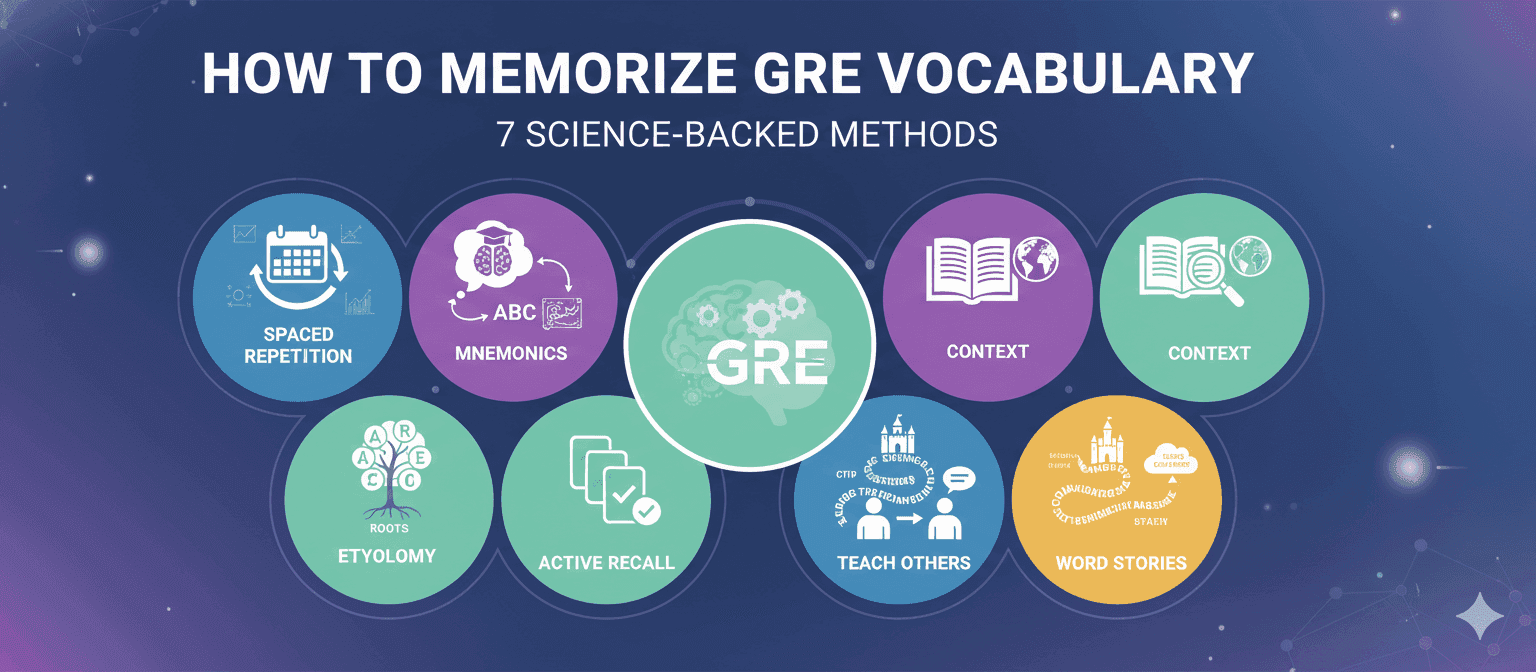
In this guide, you'll discover seven research-backed methods for memorizing GRE vocabulary that leverage cognitive science principles. These aren't generic study tips; they're techniques proven in peer-reviewed studies to increase vocabulary retention by 100-150% compared to traditional memorization approaches.
Why Traditional GRE Vocabulary Memorization Fails
Before diving into what works, let's understand why the approach most students take—reading through word lists and hoping definitions stick—produces such poor results.
The Forgetting Curve Problem
Ebbinghaus's research, replicated numerous times in modern studies, demonstrates that memory retention follows a predictable exponential decay pattern. Without intervention, you'll forget roughly half of newly learned vocabulary within 20 minutes, 70% within 24 hours, and up to 90% within a week.
The critical insight? Each time you successfully retrieve information from memory, the forgetting curve resets and flattens. This means the goal isn't to passively review words more times—it's to strategically test yourself at optimal intervals.
Passive vs. Active Learning
Research from Washington University found that students who tested themselves on material remembered 57% of it, compared to just 29% for students who simply re-read the same material. This "testing effect" is one of the most robust findings in cognitive psychology, yet most GRE students spend the majority of their vocabulary time in passive review mode.
Understanding these principles transforms how you approach GRE vocabulary memorization. The methods below translate this science into practical techniques you can implement immediately.
Method 1: Spaced Repetition — The Foundation of Effective Memorization
Spaced repetition is the single most important technique for long-term vocabulary retention. Research shows it can increase retention rates by up to 25% compared to massed practice over intervals of four weeks or longer.
How Spaced Repetition Works
Rather than reviewing all words equally, spaced repetition systems adjust review intervals based on how well you know each word. Words you struggle with appear more frequently; words you've mastered appear at longer intervals—just before you're predicted to forget them.
The science behind this is straightforward: each successful retrieval strengthens the memory trace and extends the time before you'll forget the word. By timing reviews to occur at the edge of forgetting, you maximize the strengthening effect of each practice session.
Implementing Spaced Repetition for GRE Vocabulary
Basic approach (manual tracking):
- Divide your word list into groups of 20-30 words
- Review new words on Day 1
- Review again on Days 2, 4, 7, 14, and 30
- Words you miss get reset to Day 1 intervals
Advanced approach (algorithm-based):
Modern spaced repetition algorithms like SM-2 (SuperMemo 2) calculate optimal review intervals based on your individual performance. Research from vocabulary teaching platforms found that students using AI-powered adaptive algorithms increased long-term vocabulary retention threefold compared to fixed-interval approaches.
PrepAiro's vocabulary module uses an adaptive spaced repetition algorithm that tracks your performance on each word and automatically schedules reviews at optimal intervals. This removes the cognitive burden of tracking hundreds of words manually while ensuring you never waste time reviewing words you already know well.
Sample 30-Day Spaced Repetition Schedule
| Week | New Words/Day | Review Load | Total Daily Time | |------|---------------|-------------|------------------| | 1 | 20 | 20-40 | 25-30 min | | 2 | 20 | 60-80 | 35-40 min | | 3 | 15 | 80-100 | 40-45 min | | 4 | 10 | 90-120 | 40-50 min |
This schedule assumes you're targeting approximately 500 words over a month—sufficient for most GRE score goals.
Method 2: Active Recall Testing — Make Your Brain Work
Active recall is the practice of retrieving information from memory rather than passively reviewing it. The testing effect research demonstrates that this simple shift can more than double long-term retention.
Why Testing Beats Studying
When you test yourself on a word's meaning, you engage retrieval processes that strengthen memory traces. A landmark 2008 study by Karpicke and Roediger found that students who spent time testing themselves on material remembered it better one week later than students who spent the same amount of time studying—even when the studying group felt more confident about their knowledge.
This reveals a critical metacognitive illusion: the ease of recognizing a word when you see it creates false confidence that you've learned it. True learning requires the harder work of generating the answer from memory.
Active Recall Techniques for GRE Words
Flashcard retrieval (correct approach):
- Look at the word
- Attempt to recall the definition before flipping the card
- Rate your confidence (didn't know / struggled / knew it)
- Only count it as "known" if you could produce the definition without hints
Fill-in-the-blank sentences:
Create sentences where the target word is missing:
"The professor's __________ criticism of the student's work was unnecessarily harsh and personal." (Answer: acerbic)
This tests not just definition recall but contextual understanding—exactly what GRE Sentence Equivalence and Text Completion questions require.
Definition-to-word recall:
Reverse the typical flashcard format. See the definition and try to produce the word. This is harder than word-to-definition recall but creates stronger memory traces.
The "teach it" method:
Explain each word aloud as if teaching someone else. Research on the "protégé effect" shows that preparing to teach material improves learning more than preparing to be tested on it.
Method 3: Mnemonic Devices — Memory Shortcuts That Stick
Mnemonic devices leverage existing knowledge and mental imagery to create memorable associations for new words. Research consistently shows that learners using mnemonic techniques outperform control groups by 60-90% on vocabulary tests.
The Science Behind Mnemonics
Mnemonics work through three complementary mechanisms:
-
Depth of processing: Creating a mnemonic requires thinking deeply about a word's meaning and associations, which strengthens encoding.
-
Dual coding: Many mnemonics involve both verbal and visual elements, creating two separate memory traces that can independently trigger recall.
-
Schema activation: Linking new words to existing knowledge networks makes them easier to retrieve.
Types of Mnemonics for GRE Vocabulary
Keyword method:
Connect the target word to a similar-sounding word in English (or your native language), then visualize an interaction between their meanings.
Example: Ebullient (enthusiastically excited) → sounds like "a bull in it" → Picture a bull excitedly running around a china shop, absolutely thrilled about all the breakable things.
Research from Atkinson and Raugh (1975) found that students using the keyword method achieved 88% test scores compared to 28% for control groups.
Etymology connections:
Learn root words to unlock families of vocabulary.
Example: Loquacious (talkative) comes from Latin "loqui" (to speak). Related words: eloquent, soliloquy, colloquial, ventriloquist. Learning this root helps you remember—and deduce meanings of—multiple words simultaneously.
Personal association method:
Connect words to people, places, or experiences from your own life. These self-referential memories are among the strongest.
Example: Sycophant (a person who flatters to gain advantage) → Think of that one coworker who constantly agrees with everything the boss says.
For Hindi speakers, PrepAiro provides mnemonic explanations that bridge English GRE words with familiar Hindi concepts—creating culturally relevant memory hooks that significantly improve retention for bilingual learners.
Method 4: Contextual Learning — Words in Their Natural Habitat
Memorizing definitions in isolation is like learning to swim by reading about it. GRE questions don't ask "what does X mean?"—they require you to understand how words function in sentences and distinguish between subtly different meanings.
Why Context Matters
Research on vocabulary acquisition shows that words learned in context are:
- Retained longer than words learned from definitions alone
- More easily applied to new contexts
- Better understood in their nuanced shades of meaning
A word like "appropriate" means something different as an adjective ("suitable") versus a verb ("to take for one's own use")—a distinction that only becomes clear through contextual exposure.
Contextual Learning Strategies
Read challenging material daily:
Spend 20-30 minutes daily reading publications that use GRE-level vocabulary naturally:
- The Economist
- The New Yorker
- The Atlantic
- Academic journals in areas of interest
When you encounter a target word in authentic context, the association is stronger than any flashcard.
Study words in sentence groups:
Rather than isolated definitions, learn words through example sentences:
"The austere monk lived in a spartan cell, believing that ascetic practices led to spiritual enlightenment."
This sentence reinforces three related words simultaneously and demonstrates their subtle differences.
Practice Sentence Equivalence questions:
GRE Sentence Equivalence questions are essentially vocabulary-in-context tests. Regular practice with these questions reinforces how words actually function—which is ultimately what the test measures.
PrepAiro's Sentence Equivalence practice module presents vocabulary in authentic GRE-style contexts, so you're not just memorizing definitions but developing the contextual understanding the test actually requires.
Method 5: Dual Coding — Engage Visual and Verbal Memory
Paivio's Dual Coding Theory proposes that memory has two distinct systems: verbal (language-based) and visual (imagery-based). Information encoded in both systems is significantly more memorable than information in either alone.
Research on Dual Coding
Studies demonstrate that vocabulary instruction combining images with definitions shows statistically significant improvements in both immediate and delayed recall compared to verbal-only instruction. The effect is particularly strong for concrete words but can be leveraged for abstract vocabulary through creative visualization.
Dual Coding Techniques
Create mental images:
For each word, develop a vivid mental picture. The more bizarre, emotional, or personally relevant, the better.
Example: Garrulous (excessively talkative) → Imagine your most talkative friend with their mouth literally the size of a garage, words tumbling out like cars.
Draw simple sketches:
You don't need artistic talent. Stick figures and simple symbols create visual encoding regardless of quality.
Example: Tenacious (persistent) → Draw a dog refusing to let go of a bone despite someone pulling on it.
Use visual flashcard apps:
Many vocabulary apps now include images. When images aren't provided, add your own mental visualization before reviewing the definition.
Watch the word in action:
Resources like GregMat's Movie/TV Vocabulary Project show GRE words used in film and television clips. Seeing and hearing a word in a memorable scene creates multiple encoding pathways.
Method 6: Word Grouping — Leverage Semantic Networks
Your brain naturally organizes information into connected networks. Strategic word grouping exploits this architecture to create mutually reinforcing memory structures.
Three Grouping Strategies
Synonym clusters:
Learn related words together so they reinforce each other:
Praise cluster: laud, extol, eulogize, panegyrize, acclaim
Criticize cluster: censure, castigate, excoriate, lambaste, reprove
When you encounter one word, related words become easier to recall—and you develop the synonym-discrimination skills critical for Sentence Equivalence questions.
Thematic groups:
Organize words by topic or situation:
Academic criticism: pedantic, didactic, erudite, esoteric, abstruse
Personality types: sycophant, curmudgeon, iconoclast, dilettante, raconteur
Etymology families:
Group words by Latin or Greek roots:
Root "bene" (good): benevolent, benefactor, beneficiary, benediction
Root "mal" (bad): malevolent, malicious, malfeasance, malady, malign
Learning 10 roots can help you decode hundreds of words you've never explicitly studied.
Caution: Avoid Interference
Research shows that learning highly similar words (antonyms, near-synonyms) in the same session can cause interference—you might confuse "timorous" and "temerity" if you learn them together.
Best practice: Learn similar words in separate sessions, then explicitly compare and contrast them once each is independently established.
Method 7: Consistent Daily Practice — The Compound Effect
All the techniques above work best when applied consistently. Research on skill acquisition shows that distributed practice (shorter sessions over more days) dramatically outperforms massed practice (longer sessions over fewer days) for long-term retention.
Optimal Practice Parameters
Duration: 30-45 minutes of focused vocabulary study daily is more effective than 3-hour weekend sessions.
Timing: Many learners find morning sessions most effective when cognitive resources are fresh, but consistency matters more than timing.
Quantity: Aim to learn 15-25 new words daily while reviewing previously learned words via spaced repetition. More aggressive schedules often backfire through interference and burnout.
Variety: Rotate through different techniques (flashcards one day, contextual reading the next, active recall tests the third) to maintain engagement and encode words through multiple pathways.
Building the Habit
Start small: Begin with 15 minutes daily and increase gradually. A habit you actually maintain beats an ambitious schedule you abandon.
Track progress: Research shows that monitoring improvement increases motivation. Note how many words you've mastered each week.
Use dead time: Review flashcards during commutes, waiting in lines, or other otherwise wasted moments.
Set clear goals: "Learn GRE vocabulary" is too vague. "Master 500 high-frequency words in 6 weeks" is actionable.
How Many GRE Words Should You Actually Learn?
A common question is whether you need to memorize 500, 1000, or 3000 words. The research-informed answer: 500-800 high-frequency words, learned deeply, beats 2000+ words learned superficially.
Quality Over Quantity
The GRE vocabulary that appears frequently is remarkably consistent. Magoosh, GregMat, Manhattan Prep, and other major prep companies have independently arrived at core lists of 500-1000 words that cover the vast majority of test vocabulary.
Learning these words deeply—understanding their connotations, typical contexts, and relationships to other words—matters more than accumulating definitions for obscure words you'll likely never see.
The Contextual Deduction Factor
The GRE is a reasoning test, not a vocabulary test. Questions are designed so that students with strong contextual deduction skills can often determine meaning from sentence structure and surrounding words.
Invest some vocabulary time in practicing context-based deduction strategies, not just memorization. This serves you better than memorizing low-frequency words.
Putting It All Together: A Sample Weekly Vocabulary Plan
Here's how to integrate these seven methods into a practical weekly schedule:
| Day | Focus | Time | |-----|-------|------| | Monday | Learn 20 new words (flashcards + mnemonics) | 30 min | | Tuesday | Contextual reading + word hunting | 30 min | | Wednesday | Spaced repetition review + active recall test | 35 min | | Thursday | Learn 20 new words (flashcards + mnemonics) | 30 min | | Friday | Sentence Equivalence practice | 35 min | | Saturday | Comprehensive review + word grouping | 45 min | | Sunday | Light review + contextual reading | 20 min |
This schedule introduces approximately 40 new words weekly while maintaining review of previously learned words—a sustainable pace for most 8-12 week study plans.
Frequently Asked Questions
How long does it take to memorize GRE vocabulary?
Most students require 8-12 weeks of consistent practice to master 500-800 high-frequency GRE words. The timeline depends on your starting vocabulary level, daily time investment, and how effectively you apply memory-enhancing techniques. Using spaced repetition and active recall can reduce this timeline compared to passive study methods.
What's the fastest way to memorize GRE words?
The fastest evidence-based approach combines spaced repetition algorithms with active recall testing. Research shows this combination can double retention rates compared to traditional study methods. Focus on high-frequency word lists rather than trying to memorize comprehensive 3000+ word lists, and use mnemonic devices to accelerate encoding of difficult words.
How many GRE vocabulary words should I learn per day?
Aim for 15-25 new words daily, depending on your available study time and how many days you have until your test. This pace allows adequate time for both learning new words and reviewing previously studied vocabulary. More aggressive schedules often lead to interference and forgetting that cancel out the benefits of learning more words.
Is reading enough to learn GRE vocabulary?
Reading challenging material helps reinforce vocabulary learned through other methods but is too slow and unreliable as a primary vocabulary acquisition strategy. Studies show that explicit vocabulary instruction combined with contextual exposure produces better results than either approach alone. Use reading to supplement flashcard study, not replace it.
Should I make my own flashcards or use pre-made ones?
Creating your own flashcards provides a encoding benefit through the act of creation—you process words more deeply when writing definitions and example sentences yourself. However, this takes significant time. A balanced approach uses pre-made flashcards from reputable sources (Magoosh, Manhattan Prep, GregMat) while adding personal mnemonics and example sentences.
What if I keep forgetting the same words?
Words that resist memorization usually need stronger encoding through multiple techniques. Try creating a vivid mnemonic image, finding a personal connection, learning the etymology, or encountering the word in multiple contexts. Some words simply require more exposures—spaced repetition systems automatically increase review frequency for difficult words.
Conclusion: Making GRE Vocabulary Stick
Memorizing GRE vocabulary isn't about raw memorization power—it's about working with your brain's natural learning processes rather than against them. The seven methods in this guide leverage over a century of memory research to maximize your retention per hour of study time.
The key principles to remember are simple: space your practice over time rather than cramming, actively retrieve words from memory rather than passively recognizing them, create rich associations through mnemonics and imagery, and study consistently rather than sporadically.
Start implementing these techniques today. Choose one method that resonates most, integrate it into your study routine this week, then gradually add others as each becomes habitual. The compound effect of consistent, science-backed practice will transform your vocabulary—and your GRE Verbal score—over the coming weeks.
Your goal isn't to memorize a word list; it's to expand your working vocabulary so that GRE-level words become natural, familiar, and usable. That transformation happens through the right techniques applied consistently over time.
Ready to implement these strategies with technology that adapts to your learning? PrepAiro's vocabulary module combines AI-powered spaced repetition, Sentence Equivalence practice, and adaptive algorithms that track your individual progress—ensuring you spend your study time where it matters most. [Start your free practice session today.]