
GRE Verbal 2025 Overview: Question Types, Timing & Strategy
5 min read
Dec 23, 2025
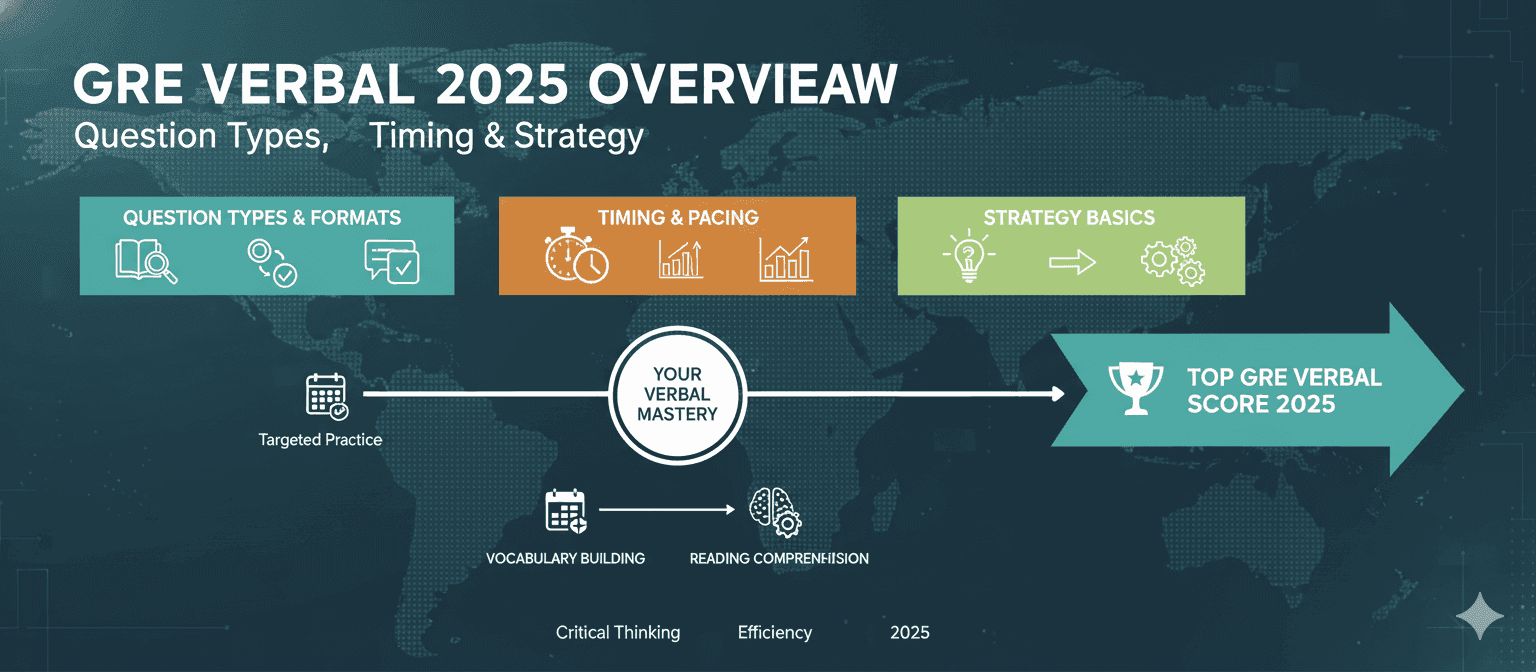
The GRE Verbal Reasoning section can feel overwhelming at first glance—dense passages, tricky vocabulary, and a ticking clock. But once you understand what's being tested and how to approach each question type strategically, the section becomes far more manageable.
Whether you're starting your prep or refining your strategy, this guide will walk you through everything you need to know about the GRE Verbal section in 2025.
What Does the GRE Verbal Section Test?
The Verbal Reasoning section measures your ability to analyze written material, understand relationships between words and concepts, and draw conclusions from incomplete information. You'll encounter two scored Verbal sections, each lasting 23 minutes with approximately 12 questions per section.
Unlike standardized tests you might have taken before, the GRE adapts to your performance. Your score on the first Verbal section influences the difficulty of the second section, which ultimately affects your final score range.
The Three Question Types You'll Face
Reading Comprehension
Reading Comprehension forms the backbone of the Verbal section, typically making up about half the questions. You'll read passages ranging from one paragraph to several paragraphs, drawn from humanities, social sciences, and natural sciences.
The passages aren't meant to be enjoyable leisure reading. They're academically dense and often discuss specialized topics you might know nothing about—and that's intentional. The test wants to see how you handle unfamiliar material under pressure.
Question formats include multiple-choice (single answer), multiple-choice (multiple answers), and select-in-passage questions where you highlight the relevant sentence within the text.
Strategic approach: Don't try to memorize every detail. Read actively to understand the main argument and structure. When you hit a question, return to the passage with a specific purpose. Most wrong answers are designed to trap test-takers who rely on memory rather than careful re-reading.
Text Completion
These questions present sentences or short paragraphs with one, two, or three blanks. Your job is to select the word or phrase that best completes the overall meaning.
Single-blank questions give you five answer choices. Two-blank and three-blank questions provide three options per blank. Here's the catch: with multiple blanks, you must get every blank correct to earn the point. There's no partial credit.
Text Completion questions test your vocabulary, yes, but more importantly, they assess your ability to understand context clues and logical flow within complex sentences.
Strategic approach: Read the entire sentence first to grasp the overall meaning. Look for transition words, contrasting ideas, and supporting details that hint at the missing words. Cover the answer choices initially to predict what might fit, then compare your prediction with the options. Some aspirants find it easier to stay consistent using structured practice tools like PrepAiro, which offers targeted drills for each question type.
Sentence Equivalence
Sentence Equivalence presents a single sentence with one blank and six answer choices. You must select two words that both complete the sentence in a way that produces similar meanings.
This question type is particularly tricky because both words must work independently to create sentences with essentially the same meaning. It's not enough for both words to "sound right"—they must be genuine synonyms in the given context.
Strategic approach: Look for the relationship between ideas in the sentence. Eliminate answers that change the meaning too drastically. Then identify which pairs of words are true synonyms. Remember, the sentence should make sense with either word, and both completed sentences should convey the same overall message.
Timing: Your Biggest Challenge
With 23 minutes for approximately 12 questions, you have roughly two minutes per question. But here's the reality—Reading Comprehension passages require more time upfront, which means you need to work efficiently on Text Completion and Sentence Equivalence to stay on track.
Many test-takers struggle more with time management than with content difficulty. You might know how to answer every question correctly, but running out of time forces you to rush or guess on the last few questions.
Timing strategy: Aim to spend 1–1.5 minutes on Text Completion and Sentence Equivalence questions. For Reading Comprehension, budget about 3–4 minutes per passage (including all associated questions). If you're stuck on a hard question beyond two minutes, flag it and move on. You can always return if time permits.
Core Strategies That Actually Work
Build contextual vocabulary: Instead of memorizing random word lists, learn words in context. Read challenging material—academic journals, quality newspapers, and GRE-level texts. Notice how words function within sentences.
Practice active reading: Engage with passages by noting the author's tone, main argument, and structure. Ask yourself: What's the author trying to prove? What evidence do they use? Where does the passage shift direction?
Eliminate systematically: On multiple-choice questions, eliminating even two wrong answers significantly improves your odds. Train yourself to spot common trap patterns—extreme language, out-of-scope options, and subtle meaning shifts.
Trust the process over hunches: The GRE rewards careful reasoning, not gut feelings. If an answer "feels" right but you can't justify it with evidence from the passage or sentence, it's probably wrong.
Common Mistakes to Avoid
Don't bring outside knowledge into Reading Comprehension. Answer based solely on what's stated or implied in the passage, even if you know the topic well.
Don't ignore transition words in Text Completion. Words like "however," "moreover," and "nonetheless" are critical clues to the logical relationship between ideas.
Don't rush through Sentence Equivalence looking for synonyms without checking the context. Two words can be synonyms in general but not in the specific sentence provided.
The Reality of Verbal Prep
Improving your Verbal score takes time—often more than quantitative improvement because language skills develop gradually. You can't cram vocabulary the night before and expect significant gains.
Consistency matters more than intensity. Thirty minutes of focused practice daily outperforms sporadic three-hour marathons. Track your mistakes, understand why you got questions wrong, and actively work on those weak areas.
When you practice, simulate test conditions. Time yourself. Work through questions without interruptions. Build the mental stamina you'll need on test day.
Moving Forward
The GRE Verbal section doesn't have to be the section you dread. With clear understanding of question types, deliberate practice, and smart time management, you can approach it with confidence.
Focus on building genuine skills rather than test-taking tricks. Read challenging material. Engage with complex ideas. Practice reasoning through difficult questions methodically.
Your score reflects both your preparation and your approach on test day. Master the content, refine your strategy, and trust the process.
FAQ Section
Q1: How many questions are in each GRE Verbal section?
Each of the two Verbal Reasoning sections contains approximately 12 questions, and you'll have 23 minutes to complete each section. The exact number may vary slightly, but you can expect around 12 questions per section consistently.
Q2: Is the GRE Verbal section harder than the Quantitative section?
Difficulty is subjective and depends on your background. Students with strong reading habits and vocabulary often find Verbal more manageable, while those from STEM backgrounds might find Quant easier. However, Verbal improvement typically takes longer because language skills develop gradually compared to math concepts you can learn and apply quickly.
Q3: How important is vocabulary for the GRE Verbal section?
Vocabulary is important but not the only factor. While Text Completion and Sentence Equivalence do test vocabulary knowledge, understanding context clues and sentence structure matters just as much. Strong vocabulary helps, but strategic reading and reasoning skills are equally crucial for success.
Q4: Can I skip questions and return to them later in the GRE Verbal section?
Yes, you can skip questions and return to them within the same section. The GRE interface allows you to flag questions for review and navigate back before time expires. However, once you move to the next section, you cannot return to previous sections.
Q5: How is the GRE Verbal section scored?
The Verbal Reasoning section is scored on a scale of 130–170 in one-point increments. Your score depends on both the number of questions you answer correctly and the difficulty level of your second section, which adapts based on your performance in the first Verbal section.
Q6: What's the best way to improve Reading Comprehension speed?
Practice active reading by identifying the main argument, structure, and purpose as you read. Don't try to memorize details—instead, note where information is located so you can quickly reference it when answering questions. Regular practice with GRE-level passages builds both speed and comprehension over time.