
Demystifying GRE Scoring: Section Adaptive Design & Percentiles Explained
5 min read
Dec 10, 2025
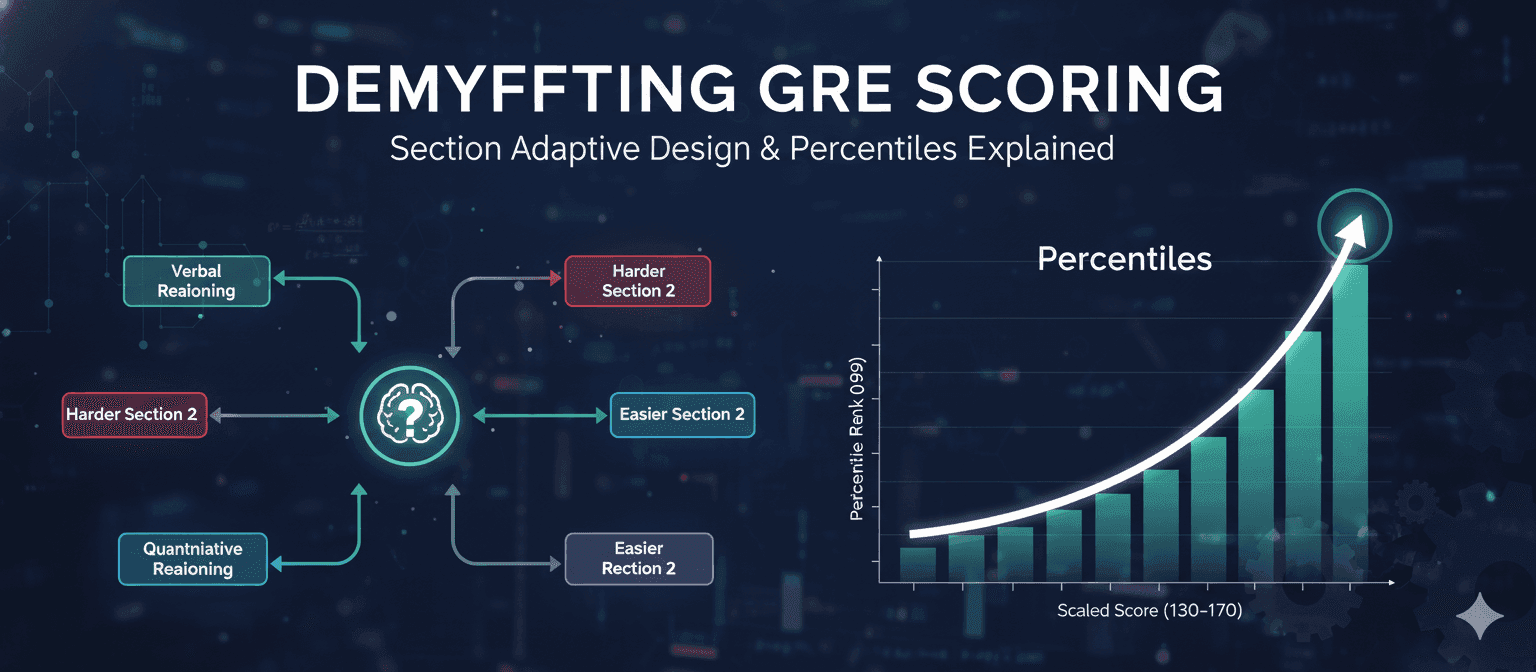
Most GRE guides tell you *what* your score means. Few explain *why* the test works the way it does—and how understanding the mechanics can actually improve your score.
Here's something that might surprise you: two test-takers who answer the same number of questions correctly can receive significantly different scores. The difference? Which *difficulty level* of Section 2 they received. This is the section-adaptive system in action, and understanding it transforms how you should approach test day.
The Section-Adaptive System: Your Scoring Gateway
Unlike older computerized tests that adjusted difficulty after every question, the GRE operates at the section level. Here's what that means practically:
Section 1 (for both Verbal and Quant) contains questions of medium difficulty. Your performance here doesn't just measure your ability—it *routes* you to one of several possible Section 2 modules, each with a different difficulty ceiling.
Think of it like this: Section 1 is a gateway. Perform well, and the gate opens to a harder Section 2 with access to higher scaled scores. Struggle in Section 1, and you're routed to an easier Section 2—but your maximum possible score is now capped.
This creates what psychometricians call a "scoring ceiling effect." Even if you answer every question correctly in an easier Section 2, your maximum achievable score is lower than someone who answered fewer questions correctly in a harder Section 2.
The practical implication? Your Section 1 performance doesn't just contribute to your score—it determines your scoring *potential*.
How Your Raw Score Becomes a Scaled Score
The GRE reports Verbal and Quantitative scores on a 130-170 scale, in one-point increments. But you never actually see your raw score (the number of correct answers). Here's the conversion process:
Step 1: Raw Score Calculation
Each correct answer counts equally—there's no penalty for guessing. A simple question about circle area and a complex probability problem carry the same weight within their section.
Step 2: Equating
ETS uses a statistical process called equating to account for difficulty differences between test versions and the adaptive routing. If you received a harder Section 2, the equating formula adjusts your raw-to-scaled conversion favorably.
Step 3: Scaled Score Assignment
Your final 130-170 score reflects both your raw correct answers and the difficulty of questions you faced. Two students answering 23/27 questions correctly could receive different scaled scores based on which Section 2 they were routed to.
This is why the GRE isn't "curved" in the traditional sense. Your score isn't affected by how other test-takers perform on your specific test day—it's calibrated against three years of historical data.
2025 GRE Percentile Rankings: What the Numbers Actually Mean
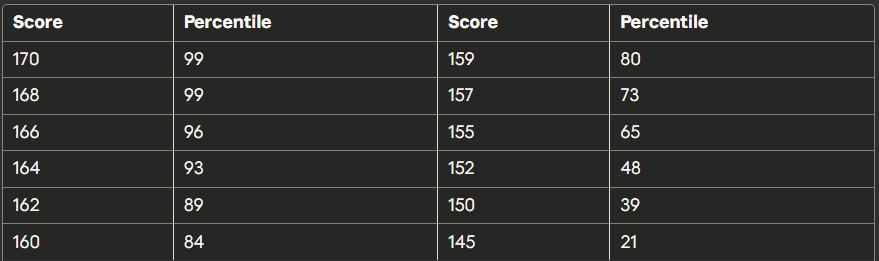
Percentiles indicate what percentage of test-takers from the past three years scored below your score. Here's the current ETS interpretive data:
Verbal Reasoning Percentiles
Quantitative Reasoning Percentiles
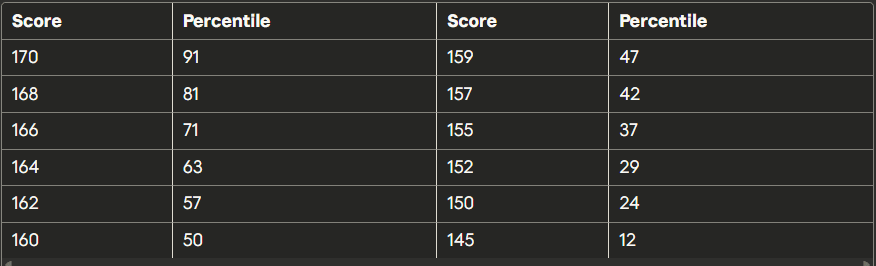
The asymmetry is striking: A 165 in Verbal places you in the 95th percentile, but the same 165 in Quant is only the 67th percentile. A perfect 170 in Quant reaches just the 91st percentile—meaning nearly 1 in 10 test-takers achieves a perfect Quant score.
This reflects the composition of the GRE test-taking pool. Many international STEM applicants with strong quantitative backgrounds take the GRE, compressing Quant percentiles at the top.
Why Percentiles Keep Shifting (And Why That Matters)
ETS updates percentile tables annually using a rolling three-year data window. Recent trends show Quant percentiles continuing to compress—a score that placed you in the 61st percentile in 2023 might only reach the 50th percentile today.
Several factors drive this shift. As more programs become test-optional, students who expect to score well are more likely to submit scores, effectively raising the competitive bar. Improved prep resources and longer study timelines have also elevated average performance.
The strategic takeaway: Research your target programs' percentile expectations, not just raw score averages. A "good" score is relative to your applicant pool, and that bar may be higher than published averages suggest.
Strategic Implications: How to Approach Each Section
Understanding section-adaptive design should change how you allocate effort on test day.
Section 1: Your High-Stakes Gateway
The first section of each measure deserves maximum focus and energy. This isn't the time to save mental reserves—it's the moment that determines your scoring ceiling. Approach every question with full engagement. If you're running low on time, strategic guessing is better than leaving questions blank.
Section 2: Adapt to What You Receive
If Section 2 feels noticeably harder, that's actually a positive signal—you've unlocked access to higher scaled scores. Don't be discouraged by challenging questions; they indicate you're in the upper scoring track.
If Section 2 feels similar or easier than Section 1, focus on accuracy. While your ceiling may be lower, you can still maximize your score within that range through careful, precise work.
The Analytical Writing Score: Separate and Simpler
The AWA operates differently. Your single essay is scored by both a human rater and ETS's automated e-rater system on a 0-6 scale in half-point increments. If the two scores differ significantly, a second human rater breaks the tie.
The AWA score isn't part of your 260-340 composite and isn't section-adaptive. Most graduate programs expect a minimum of 4.0, with top programs preferring 4.5 or higher. Humanities programs may weight AWA more heavily than STEM programs.
Frequently Asked Questions
What is a good GRE percentile?
"Good" depends entirely on your target programs. Generally, aim for at least the 50th percentile in your weaker section and 70th+ in your stronger section. Competitive programs often prefer 80th percentile or above in the section most relevant to their field.
Does my Verbal score affect my Quant section difficulty?
No. Each measure adapts independently. Your Verbal performance has no impact on your Quantitative section routing, and vice versa.
Is there a best time of year to take the GRE?
No. The equating process normalizes for any difficulty variations across test administrations. Your score reflects your ability, not when you happened to test.
Why is a perfect 170 Quant only the 91st percentile?
The GRE test-taking pool includes many quantitatively strong applicants, particularly international STEM candidates. This concentration of high scorers compresses the upper Quant percentiles.
How long are GRE scores valid?
Five years from your test date. Scores are reportable to institutions throughout this window.
---
The GRE's section-adaptive design isn't just a testing mechanism—it's a strategic factor that rewards strong starts and informed preparation. Understanding how your score is actually determined gives you an edge that pure content knowledge alone cannot provide.
---