
Should You Take the GRE at Home or at a Test Center? Pros, Cons & Tech Prep
5 min read
Dec 08, 2025
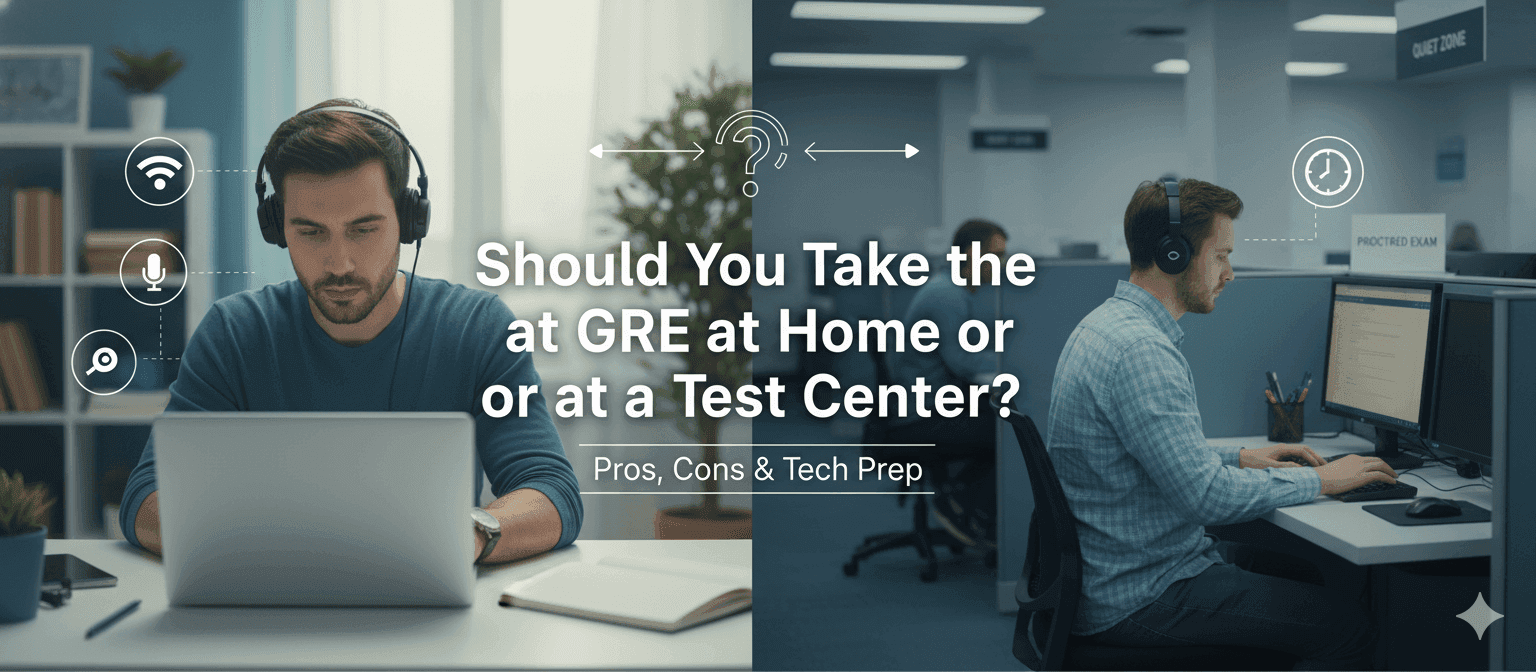
The decision to take the GRE at home or at a test center feels like choosing between comfort and certainty. Both options deliver the exact same exam with identical scoring, yet the testing experience differs dramatically. Your choice could mean the difference between peak performance and unnecessary stress.
Here's what most prep guides won't tell you: the "right" answer depends entirely on your personal circumstances, not on which option sounds more convenient.
The Test Is Identical—Your Experience Isn't
First, let's establish the facts. Whether you test at home or in-person, you'll face the same 1 hour and 58-minute exam with identical Analytical Writing, Verbal Reasoning, and Quantitative Reasoning sections. Your score report won't indicate where you tested, and graduate schools cannot distinguish between the two.
The difference lies in everything surrounding the test itself.
GRE at Home: Freedom With Strings Attached
The Appeal: Take your test at 2 AM if you're a night owl. Skip the commute. Test in your favorite chair (well, almost—it must be a standard chair). The 24/7 availability is genuinely liberating for working professionals juggling demanding schedules.
The Reality Check: That freedom comes with significant responsibilities. You become your own testing facility, which means any technical failure is your problem. A flickering WiFi connection, an unexpected Windows update, or a roommate accidentally walking in could derail your entire exam.
Reports from test-takers reveal that at-home score cancellations happen more frequently than test center cancellations—often for reasons that seem minor, like moving your lips while reading or briefly glancing away from the screen. The human proctor watching through your webcam follows strict protocols, and what feels natural to you might trigger a security flag.
Test Center: Controlled Chaos
The Appeal: Show up, sit down, test. The facility handles everything technical. If something goes wrong with equipment, it's their responsibility to fix it. You also get proper noise-cancelling headphones and spiral-bound scratch paper—significantly better than a small whiteboard.
The Reality Check: Test centers aren't spas. You'll share space with other anxious test-takers. The biometric check-in process takes time. Scheduling options are limited, and popular time slots fill up weeks in advance. Some test-takers also find the sterile, observed environment heightens their anxiety rather than reducing it.
Side-by-Side Comparison

The Tech Prep Checklist for At-Home Testing
If you're leaning toward the at-home GRE, this checklist is non-negotiable. Failing any requirement on test day means no refund and no reschedule.
Hardware Requirements:
- Desktop or laptop computer (tablets and Chromebooks are not permitted)
- Single monitor only (dual monitors are strictly prohibited)
- Working webcam capable of 360-degree room scans
- Built-in speakers and microphone (external headsets not allowed)
- Stable internet connection with consistent bandwidth
Software Setup (Complete 48 Hours Before):
- Download and install ETS Secure Test Browser
- Run the ProctorU Equipment Check from your actual testing computer
- Disable all screen-sharing software (Zoom, Teams, Skype, TeamViewer)
- Close unnecessary background applications to preserve bandwidth
Environment Preparation:
- Private room with a closed door—no one may enter during testing
- Clear desk with only approved items: ID, small mirror or phone (for check-in only), and note-taking materials
- Small desktop whiteboard with erasable marker OR single sheet of paper in transparent sheet protector
- Standard chair (no beds, couches, or overstuffed chairs)
- Remove all phones, tablets, and study materials from the room
Personal Preparation:
- Ears and face must remain visible throughout the exam
- Avoid jewelry, hair accessories that cover ears, or anything that might obstruct the proctor's view
- Have a small mirror or phone camera ready to show your computer screen to the proctor during check-in
Making Your Decision
Choose the at-home GRE if:
- You have a reliable, private testing space with excellent internet
- Your schedule requires flexibility that test centers cannot accommodate
- You perform better in familiar environments
- You can handle strict proctoring without getting flustered
Choose a test center if:
- Your home environment has potential distractions (roommates, family, pets)
- Your internet connection is inconsistent
- You prefer having technical problems handled by someone else
- You work better with more scratch paper space
- You want to minimize any risk of score cancellation
The Overlooked Factor: Practice Environment Alignment
Here's strategic advice that most guides miss: whichever format you choose, practice under those exact conditions. If you're taking the at-home GRE, do your practice tests at the same desk, in the same room, using the same whiteboard. This environmental consistency reduces test-day anxiety and allows you to focus entirely on the questions rather than adjusting to unfamiliar surroundings.
PrepAiro's practice tests simulate both testing environments, letting you build familiarity with your chosen format before the high-stakes day arrives.
Final Thought
There's no universally "better" option—only the option that's better for you. The student who aces the GRE at 3 AM in their apartment might struggle in a fluorescent-lit testing room, and vice versa. Understand your own testing psychology, prepare accordingly, and trust your preparation.
The GRE measures your reasoning abilities, not your ability to navigate testing logistics. Remove the logistics variable by choosing the environment where you'll perform your best.
---
FAQ Section (Optimized for Featured Snippets)
Is the GRE at home the same as the test center exam?
Yes, the GRE at home is identical to the test center version in content, format, timing, and scoring. Both exams are 1 hour and 58 minutes long, and your score report will not indicate where you tested.
Can I use scratch paper for the at-home GRE?
No traditional scratch paper is allowed. You may use either a small desktop whiteboard with an erasable marker or a single sheet of paper inside a transparent sheet protector with an erasable marker.
What happens if my internet disconnects during the at-home GRE?
If your connection drops momentarily, you'll automatically reconnect to the proctor. If you cannot reconnect, contact ProctorU immediately. However, extended outages may result in test cancellation without refund.
Do graduate schools prefer one GRE format over the other?
No. Graduate schools receive identical score reports regardless of testing format and cannot distinguish between at-home and test center scores. Both are equally valid for admissions.
How early should I book a test center appointment?
Book at least 2-4 weeks in advance, especially during peak application seasons. Popular time slots fill quickly, and limited availability may force you to travel to a more distant location.