
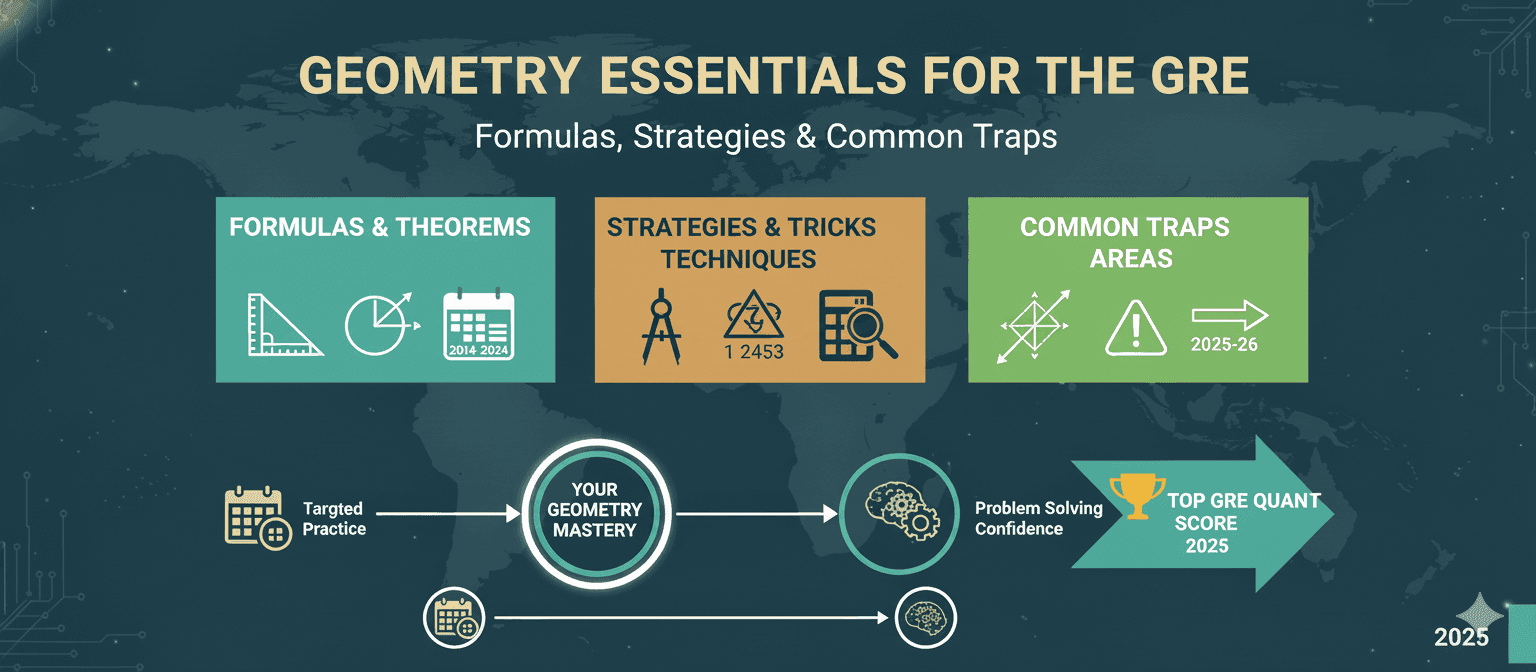
Geometry Essentials for the GRE: Formulas, Strategies & Common Traps
5 min read
Dec 22, 2025
Why Geometry Matters on the GRE
Geometry typically appears in 3-4 questions per Quant section on the GRE. While it's not the heaviest-weighted topic, these questions are often where aspirants lose easy points—not because the concepts are difficult, but because of careless errors and overlooked details.
The good news? Geometry on the GRE is finite. There's a limited set of formulas and question types. Master these, and you'll approach every geometry problem with confidence.
Core Geometry Formulas You Must Know
Triangles
Area: ½ × base × height
Pythagorean Theorem: a² + b² = c² (for right triangles)
Special Right Triangles:
45-45-90 triangle: sides are x, x, x√2
30-60-90 triangle: sides are x, x√3, 2x
Triangle Inequality: The sum of any two sides must be greater than the third side.
Circles
Area: πr²
Circumference: 2πr
Arc Length: (θ/360) × 2πr
Sector Area: (θ/360) × πr²
Quadrilaterals
Rectangle Area: length × width
Square Area: side²
Parallelogram Area: base × height
Trapezoid Area: ½ × (base₁ + base₂) × height
3D Figures
Rectangular Solid Volume: length × width × height
Cylinder Volume: πr²h
Cylinder Surface Area: 2πr² + 2πrh
Cube Volume: side³
Strategic Approaches That Work
Draw Everything Out
Never solve geometry problems in your head alone. Even if the GRE provides a diagram, redraw it yourself. This physical act helps you spot relationships and angles you might otherwise miss.
Label everything—sides, angles, known values. Make notes directly on your diagram.
Watch Out for "Not Drawn to Scale"
When you see this warning, the figure is deliberately misleading. Don't trust what your eyes tell you. Instead, rely entirely on the given information and mathematical relationships.
Test extreme cases. If a triangle looks equilateral but isn't specified as such, imagine it as very flat or very tall.
Use the Answer Choices
For quantitative comparison questions, sometimes plugging in values or working backwards from answer choices saves time. If you're asked whether Quantity A or B is greater, test specific numbers that satisfy the conditions.
Remember Coordinate Geometry Basics
Distance formula: √[(x₂-x₁)² + (y₂-y₁)²]
Midpoint formula: ((x₁+x₂)/2, (y₁+y₂)/2)
Slope: (y₂-y₁)/(x₂-x₁)
These appear regularly in GRE geometry questions, especially those combining algebra with spatial reasoning.
Common Traps and How to Avoid Them
Trap 1: Assuming Figures Are Accurate
Many aspirants lose points by trusting how a figure looks rather than what's stated. If an angle looks like 90° but isn't marked as such, don't assume it's a right angle.
Prevention: Rely only on marked information—tick marks indicating equal sides, right angle symbols, or explicitly stated measurements.
Trap 2: Forgetting About Units
Questions might give you a radius in centimeters and ask for area in square meters. Always check whether unit conversion is needed.
Prevention: Circle the units in the question stem before you start solving.
Trap 3: Mixing Up Diameter and Radius
This simple confusion costs countless points. The GRE knows aspirants rush and will use diameter in the question but structure answer choices as if you used radius (or vice versa).
Prevention: Write "d = 2r" at the top of your scratch paper for every circle problem.
Trap 4: Overlooking Multiple Solutions
Some geometry problems have more than one valid answer. A triangle with two sides of length 5 and 7 could have a third side anywhere between 2 and 12.
Prevention: When finding lengths or angles, ask yourself: "Could this have another valid value?"
Trap 5: Neglecting 3D Visualization
Volume and surface area questions require you to mentally unfold or rotate shapes. Aspirants often calculate only visible faces or forget the base of a cylinder.
Prevention: List out every face or component before calculating. For a cylinder: two circles + one rectangle (the curved surface).
Making Practice Count
Formula memorization is just the starting point. The real skill develops through deliberate practice—working through problems, analyzing your mistakes, and recognizing patterns.
Some aspirants find it easier to stay consistent using structured practice tools like PrepAiro, which offers section-wise drills, but the core principle remains the same: quality repetition builds speed and accuracy.
Track which trap types catch you most often. If you consistently miss "not drawn to scale" questions, dedicate a practice session exclusively to those.
The Reality Check
Here's what separates average geometry performance from excellent: attention to detail. The concepts aren't advanced—most are from secondary school—but the GRE tests your precision under pressure.
You'll solve problems correctly in practice and still miss them on test day because you rushed the last step or misread a label. This is normal. The solution isn't to study harder—it's to build checking mechanisms into your process.
Before you confirm any geometry answer, do a quick sanity check. Does this area seem reasonable given the dimensions? Is this angle sum actually 180°? Does my answer match the question being asked?
Moving Forward
Geometry success on the GRE comes down to three things: knowing your formulas cold, recognizing the trap patterns, and maintaining discipline in your solving process.
You don't need to become a geometry expert. You need to be methodical, careful, and strategic. Master the fundamentals, learn from every practice mistake, and trust that consistency builds the intuition you need.
The questions might look different on test day, but the underlying concepts won't change. That's your advantage.
FAQ Section
Q1: How many geometry questions appear on the GRE?
Typically 3-4 geometry questions appear per Quantitative Reasoning section. While not the most frequent topic, these questions are often worth securing because they test a limited set of concepts that can be thoroughly prepared.
Q2: Do I need to memorize all geometry formulas for the GRE?
Yes, formula recall should be automatic. The GRE doesn't provide a formula sheet, so you'll need instant access to area, volume, perimeter, and special triangle formulas. Create flashcards or a formula sheet for daily review.
Q3: What's the biggest mistake students make in GRE geometry?
Trusting how figures look rather than what's explicitly stated. Many diagrams are marked "not drawn to scale" precisely to test whether you rely on visual intuition or mathematical reasoning. Always work from given information only.
Q4: How should I approach "Quantitative Comparison" geometry questions?
Test extreme cases and special values. If the question doesn't specify that a shape is regular or that angles are equal, try plugging in different valid configurations to see if Quantity A could be greater than, less than, or equal to Quantity B.
Q5: Are coordinate geometry questions common on the GRE?
Yes, the GRE frequently combines coordinate plane concepts with geometric shapes. You should be comfortable with distance formula, midpoint calculations, slope, and identifying shapes based on coordinate points.
Q6: How long should I spend on a geometry question during the test?
Aim for 1.5-2 minutes per question. If you're stuck after 2 minutes, make your best educated guess and move on. Time management is crucial, and getting trapped on one difficult geometry problem can cost you points on easier questions later.