
Current Affairs Strategy 2026: Digital Sources, Newspapers & Smart Filtering for UPSC
5 min read
Dec 11, 2025
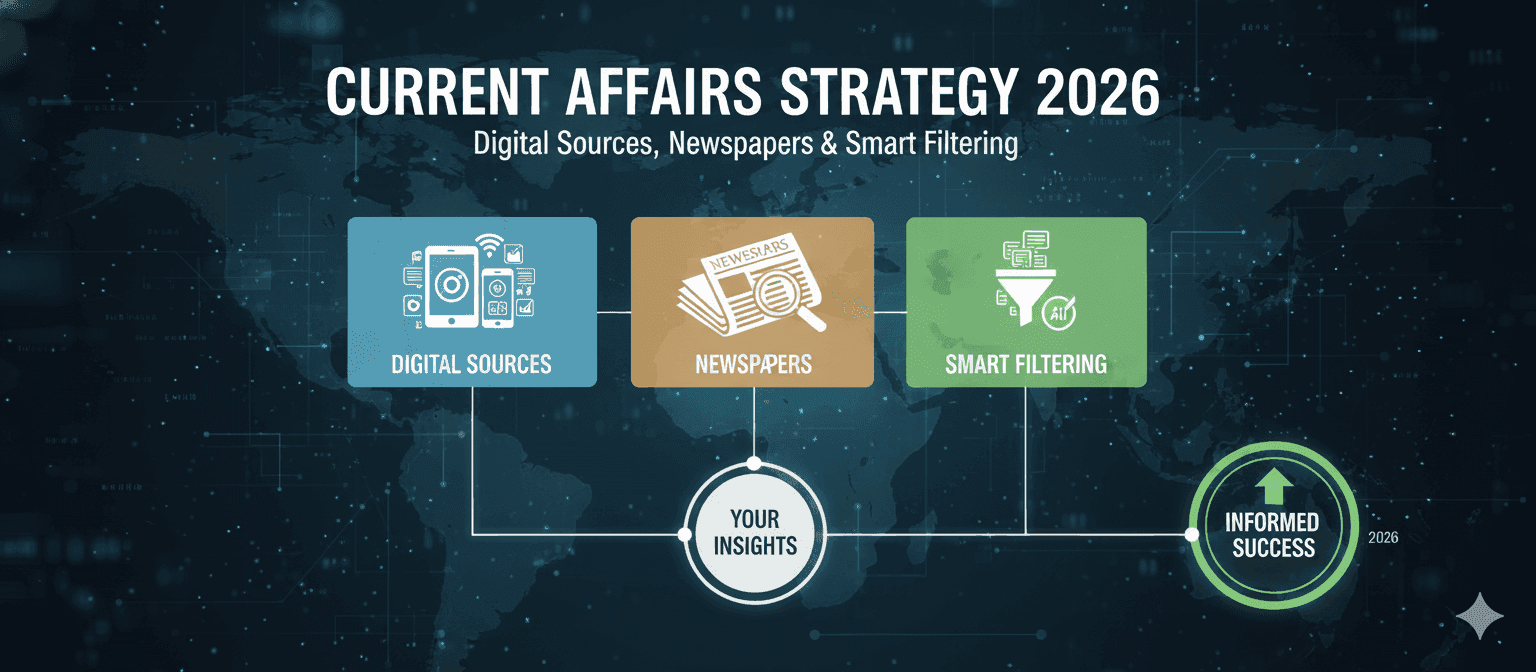
Current Affairs Strategy 2026: Digital Sources, Newspapers & Smart Filtering for UPSC
The biggest mistake UPSC aspirants make with current affairs isn't reading too little—it's reading too much without a system. In 2026, information is everywhere: YouTube channels, Telegram groups, coaching apps, Twitter threads, and the classic newspaper stack. The aspirants who succeed aren't those who consume the most content, but those who filter ruthlessly and connect strategically. This guide gives you a modern current affairs framework that balances digital efficiency with depth, helping you avoid the paralysis of information overload while building exam-ready knowledge.
The Core Problem: Information Overload in 2026
Consider this scenario: You wake up, check three Telegram channels pushing "Important Current Affairs," watch two YouTube videos on yesterday's news, skim The Hindu, and then receive a coaching notification about "Breaking UPSC News." By 10 AM, you've consumed information for two hours but retained almost nothing useful.
This is the current affairs trap. UPSC doesn't reward aspirants who know everything that happened—it rewards those who understand why events matter and how they connect to the syllabus. The 2024 Prelims demonstrated this clearly: questions tested conceptual understanding of current developments, not mere factual recall. Your strategy for 2026 must prioritize depth over breadth and connection over collection.
Building Your Digital Source Ecosystem
The digital landscape offers tremendous efficiency if curated properly. Your goal is creating a lean information pipeline that delivers high-relevance content without the noise.
Primary Digital Sources should include the PIB (Press Information Bureau) website for government announcements and policy statements, which provides the official position UPSC often tests. The PRS Legislative Research portal offers bill summaries and policy briefs that explain parliamentary developments in exam-friendly language. For international affairs, MEA statements and monthly briefings provide authoritative content on India's foreign policy positions.
Secondary Curation Sources like coaching apps and YouTube channels serve best as consolidators, not primary sources. Use them for weekly or monthly summaries, not daily updates. The key principle: if you're spending more than 30 minutes daily on digital current affairs sources beyond your newspaper, you're likely duplicating effort.
What to Avoid: Random Telegram forwards, unverified Twitter news, multiple sources covering identical content, and any channel that uses "urgent" or "must-read" for routine news. These create anxiety without adding value.
Newspaper Reading: The 45-Minute Method
Despite digital alternatives, newspapers remain irreplaceable for UPSC preparation. They provide editorial depth, diverse perspectives, and the analytical framing that digital snippets lack. However, the traditional approach of spending 2-3 hours on The Hindu is neither sustainable nor necessary.
The 45-Minute Method structures your newspaper reading into three phases. In the first 15 minutes, scan all headlines and identify 5-7 stories relevant to the UPSC syllabus. Skip sports, entertainment, and routine political coverage unless they have policy implications. During the next 20 minutes, read the selected articles thoroughly, focusing on government reports, committee recommendations, international agreements, and editorial opinions on policy matters. In the final 10 minutes, note down 3-4 key points per article in your consolidation document, focusing on facts, implications, and syllabus connections.
For The Hindu specifically, prioritize the Editorial page (especially op-eds on economy, polity, and international relations), the National page for policy announcements, and the Science & Technology section for space, health, and environment updates. The Business section matters for economic policy changes, budget-related news, and RBI decisions.
Indian Express adds value through its "Explained" section, which breaks down complex issues into exam-friendly explanations, and investigative pieces that provide depth on governance issues UPSC frequently tests.
Monthly Consolidation: From News to Notes
Daily reading without monthly consolidation creates an illusion of preparation. By month-end, you'll struggle to recall what you read in week one. The consolidation process transforms scattered information into structured knowledge.
The Monthly Review Process should happen in the first week of each new month. Gather your daily notes and categorize them under GS Paper headings: Polity & Governance, Economy, International Relations, Environment & Ecology, Science & Technology, and Social Issues. For each category, identify recurring themes—if farm distress appeared in multiple articles, it's likely exam-relevant. Create summary sheets with key facts, government responses, and committee recommendations for each major theme.
Static-Dynamic Linking is where current affairs preparation truly becomes powerful. Every current event connects to static syllabus concepts. For example, news about SC/ST reservation connects to constitutional provisions under Articles 15 and 16, the Indra Sawhney judgment, and the concept of creamy layer. A story on India-Maldives relations links to India's Neighborhood First policy, SAGAR doctrine, and competition with China in the Indian Ocean Region.
Train yourself to ask three questions for every important news item: What static topic does this relate to? What previous year questions have tested this area? How might UPSC frame a question on this?
Smart Filtering: The Relevance Framework
Not everything in the news deserves your attention. UPSC has clear patterns in what it tests, and your filtering should align with these patterns.
High-Relevance Categories that consistently appear in UPSC include government schemes and their implementation, Supreme Court judgments on constitutional matters, international summits and India's participation, environmental policies and conservation efforts, economic indicators and RBI policy changes, and committee reports and their recommendations.
Medium-Relevance Categories worth tracking but not deep-diving include bilateral visits and MoU signings (note the broad themes), state-level political developments with national implications, and corporate sector news with policy dimensions.
Low-Relevance Categories to largely skip include routine political statements, celebrity and entertainment news, sports results (unless policy-related like National Sports Policy), and local crime and accidents.
Apply this filter ruthlessly. If news doesn't fit high or medium relevance, spending time on it is preparation for anxiety, not for UPSC.
Weekly and Monthly Rhythm
Structure creates sustainability. A realistic current affairs rhythm for UPSC 2026 involves daily activities of 45 minutes newspaper reading plus 15-20 minutes of digital source review, with immediate noting of key points. Weekly activities should include a Sunday review of the week's notes, identifying gaps, and connecting to static portions. Monthly activities involve comprehensive consolidation, theme identification, and practice questions based on that month's developments.
This rhythm ensures you're always building on previous work rather than starting fresh each day. The aspirant who follows this system for 12 months will have a comprehensive, interconnected current affairs base that scattered daily reading can never provide.
Conclusion
Current affairs preparation in 2026 isn't about consuming more information—it's about building a system that filters noise, consolidates knowledge, and connects daily news to exam requirements. The digital ecosystem offers efficiency, but only when curated ruthlessly. Newspapers provide depth, but only when read strategically. Monthly consolidation transforms information into knowledge, and static-dynamic linking makes that knowledge exam-ready.
Start with less: one newspaper, 2-3 digital sources, and a consistent consolidation practice. Master this system before adding anything new. The aspirants who clear UPSC aren't those drowning in information—they're the ones who learned to swim in selected, purposeful currents.