Current Affairs Integration: Linking News to Static Syllabus for UPSC 2026
5 min read
Dec 16, 2025
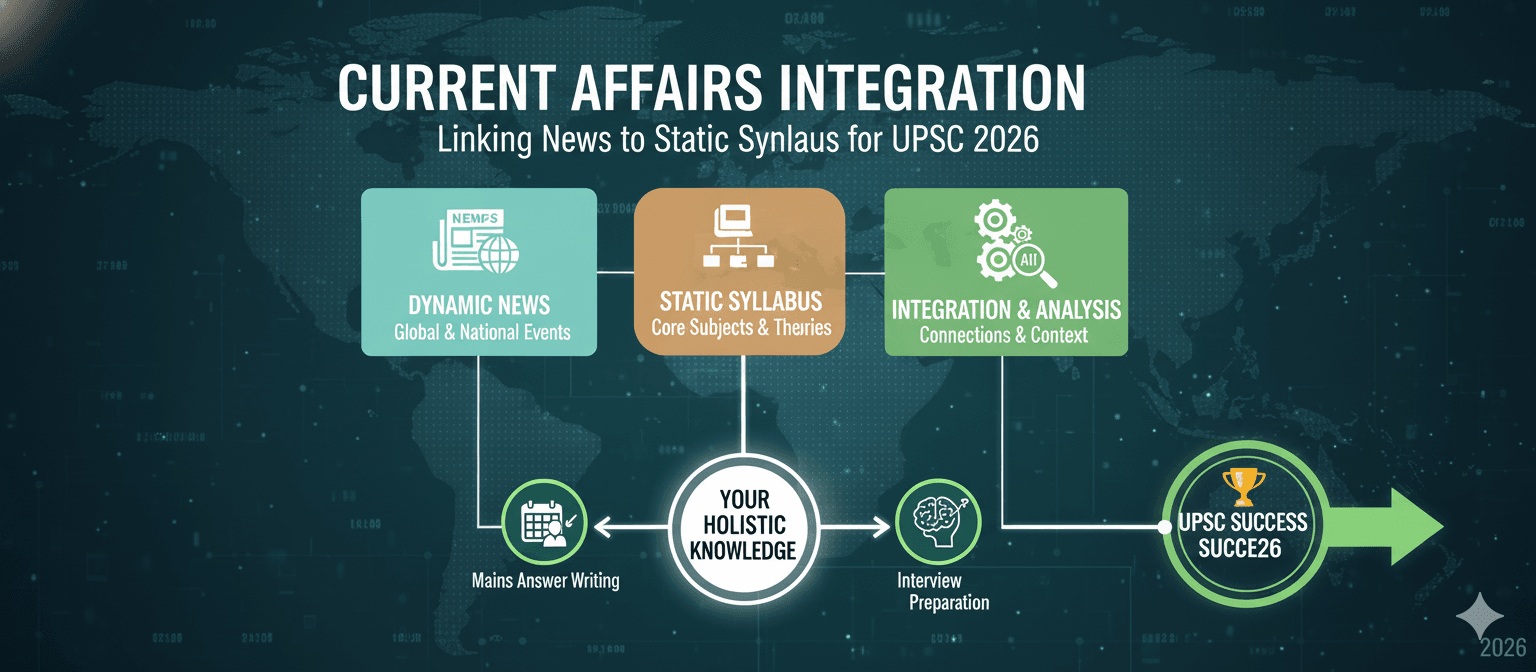
The difference between an average UPSC aspirant and a successful one often lies not in how much they read, but in how well they connect the dots. Current affairs in isolation is just information—but when systematically linked to your static syllabus, it becomes a weapon for scoring in both Prelims and Mains.
This guide breaks down practical integration techniques that top rankers use to convert daily news into exam-ready knowledge.
Why Integration Matters More Than Accumulation
UPSC rarely asks questions in silos. A 2024 Mains question on climate finance wasn't just about Paris Agreement facts—it demanded understanding of India's fiscal federalism, international commitments, and developmental priorities. Aspirants who had linked their climate news to GS-II governance and GS-III economy scored higher.
The exam rewards connected thinking. Your preparation strategy must mirror this reality.
Building Topic-Wise Current Affairs Banks
The foundation of effective integration is organized storage. Instead of chronological note-making (January news, February news), structure your current affairs around syllabus topics.
Create syllabus-mapped folders covering every GS paper topic. When you read about India's semiconductor policy, it doesn't go into a generic "economy" file—it gets tagged under GS-III (Industrial Policy), GS-II (India and its Neighbourhood), and potentially GS-I (Post-independence consolidation) if historical context applies.
Use a three-column format for each entry: the news item, its static syllabus connection, and potential question angles. For example, a news piece on the Finance Commission's recommendations connects to Articles 280-281 (Polity), fiscal federalism debates (Economy), and Centre-State relations (Governance). The question angle might explore whether the current devolution formula adequately addresses regional disparities.
Digital tools accelerate this process. Apps like Notion or simple Google Sheets allow tagging single news items under multiple syllabus sections—something physical notes cannot replicate efficiently.
Linking News to Specific Syllabus Sections
Every news item you read should trigger an automatic question: Which syllabus topic does this illuminate?
For Polity topics, connect constitutional developments with foundational concepts. When Uttarakhand implements its Uniform Civil Code, link it to Article 44 (Directive Principles), federalism debates, and the Constituent Assembly's original intent. This transforms a news headline into a comprehensive answer resource.
For Economy topics, trace policy announcements to their theoretical roots. RBI's stance on inflation targeting connects to monetary policy frameworks, the Monetary Policy Committee's constitutional basis, and India's macroeconomic management challenges. One news piece, multiple syllabus touchpoints.
For Geography and Environment, map events to physical and human geography concepts. The 2024 monsoon patterns connect to Indian climatology, agricultural productivity, food security policies, and even international food trade dynamics.
For International Relations, every diplomatic development has historical precedent. India's engagement with the Global South isn't new—link it to NAM principles, Panchsheel, and post-Cold War foreign policy evolution.
The key is developing this linking instinct through deliberate practice. Initially, explicitly write out connections. Within weeks, your brain will automatically process news through the syllabus lens.
Annual Compilation Methods That Actually Work
Monthly magazines pile up. Daily notes become unwieldy. The solution is structured annual compilation that condenses a year's current affairs into exam-ready format.
Quarterly consolidation prevents last-minute chaos. Every three months, revisit your topic-wise banks and create summary sheets. Identify recurring themes—these often signal UPSC's focus areas. If judicial reforms appeared repeatedly across quarters, expect related questions.
Create "anchor topics" for each GS paper. These are 15-20 themes per paper that attracted maximum news coverage during the year. For GS-III in 2025-26, anchor topics might include green hydrogen, semiconductor manufacturing, and agricultural market reforms. Build comprehensive notes around these anchors, incorporating all related news throughout the year.
Develop fact sheets with exam-ready data. UPSC Mains rewards specific, accurate information. Compile key statistics, committee recommendations, and government targets in quick-reference format. The Economic Survey and India Year Book are goldmines for this purpose.
Backward-forward linkage mapping strengthens retention. For every major policy or event, note its historical origins (backward) and likely future trajectory (forward). The National Education Policy 2020, for instance, links backward to Kothari Commission and forward to India's skill development goals for 2047.
Using Current Affairs in Mains Answer Writing
Integration is only valuable if it translates into better answers. Current affairs serve three functions in Mains responses.
As evidence for arguments, contemporary examples add weight to your analysis. An answer on cooperative federalism gains credibility when you cite recent GST Council decisions or inter-state water disputes. Examiners notice when theoretical concepts are grounded in current realities.
As case studies for application, news events demonstrate your ability to apply concepts. Discussing judicial activism? Reference recent Supreme Court interventions in environmental or electoral matters. This shows conceptual understanding beyond textbook definitions.
As hooks for introduction and conclusion, a well-placed current reference creates strong opening impact. Beginning an answer on urbanization challenges with recent smart cities data immediately signals updated preparation. Conclusions that connect to ongoing policy initiatives demonstrate forward-thinking analysis.
Maintain balance. Current affairs should enhance static content, not replace it. Answers overloaded with news references but lacking conceptual depth score poorly. The ideal ratio is approximately 70% static foundation with 30% current affairs enrichment.
Common Integration Mistakes to Avoid
Forcing connections that don't exist. Not every news item links to every syllabus topic. Forced linkages confuse rather than clarify. Be selective and genuine in your connections.
Neglecting static foundations. Some aspirants become so focused on current affairs that they skip standard texts. Remember—current affairs is the building's decoration, not its foundation. Laxmikanth for Polity, NCERTs for basics, and standard Economy texts remain non-negotiable.
Information overload without synthesis. Reading five newspapers daily is pointless if you cannot recall key points during the exam. Quality of processing beats quantity of consumption every time.
Final Takeaway
Current affairs integration isn't an advanced technique reserved for later preparation stages. Start building your topic-wise banks from day one. The aspirant who begins linking news to syllabus in June 2025 arrives at UPSC 2026 with a year's worth of connected, consolidated, exam-ready material.
The news you read tomorrow is potential answer content. Process it strategically.
