
GRE Word Problems & Quant Comparison: Strategies That Work
5 min read
Dec 22, 2025
Understanding the Challenge
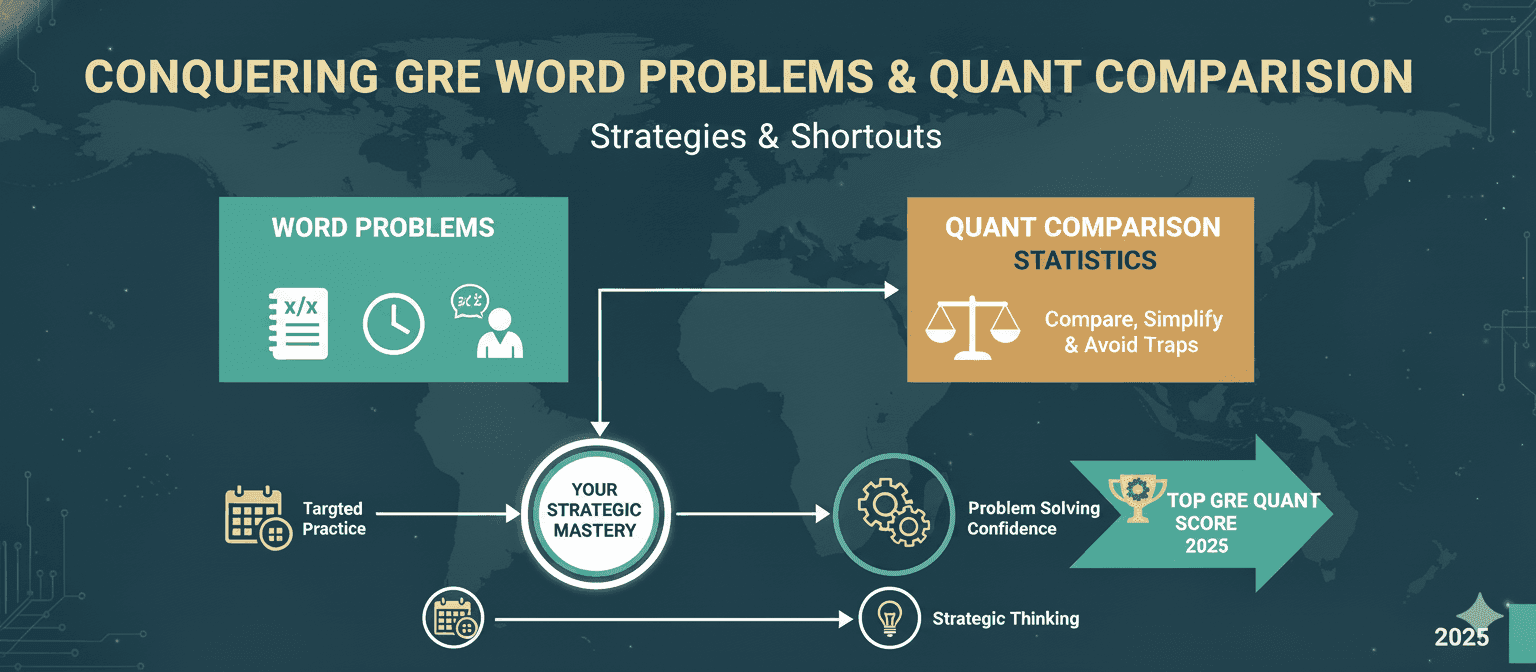
Word problems and quantitative comparison questions form the backbone of GRE Quant. While formulae and concepts matter, these question types test something deeper—your ability to translate language into logic, compare information strategically, and avoid cleverly designed traps.
Most aspirants struggle not because they lack mathematical knowledge, but because they rush through reading, misinterpret what's being asked, or fall for answer choices designed to punish careless reasoning.
Let's break down both question types with strategies that actually work.
Decoding GRE Word Problems
Word problems wrap mathematical concepts in real-world scenarios. The GRE tests whether you can extract relevant information, ignore distractions, and apply the right approach.
Step 1: Read Actively, Not Passively
Don't just skim. Read each sentence like it contains a clue. Ask yourself:
- What is being asked?
- What information is given?
- What's irrelevant?
Underline key numbers, relationships, and the actual question. This prevents you from solving for the wrong variable—a common mistake that costs easy points.
Step 2: Translate Words into Equations
Create a mental or written map. If the problem says "Raj's age is three years more than twice Priya's age," write:
R = 2P + 3
Building equations from language is a skill. Practice it deliberately. The more you do this, the faster and more accurate you become.
Step 3: Identify the Question Type
Is it rates and work? Ratios? Probability? Recognising the category helps you recall the right formula or approach instantly.
For instance, distance-rate-time problems always revolve around D = R × T. Mixture problems use weighted averages. Knowing this upfront saves precious seconds.
Step 4: Estimate Before You Calculate
Sometimes, calculating exact values wastes time. If the question asks "approximately how many," or if answer choices are far apart, estimate aggressively.
For example, if you need to find 23% of 487, think: "About 25% of 500 = 125." This narrows down answer choices immediately.
Step 5: Check Your Answer Against the Question
After solving, pause. Did you answer what was asked? If the question asks for "how many more," did you subtract? If it asks for a percentage, did you convert?
This five-second check prevents silly errors that haunt post-test regret sessions.
Mastering Quantitative Comparison Questions
Quantitative comparison (QC) questions ask you to compare two quantities—Quantity A and Quantity B—and choose:
(A) Quantity A is greater
(B) Quantity B is greater
(C) The two quantities are equal
(D) The relationship cannot be determined
These questions reward strategic thinking over calculation.
Strategy 1: Don't Calculate—Compare
Your goal isn't to find exact values. It's to determine which quantity is larger. This mindset shift is crucial.
If both quantities involve variables, try plugging in smart numbers. Use 0, 1, -1, or fractions to test different scenarios. If the relationship changes, the answer is (D).
Strategy 2: Simplify Both Sides Simultaneously
If Quantity A is 3x + 5 and Quantity B is 3x + 7, subtract 3x from both sides mentally. Now you're comparing 5 and 7. Done.
This technique works when both quantities share common terms. Eliminate what's identical and focus on the difference.
Strategy 3: Test Edge Cases
Variables can behave differently depending on whether they're positive, negative, zero, or fractional. Always test:
- Positive integers
- Negative numbers
- Zero
- Fractions between 0 and 1
If the relationship holds across all cases, you've found your answer. If it flips, choose (D).
Strategy 4: Beware of Hidden Assumptions
The GRE loves to trick you into assuming things. If a variable is described as "a number," don't assume it's positive. If it says "integer," remember negatives count too.
Read the given information carefully. What's stated explicitly? What are you assuming on your own?
Strategy 5: Recognise "Cannot Be Determined" Patterns
Answer choice (D) appears when:
- The relationship changes based on variable values
- Not enough information is provided
- The question involves inequalities or ranges
Don't force an answer if you're unsure. Test cases methodically.
Common Pitfalls to Avoid
Rushing through the setup. Taking 10 extra seconds to organise your thoughts saves minutes of recalculation later.
Ignoring units. If one quantity is in hours and another in minutes, convert before comparing.
Overthinking. Sometimes the simplest approach is correct. Trust your instincts when a solution feels too complicated.
Not practicing variety. Word problems span multiple topics—geometry, algebra, statistics. Expose yourself to all types regularly. Some aspirants find it easier to stay consistent using structured practice tools like PrepAiro, which offers topic-wise drills and adaptive question sets.
Building Speed Without Sacrificing Accuracy
Speed comes from pattern recognition, not frantic solving. The more problems you solve, the faster you identify question types and recall strategies.
Set mini-goals. This week, master rate problems. Next week, focus on ratio questions. Layered learning builds confidence and reduces test-day panic.
Time yourself, but don't obsess. If a question takes over two minutes, mark it and move on. Returning with fresh eyes often reveals the shortcut you missed.
Final Thoughts
GRE Quant isn't about knowing every formula—it's about knowing which formula to use, when to estimate, and how to avoid traps. Word problems and quantitative comparison questions reward clarity, strategy, and practice.
Start with understanding. Then build speed. Then refine accuracy. That sequence matters.
Every problem you solve is a pattern learned, a trap avoided, a second saved. Keep practising with intention, not just volume, and you'll walk into the test centre knowing you're ready.
FAQ Section
Q1: How do I avoid silly mistakes in GRE word problems?
Read the question twice, underline what's being asked, and always verify your final answer matches the question. Taking five extra seconds to check prevents careless errors that cost points.
Q2: What's the fastest way to solve quantitative comparison questions?
Don't calculate exact values—compare directly. Simplify both quantities simultaneously, test edge cases with smart numbers (0, 1, -1, fractions), and recognise when the relationship cannot be determined.
Q3: Should I memorise formulas for every word problem type?
Focus on understanding core concepts like distance-rate-time, ratios, percentages, and weighted averages. Recognition comes from practice—solving diverse problems helps you recall the right approach instinctively.
Q4: How many word problems should I practice daily?
Quality over quantity. Solve 10-15 varied problems daily with full focus. Analyse mistakes, understand why you got them wrong, and revisit similar questions until the pattern clicks.
Q5: When should I choose "Cannot Be Determined" in quantitative comparison?
Choose (D) when the relationship between quantities changes based on different values of variables, or when insufficient information is provided. Always test multiple cases before deciding.
Q6: How can I improve my speed on GRE Quant without losing accuracy?
Build speed through pattern recognition, not rushing. Practice topic-wise, time individual questions, and learn when to estimate versus calculate exactly. Speed develops naturally with consistent, focused practice.