
6-Month GRE Prep Roadmap: Science-Backed Study Plan for 2025
5 min read
Dec 15, 2025
Most GRE prep advice treats six months like an extended cram session—the same tactics stretched thinner. That's backwards. Six months isn't just more time; it's a fundamentally different kind of preparation that rewires how your brain processes and retains information.
Here's why this matters: Research by cognitive scientist Sean Kang demonstrates that spaced learning produces dramatically superior long-term retention compared to massed practice. In one foundational study, students who learned material across multiple sessions separated by days outperformed immediate-repetition groups on tests four weeks later—even though the cramming group initially scored slightly higher.
Your six-month timeline isn't a luxury. It's the optimal window for building genuine, lasting competence rather than fragile test-day performance.
Why Six Months Actually Works (The Science)
The GRE isn't testing what you can temporarily hold in working memory. It's measuring reasoning patterns that need to become automatic. This requires memory consolidation—a process where neural connections strengthen during the intervals between study sessions.
Here's the key insight most prep guides miss: the spacing effect works because each review triggers retrieval and reactivation of existing memory traces, making them progressively more durable. One hour of study distributed across four days beats four hours crammed into one day, according to research published in Nature Reviews Neuroscience.
For GRE preparation specifically, six months allows three critical cognitive processes:
- Initial encoding of concepts and strategies
- Consolidation through spaced review intervals
- Automaticity development where reasoning patterns become second-nature
The 2025 GRE's shorter two-hour format actually amplifies these benefits. With less time for fatigue to accumulate, the skills you've genuinely internalized—not just temporarily memorized—become your primary advantage.
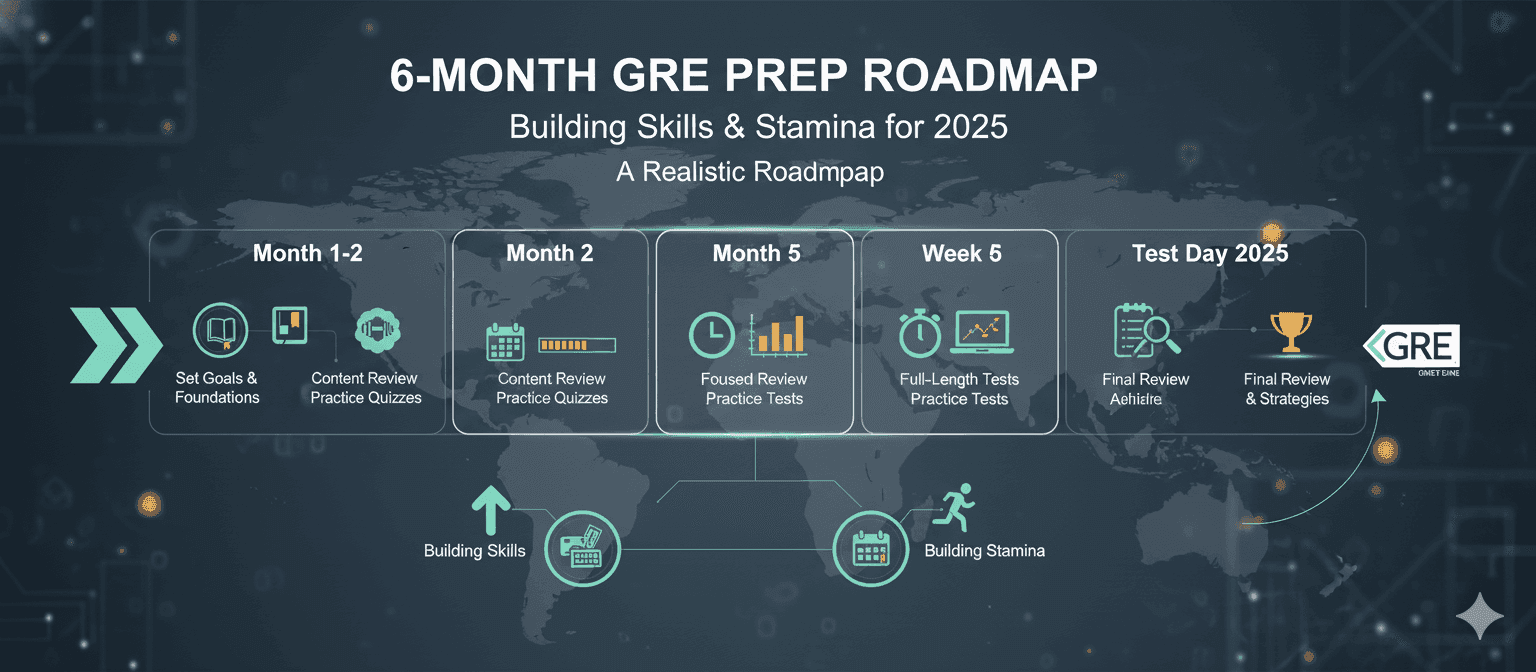
The Three-Phase Roadmap
Phase 1: Foundation Building (Months 1-2)
Goal: Establish baseline and master fundamentals
This phase prioritizes understanding over speed. You're building the neural infrastructure that later phases will reinforce.
Quant Focus:
- Core arithmetic, algebra, and geometry concepts
- Data interpretation fundamentals
- Problem-recognition patterns (learning to identify question types)
Verbal Focus:
- Vocabulary acquisition (25-30 words daily using spaced repetition)
- Reading comprehension strategies for academic passages
- Sentence structure analysis
Weekly Structure: Distribute 10-12 hours across 4-5 days. Avoid consecutive-day coverage of the same topic—the spacing between sessions is where consolidation happens.
Key Milestone: Take a full diagnostic at Month 2's end. This isn't just measuring progress; it's calibrating your brain's pattern recognition against real test conditions.
Phase 2: Skill Deepening (Months 3-4)
Goal: Build accuracy and strategic flexibility
Now you're strengthening existing memory traces while adding complexity. Research shows that reactivating learned material at increasing intervals produces the most durable retention.
Quant Focus:
- Advanced problem types (combinations, probability, coordinate geometry)
- Multiple-approach solutions (building strategic flexibility)
- Timed practice sets (developing pacing intuition)
Verbal Focus:
- Complex reading passages (scientific, philosophical, historical)
- Text completion and sentence equivalence strategies
- Vocabulary reinforcement through contextual application
Weekly Structure: Maintain 12-15 hours across 5 days. Introduce weekly timed sections to build stamina without overwhelming cognitive resources.
Critical Practice: Build an error log. The questions you miss aren't failures—they're your brain's signal about which neural pathways need reinforcement.
Phase 3: Test Simulation (Months 5-6)
Goal: Develop automaticity and test-day readiness
This phase converts accumulated knowledge into fluid, automatic performance. You're training your brain to retrieve strategies instantly under time pressure.
Full-Test Practice:
- Complete practice tests every 7-10 days
- Simulate exact test conditions (timing, breaks, environment)
- Review sessions within 24-48 hours of each test
Targeted Refinement:
- Focus remaining study on your specific weak areas
- Practice the most challenging question types until they feel routine
- Develop personal decision rules for time management
The Final Week: Reduce intensity. Your brain needs consolidation time before test day. Light review of strategies and high-frequency vocabulary—no new learning.
What Makes This Different
Most six-month plans simply stretch three-month content thinner. The approach above works differently because it's designed around how memory actually forms.
The critical difference: phases build on each other neurologically, not just topically. Phase 1 creates the memory traces. Phase 2 strengthens them through spaced retrieval. Phase 3 transforms them into automatic responses.
This is why the seemingly relaxed early pace matters. Research on skill acquisition shows that less intense distributed training produces faster and more accurate performance than cramming, even when total study time is equal.
Adapting for Your Schedule
Working professionals and students with heavy course loads can modify this framework:
- Reduce daily hours, maintain spacing: Four 90-minute sessions weekly beats two 6-hour weekends
- Prioritize consistency over intensity: Showing up for 45 minutes daily outperforms sporadic marathon sessions
- Use commute and breaks strategically: Vocabulary review via flashcard apps keeps spaced repetition active
The key principle remains: distributed practice with adequate intervals between sessions. Your brain builds stronger connections when it has time to consolidate between study bouts.
Your Next Step
Start with an honest diagnostic, not to judge yourself, but to give your six-month journey a clear starting point. The gap between your baseline and target score determines how aggressively you'll need to build during each phase.
Six months from now, you won't just know GRE material. You'll have internalized reasoning patterns that the test is actually measuring. That's the difference between fragile cramming and genuine preparation, and it's exactly what the research supports.
PrepAiro's approach to GRE preparation emphasizes cognitive science principles over generic test-prep tactics. Our adaptive practice platform is designed around the same spaced repetition research referenced in this article.