Mastering Current Affairs for UPSC CSE 2026: From Newspaper Reading to Answer Writing Excellence
10 min read
Feb 03, 2026
Why Most Aspirants Fail at Current Affairs (And How You Won't)
Every UPSC aspirant reads the newspaper. Very few actually use it.
If you feel:
- You read The Hindu / Indian Express daily but can't recall content
- Current affairs feel endless and unmanageable
- Mains answers sound generic despite "good preparation"
- Prelims questions feel unfamiliar even after months of reading
…this guide is for you.
Current Affairs is not about reading more, it's about reading right.
UPSC doesn't test "what happened yesterday", it tests why it happened, how it matters, and what it means for governance.
This blog is a complete, end-to-end system:
- How UPSC actually uses current affairs
- How to read newspapers like a topper
- How to convert news into syllabus-linked notes
- How to use CA for Prelims + Mains + Interview
- PYQ-backed evidence, NCERT linkages, and insider mistakes to avoid
Bookmark this. You'll return to it all year.
Table of Contents
- How UPSC Uses Current Affairs (The Reality)
- Newspaper Selection: What to Read & What to Skip
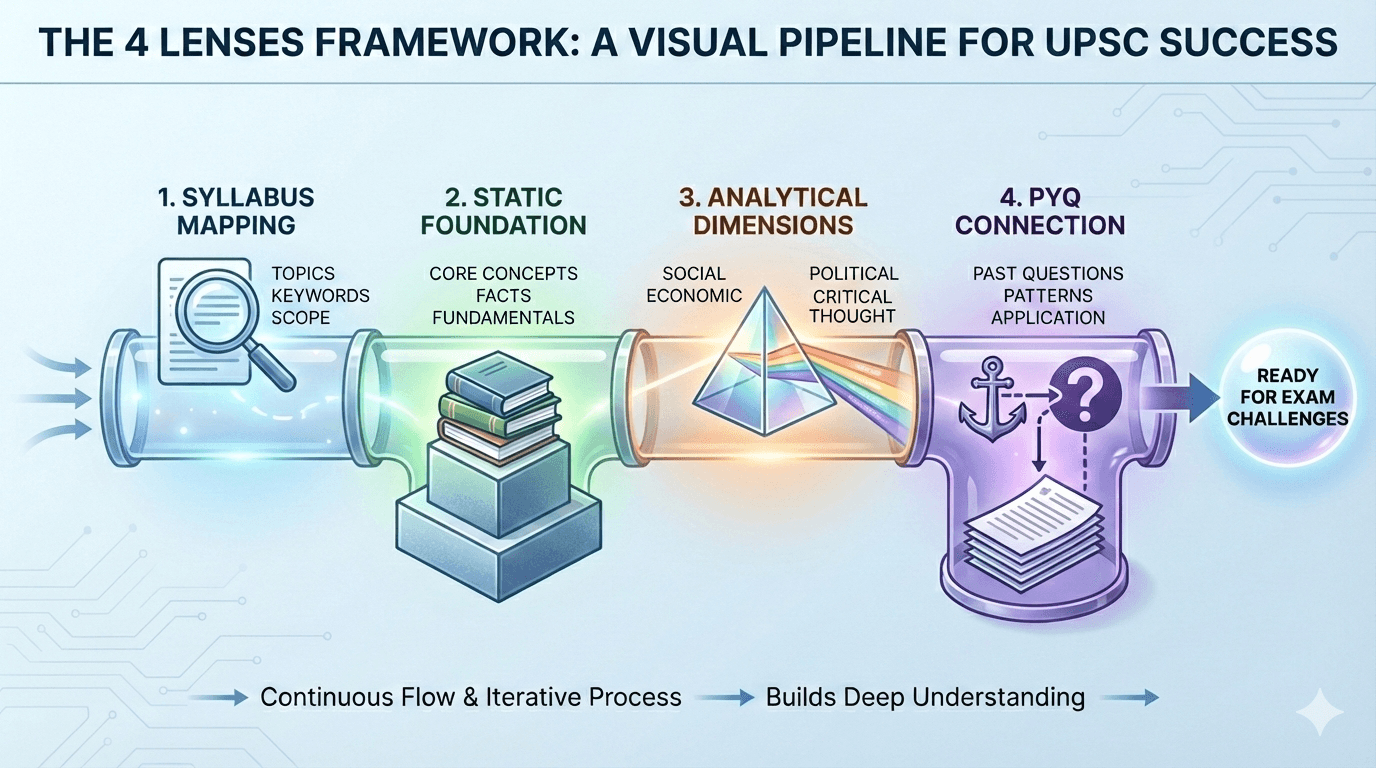
- The 4-Lens Newspaper Reading Framework
- Linking Current Affairs to UPSC Syllabus (Step-by-Step)
- Note-Making That Actually Works
- Prelims Strategy: Turning News into MCQs
- Mains Strategy: News → 250-word Answers
- PYQ Analysis: How UPSC Recycles Issues
- Common Mistakes Aspirants Make (I Made Them Too)
- Monthly & Daily CA Workflow (Toppers' System)
- FAQs on Current Affairs Preparation
- Final Checklist + PrepAiro CTA
1. How UPSC Uses Current Affairs (The Reality)
UPSC does NOT ask:
"What happened?"
UPSC asks:
- Why did it happen?
- What structural issue does it represent?
- What are the constitutional, economic, ethical implications?
- What solutions are feasible in Indian conditions?
Evidence from PYQs
Example – GS II (2023):
"The Indian Constitution has provisions for holding joint sessions of Parliament. Explain the rationale and its relevance today."
This question:
- Triggered by frequent legislative deadlocks in news
- Rooted in Polity static (NCERT + Laxmikanth)
- Framed as current relevance + analysis
👉 Current Affairs is the bridge between static syllabus and contemporary governance.
2. Newspaper Selection: What to Read & What to Skip
Ideal Sources (Maximum 2)
- The Hindu OR Indian Express (not both)
- PIB (selectively)
- Monthly CA compilation (revision tool, not primary source)
What to Avoid
- Multiple newspapers
- Telegram "breaking news" channels
- Reading editorials without syllabus context
Insider Tip
If an article cannot be linked to any GS paper or Essay theme, skip it guilt-free. UPSC rewards depth, not volume.
3. The 4-Lens Newspaper Reading Framework
This framework alone can cut your reading time by 50%.
For every relevant article, ask:
Lens 1: Syllabus Mapping
- GS I → Society, Geography, History
- GS II → Polity, Governance, IR
- GS III → Economy, Environment, Security
- GS IV → Ethics, case studies
- Essay themes
If no mapping → skip.
Lens 2: Static Foundation
Ask:
- Which NCERT chapter does this relate to?
- Is there a constitutional article, committee, theory behind this?
Example:
- News on federal disputes →
- Polity NCERT Class XI, "Federalism" (Ch. 8)
- Laxmikanth: Centre–State Relations
Lens 3: Analytical Dimensions
Break news into:
- Background
- Stakeholders
- Challenges
- Government response
- Way forward
This is directly reusable in Mains answers.
Lens 4: PYQ Connection
Search:
- Has UPSC asked something similar before?
- Can this become a "Why / Critically examine / Discuss" question?
4. Linking Current Affairs to UPSC Syllabus (Step-by-Step)
Example: News on Climate Finance
| Aspect | Details |
|---|---|
| News | Green Climate Fund pledges increased |
| GS Paper | GS III – Environment |
| Static Base | • NCERT Geography Class XII – Climate Change chapter • IPCC basics |
| Mains Angles | • Equity vs responsibility • India's climate commitments • Developed vs developing nations debate |
This is how one article = 3 questions worth preparation.
5. Note-Making That Actually Works
❌ The Wrong Way
- Daily bulky notes
- Copy-pasting articles
- Chronological storage
✅ The Right Way (Topper Method)
Ideal Note Format (One Page Max)
Topic: Data Protection
- Why in news: New DPDP Act provisions
- Static base: Privacy (Article 21), Puttaswamy judgment
- Key issues: Consent, state exemptions
- Way forward: Global best practices
Store notes topic-wise, not date-wise.
6. Prelims Strategy: Turning News into MCQs
UPSC Prelims:
- Tests conceptual clarity
- Uses current affairs as camouflage
How to Prepare
- Focus on terms, institutions, reports
- Link facts to static concepts
- Practice elimination, not memorization
Example: Question on Global Methane Pledge
UPSC tested:
- Methane's impact vs CO₂
- Voluntary nature of pledge
7. Mains Strategy: News → 250-word Answers
Perfect Answer Structure
- Intro: Context from current affairs
- Body:
- Dimensions (social, economic, political)
- Data/examples
- Conclusion: Way forward + optimism
Example Line
"Recent debates on cooperative federalism highlight the need to rebalance Centre–State relations in line with constitutional morality."
8. PYQ Analysis: How UPSC Recycles Issues
Repeating Themes:
- Federalism
- Climate change
- Social justice
- Technology & governance
- Ethics in public administration
If an issue appears in news 2–3 years in a row, expect a question.
9. Common Mistakes Aspirants Make (I Made Them Too)
Mistake 1: Over-reading
Quality > Quantity.
Mistake 2: Ignoring Static
Current affairs without static = hollow answers.
Mistake 3: No Revision Cycle
Monthly consolidation is non-negotiable.
Mistake 4: No Answer Writing
Knowledge unused = marks lost.
10. Daily & Monthly Workflow (Proven System)
Daily (90 minutes)
- Newspaper: 45 min
- Note update: 30 min
- PYQ linkage: 15 min
Monthly
- Revise themes
- Practice 5–6 Mains questions
- Attempt Prelims quizzes
11. FAQs on Current Affairs for UPSC
Q1. How many months of CA is enough? 👉 18 months for Mains, 12 months for Prelims (minimum).
Q2. Are monthly magazines enough? 👉 Only for revision, never as primary source.
Q3. Should beginners read newspapers? 👉 Yes, but with syllabus in hand.
Q4. How to revise current affairs? 👉 Theme-based notes + PYQs.
Q5. Is current affairs the same for Prelims and Mains? 👉 Same source, different usage.
12. Final Checklist (Bookmark This)
- Syllabus-linked reading
- Topic-wise notes
- PYQ integration
- Monthly revision
- Answer writing practice
13. Try PrepAiro's Current Affairs Ecosystem
Turn this strategy into execution with:
- AI-powered syllabus tagging
- PYQ-mapped daily current affairs
- Answer writing evaluation
- Smart quizzes for Prelims
👉 Stop reading more. Start reading smarter.
You might also enjoy reading our related post here: Current Affairs Integration: Linking News to Static Syllabus for UPSC 2026
