The GRE Second-Pass Economy: Why Top Scorers Spend More Time Skipping Questions Than Solving Them
7 min read
Apr 07, 2026
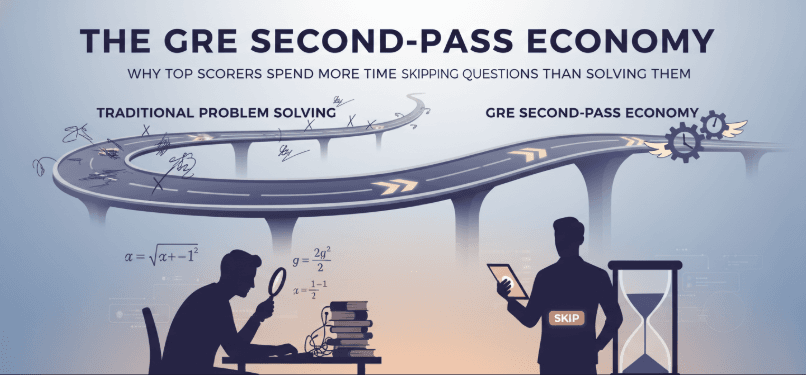
Most GRE advice sounds like this:
“Practice more.”
“Solve faster.”
“Attempt everything.”
It feels productive. It feels disciplined. It also quietly sabotages your score.
Because top GRE scorers aren’t trying to solve everything.
They’re playing a different game entirely.
They treat the test like a marketplace of decisions, where time is currency and questions have different returns.
Welcome to the Second-Pass Economy—where knowing what to skip matters more than knowing what to solve.
🧠 The Myth: “Attempt Everything”
There’s an unspoken pressure during the GRE:
👉 “If I leave a question, I’m losing marks.”
So what happens?
- You wrestle with a tough question for 3 minutes
- You almost get it
- You sink more time into it
- You finally move on… mentally drained
That’s not persistence. That’s poor resource allocation.
Because every extra second you spend on one question is borrowed from another.
💰 How the GRE Rewards Strategic Skipping
Here’s the quiet rule of the GRE:
Not all questions are equal in time cost, but they are equal in score value.
A brutally hard question gives you the same 1 mark as an easy one.
So if:
- Easy question → 40 seconds
- Hard question → 3 minutes
Then spending time evenly is irrational.
Top scorers understand this instinctively.
They don’t chase every question.
They invest in the right ones.
⏱️ Time Arbitrage: Where Scores Are Actually Made
Think like a trader.
You have a fixed budget: ~30 minutes per section.
Now imagine three types of questions:
- 🟢 Easy → High accuracy, low time
- 🟡 Medium → Moderate accuracy, moderate time
- 🔴 Hard → Low accuracy, high time
The insight:
Your score doesn’t come from conquering 🔴 questions.
It comes from maximizing returns on 🟢 and 🟡 questions.
That’s time arbitrage.
You’re shifting time away from low-return problems to high-return ones.
🎯 The 3-Bucket First-Pass System
Top scorers don’t “attempt all questions.”
They filter them instantly.
On the first pass, every question goes into one of three buckets:
🟢 1. Solve (Under ~60 Seconds)
- You understand the question immediately
- The path is clear
- No heavy computation or confusion
👉 Solve and move on. No second-guessing.
🟡 2. Flag (Uncertain but Doable)
- You partially understand it
- Might take 90–120 seconds
- Some ambiguity exists
👉 Make a quick attempt or mark it for review.
🔴 3. Skip (Time Sink)
- Confusing wording
- Heavy calculation
- No clear approach
👉 Skip immediately. No emotional debate.
This system is ruthless. And that’s why it works.
📉 The Hidden Cost of “Ego Solving”
Every test-taker has felt this:
“I should be able to solve this.”
So you stay.
You push.
You refuse to skip.
That’s ego solving.
And it comes with three costs:
- Time Drain – You lose minutes on one question
- Mental Fatigue – Your brain gets overloaded
- Score Ripple Effect – Easier questions later suffer
Top scorers detach from ego.
They don’t ask:
“Can I solve this?”
They ask:
“Is this worth solving right now?”
🔁 Why Second-Pass Accuracy Is Higher
Here’s the counterintuitive magic:
👉 You’re more accurate on the second pass than the first.
Why?
Because:
- Your brain has seen the question once already
- Anxiety is lower (you’ve secured easier marks)
- You approach it with fresh context
Questions that looked impossible often become manageable.
Not because you got smarter.
Because you got strategic.
🧩 How This Improves Speed AND Score Stability
Most people think skipping slows them down.
It does the opposite.
Here’s what happens:
- You clear easy questions quickly → early confidence boost
- You avoid time traps → consistent pacing
- You return with clarity → higher accuracy
Result:
- Fewer careless mistakes
- Better time distribution
- More predictable scores across mocks
Your performance becomes stable, not volatile.
🛠️ Building Your Second-Pass System
This isn’t just a concept. It’s a trainable system.
Step 1: Set a “Skip Threshold”
Decide in advance:
👉 “If I don’t see a path in 20–30 seconds, I skip.”
No exceptions.
Step 2: Use Visual Marking
Flag questions clearly so you can return fast.
Your second pass should feel like:
“Targeted cleanup,” not “random revisiting.”
Step 3: Allocate Time for Pass 2
Don’t let the second pass be accidental.
Plan it.
Example:
- First pass → 20 minutes
- Second pass → 10 minutes
Step 4: Train Emotional Discipline
The hardest part isn’t strategy.
It’s letting go.
Skipping feels uncomfortable at first.
Then it becomes powerful.
🧪 Practice Framework: Train Like a Decision-Maker
Stop practicing like this:
❌ “Let me solve every question perfectly.”
Start practicing like this:
✅ “Let me decide which questions deserve my time.”
Try this in your next mock:
- Force yourself to skip 3–5 questions in the first pass
- Track how much time you save
- Measure second-pass accuracy
You’ll notice something surprising:
Your score doesn’t drop.
It often goes up.
🎯 Final Takeaway
The GRE isn’t just testing how much you know.
It’s testing how well you allocate limited time under pressure.
Top scorers don’t win by solving more.
They win by skipping smarter.
They treat time like capital.
Questions like investments.
And decisions like strategy.
So the next time you face a tough question, pause.
Don’t ask:
“How do I solve this?”
Ask:
“Should I solve this now?”
Because in the GRE economy…
The richest scores don’t come from effort alone.
They come from precision in where that effort goes.
Table of content
Share
Written By

Suggested Posts

Why Germany's Low Cost MS Degrees Are Reshaping Indian Study Abroad Dreams
Jun 26, 2026

Why JEE Toppers Struggle With GRE Verbal More Than Quant
Jun 25, 2026

Can Your GRE Score Pay Back Your Study Abroad Investment?
Jun 25, 2026

Europe’s GRE Route Indian Students Are Choosing in 2026
Jun 23, 2026

The Hidden GRE Report Most Students Never Use Properly
Jun 22, 2026

The Reading Mistakes Quietly Destroying Your GRE Verbal Score
Jun 21, 2026

The Hidden GRE Tool Most Students Ignore Before Retakes
Jun 20, 2026

The Hidden Verbal Score Killer: Why Reading Comprehension Is Costing You Points
Jun 19, 2026

One GRE Score, Five Countries: The Smart MS Strategy for 2026
Jun 18, 2026

Why Your SOP Can Make or Break a GRE Score in 2026
Jun 18, 2026