The Working Professional's 12-Month UPSC Blueprint
7 min read
Feb 18, 2026
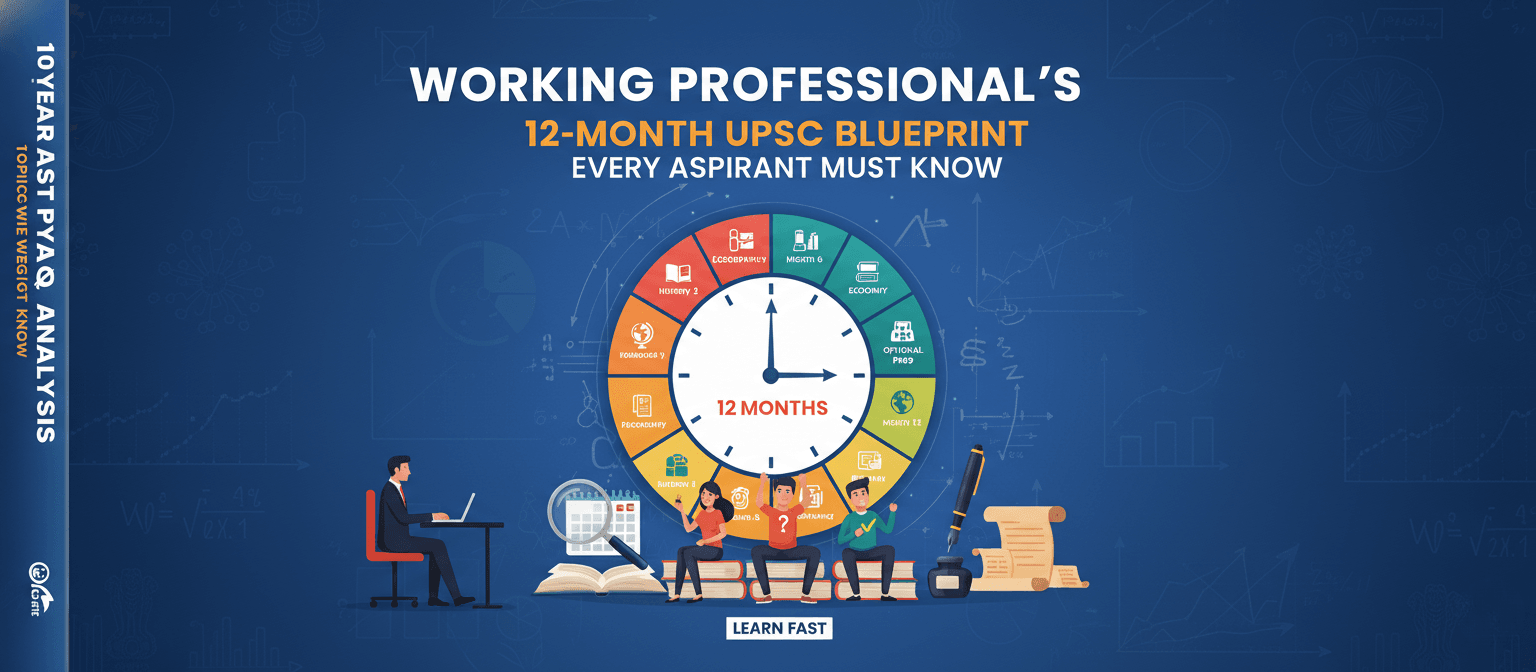
More than 40% of UPSC aspirants are working professionals — yet almost all the study plans, YouTube schedules, and coaching timetables are built for someone with 10–12 hours a day to spare. If you're pulling 8-hour office shifts and still chasing the IAS dream, this blueprint is built for you.
No fluff. No "wake up at 4 AM and grind" advice. Just a realistic, structured 12-month plan that respects your constraints and maximises what you actually have.
The Ground Reality: What You're Working With
Before diving into months, let's be honest about the numbers. Most working professionals can realistically extract 3–4 hours on weekdays and 6–8 hours on weekends. That works out to roughly 1,100–1,200 hours annually — which is sufficient, but only if used with surgical precision.
The biggest mistake working professionals make isn't lack of time. It's using limited time without a clear phase-wise plan, and treating all subjects as equally urgent throughout the year.
Phase 1 (Months 1–3): Foundation Without Overwhelm
Goal: Build conceptual clarity in high-weightage static subjects.
Start with subjects that reward deep understanding over rote learning — Indian Polity, Modern History, and Geography. These three alone account for a substantial chunk of both Prelims and Mains.
- Weekdays: 1 hour reading + 30 mins revision using short notes
- Weekends: 3-hour deep-dive sessions per subject; make your own one-page summaries
- Newspaper: Stick to 30 minutes max — The Hindu or Indian Express. Don't annotate everything. Flag only what connects to syllabus topics.
Tip: Don't start Economics or Environment in Phase 1. Sequencing matters. Polity → History → Geography creates a natural scaffolding for everything else.
Phase 2 (Months 4–6): Expanding the Static Base
Goal: Cover remaining GS subjects and begin integrating Current Affairs.
This is where most working professionals hit their first wall — the syllabus starts feeling endless. Stay the course.
- Add Economics (Indian Economy), Environment & Ecology, and Science & Technology
- Begin maintaining a Current Affairs digest — weekly, not daily. Spend Sunday evening linking news to static topics
- Start solving previous year Prelims questions topic-wise as you finish each subject
A word on optional subjects: If you haven't chosen yet, Month 5 is your deadline. Pick based on overlap with GS (Public Administration, Geography, and Sociology have strong overlap), not passion alone.
Phase 3 (Months 7–9): Prelims-Focused Intensive
Goal: Shift gears to Prelims consolidation and CSAT.
By now your static base exists. The job is to sharpen it, not keep adding.
- Weekdays: 2 hours of MCQ practice (topic-wise, then mixed)
- Weekends: 1 full mock test + detailed analysis session
- Allocate dedicated time for CSAT Paper 2 — don't neglect it. Many working professionals, especially from non-engineering backgrounds, underestimate Paper 2's difficulty.
Use platforms like PrepAiro to track your accuracy trends and identify weak zones efficiently — because you simply can't afford to spend three hours manually analysing a single mock.
Target: Complete at least 15–20 full-length Prelims mocks before the actual exam.
Phase 4 (Months 10–11): Mains Answer Writing
Goal: Develop structured, exam-ready answer writing.
This is the phase most working professionals skip or delay — and it shows in results. Answer writing is a skill, and skills need practice, not just knowledge.
- Write at least 2 answers daily on weekdays (15-marker and 10-marker alternately)
- On weekends, attempt full GS paper simulations — timed, handwritten
- Focus on structure over content initially: Introduction → Body (3–4 points) → Conclusion with a way forward
- Review your answers critically or get them reviewed — vague answers with good content still score poorly
Common working professional mistake: Writing answers that read like office reports — overly formal, bullet-heavy, no analytical flow. UPSC rewards nuanced, balanced perspectives. Practice writing in flowing paragraphs, not just lists.
Phase 5 (Month 12): Revision, Interview Prep Basics & Mental Management
Goal: Consolidate everything; don't introduce new material.
The final month is about revision and confidence, not discovery.
- Revisit your one-page summaries from Phase 1
- Revise current affairs compilations from the full year
- Attempt 5–7 more full mocks to maintain exam temperament
- If Mains results are anticipated, spend 2–3 hours weekly on personality test basics — your work experience is actually an asset in the interview round
The Non-Negotiables for Working Professionals
Beyond the month-wise plan, a few habits separate those who clear UPSC while working from those who don't:
- Protect your weekends ferociously. Social commitments, family obligations, and fatigue are real — but weekend study time is your biggest differentiator.
- Use commute time smartly. 45–60 minutes of daily commute = 4–5 hours of audio-based revision per week (podcasts, recorded lectures, or self-dictated notes).
- Don't take leaves randomly. Plan strategic study leaves around mock test weeks or high-intensity revision phases.
- Manage your manager. Many working professionals clear Prelims and then panic about leave during Mains. Plan this conversation early.
A Note on Realistic Expectations
Clearing UPSC in the first attempt while working full-time is possible — but not the norm. Many successful IAS and IPS officers attempted 2–3 times. What matters is whether each attempt is smarter than the last.
Track your progress, adjust your plan quarterly, and use the right tools to study efficiently. The 12 months outlined here won't be linear — life happens. But having a blueprint means you always know where to return.
PrepAiro is built for aspirants who don't have time to waste — with AI-driven tools that adapt to your pace, identify your gaps, and help you prepare smarter, not just harder.
Before locking your CSAT preparation plan, study this 10-Year CSAT PYQ Analysis to see where the real weightage lies.
