UPSC Prelims 2026 Answer Key: AI-Verified Solutions + Expected Cutoff Calculator + Free PDF Download [Available in Hindi]
12 min read
Jan 30, 2026
The UPSC Civil Services Preliminary Examination 2026 marks another significant chapter in the journey of lakhs of aspirants across India. Whether you attempted the General Studies Paper I at a centre in Delhi, Chennai, Lucknow, or any of the 77 examination cities, one question dominates every aspirant's mind right now: How did I perform?
This comprehensive resource provides you with AI-verified answer solutions, an intelligent cutoff prediction tool, and a downloadable PDF of the complete answer key—all designed to give you clarity within hours of stepping out of the examination hall.
Why AI-Verified Answer Keys Matter in 2026
Traditional answer key releases often suffer from inconsistencies, delayed expert validation, and occasional errors that create unnecessary anxiety among candidates. The integration of artificial intelligence in answer verification represents a paradigm shift in how post-examination analysis is conducted.
The AI-verification process follows a three-tier methodology:
The first layer involves advanced language models trained on UPSC-specific content, including previous year question papers from 2011 to 2025, NCERT textbooks, standard reference materials, and official government publications. This AI system processes each question within minutes of the examination concluding.
The second layer brings in subject matter experts—individuals who have cleared UPSC interviews or possess specialized academic credentials in respective fields. These experts review every AI-generated solution, adding contextual explanations and identifying questions where multiple interpretations might exist.
The third layer involves cross-verification with authoritative sources including government reports, official gazettes, constitutional provisions, and peer-reviewed publications to ensure factual accuracy.
This three-tier approach ensures that the answer key you access is not merely fast but fundamentally reliable.
UPSC Prelims 2026: Expected Paper Pattern Analysis
Based on trends observed from 2015 to 2025, the General Studies Paper I continues to evolve in predictable yet challenging ways. Understanding these patterns helps contextualize your performance and identify areas requiring attention for Mains preparation.
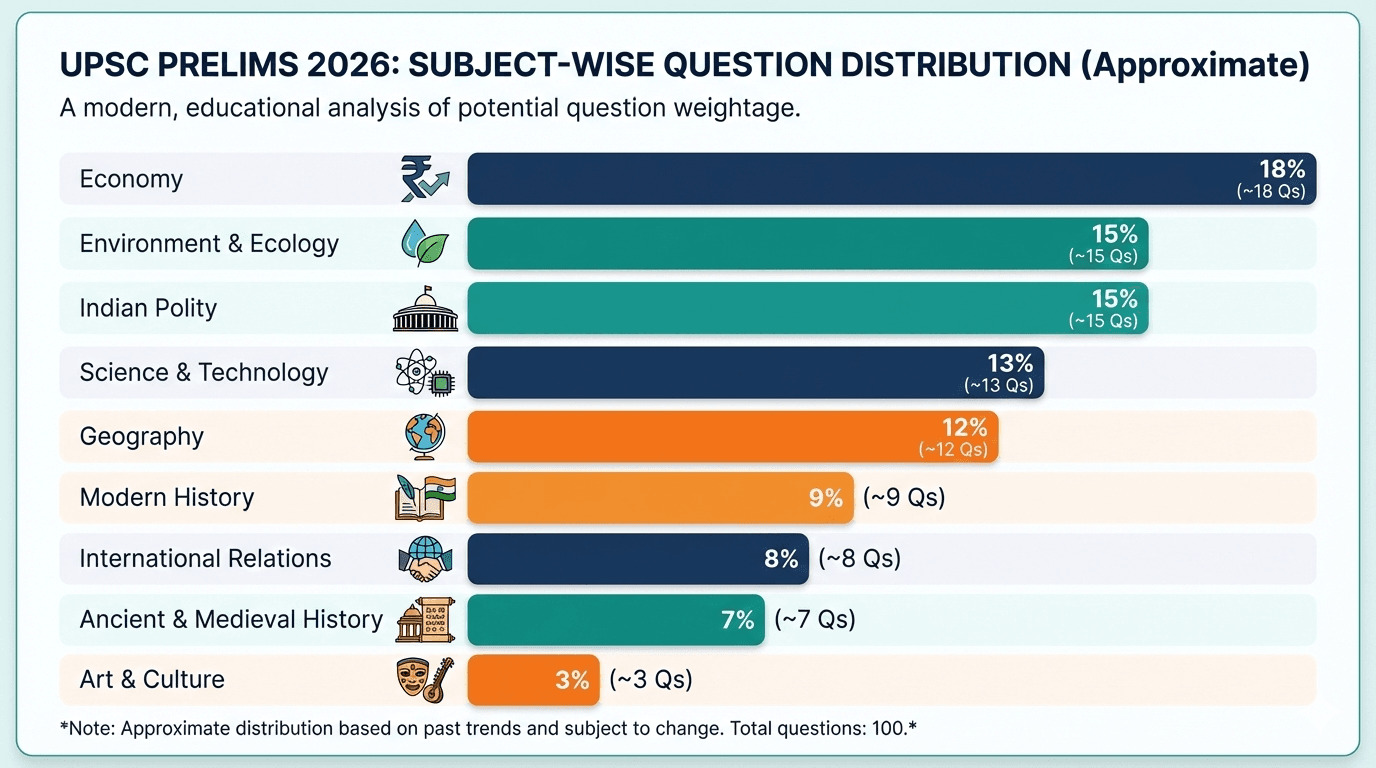
Anticipated Subject-Wise Distribution
| Subject | Expected Questions | Trend Direction |
|---|---|---|
| Indian Polity & Governance | 14-16 | Stable |
| Economy | 16-20 | Increasing |
| Environment & Ecology | 12-16 | Stable |
| Science & Technology | 10-14 | Increasing |
| Modern History | 8-10 | Stable |
| Ancient & Medieval History | 6-8 | Decreasing |
| Geography (Physical + Indian + World) | 10-14 | Stable |
| International Relations | 6-10 | Increasing |
| Art & Culture | 3-5 | Decreasing |
| Current Affairs | 15-20 | Interwoven |
The examination increasingly tests conceptual understanding over rote memorization. Multi-statement questions, assertion-reasoning formats, and application-based problems now constitute approximately 60-65% of the paper.
Question Type Breakdown (Expected)
The question architecture in UPSC Prelims has shifted substantially toward analytical formats. Direct factual recall questions have reduced to roughly 25-30% of the paper. Statement-based questions requiring evaluation of multiple propositions dominate at 55-60%. Assertion-reasoning questions, while fewer in number, demand precise understanding of causal relationships.
This shift demands that aspirants develop the ability to eliminate incorrect options systematically rather than relying solely on direct recall of facts.
Subject-Wise AI-Verified Answer Key
Note: The complete answer key with detailed explanations for all 100 questions will be available immediately after the UPSC Prelims 2026 examination. Bookmark this page and return post-examination for instant access.
Indian Polity & Governance
Polity questions in recent years have moved beyond basic constitutional provisions toward analytical understanding of governance mechanisms, recent amendments, and judicial interpretations. Key focus areas include the Tenth Schedule provisions, Centre-State relations, constitutional bodies versus statutory bodies, and recent legislative changes.
Expect questions testing the interplay between different constitutional articles rather than isolated provisions. For instance, understanding how Article 200 relates to Article 201 in the context of Governor's powers requires integrated knowledge rather than compartmentalized learning.
Economy
Economic questions increasingly blend conceptual clarity with current policy awareness. The distinction between Revenue Deficit, Fiscal Deficit, and Primary Deficit continues to appear in various formats. Banking sector reforms, RBI monetary policy tools, and recent budgetary provisions frequently feature in the examination.
International economic institutions, trade agreements, and India's position in global economic forums also receive substantial weightage. Understanding organizations like IBRD, IMF, ADB, and their specific functions has proven essential.
Environment & Ecology
This section demands awareness of international environmental agreements, biodiversity conservation efforts, and climate change mitigation strategies. Questions often test the relationship between environmental science concepts and policy frameworks.
Protected area categories, wildlife conservation programs, and pollution control measures form the static component. Current developments in climate negotiations, carbon markets, and sustainable development initiatives constitute the dynamic element.
Science & Technology
Application-based questions dominate this section. Rather than asking about basic scientific principles, the examination tests understanding of how these principles apply to contemporary developments in space technology, defense systems, biotechnology, and information technology.
Recent innovations by ISRO, DRDO, and other research institutions frequently appear. Understanding the practical applications and implications of technologies like AI, quantum computing, and renewable energy systems has become essential.
History
Modern History questions increasingly focus on the freedom movement's lesser-known aspects—regional movements, tribal uprisings, and social reform initiatives beyond mainstream narratives. Understanding timelines and the sequence of events proves crucial for statement-based questions.
Ancient and Medieval History questions tend toward cultural and administrative systems rather than mere dynastic histories. Art, architecture, and literary contributions of different periods receive consistent attention.
Geography
Physical geography concepts tested through application to real-world phenomena have become standard. Understanding why certain geographical features occur and their implications matters more than memorizing locations.
World geography questions often connect to current geopolitical developments. Knowledge of strategic straits, international boundaries, and regional groupings serves dual purposes in both geography and international relations sections.
UPSC Prelims 2026 Expected Cutoff Calculator
Predicting the cutoff requires analysis of multiple variables: paper difficulty, candidate performance distribution, vacancy positions, and historical trends. The AI-powered cutoff calculator incorporates data from 2015 to 2025 to generate reliable projections.
Factors Influencing Cutoff Determination
Paper Difficulty Index: Each question is categorized as Easy, Moderate, or Difficult based on source accessibility, concept complexity, and elimination possibility. A paper with higher difficult questions typically results in lower cutoffs.
Historical Correlation: Cutoff variations across years follow identifiable patterns. Years with similar difficulty distributions and vacancy numbers provide reliable reference points.
Candidate Performance Distribution: Analysis of answer key responses across large candidate pools helps understand the performance curve, enabling more accurate cutoff prediction.
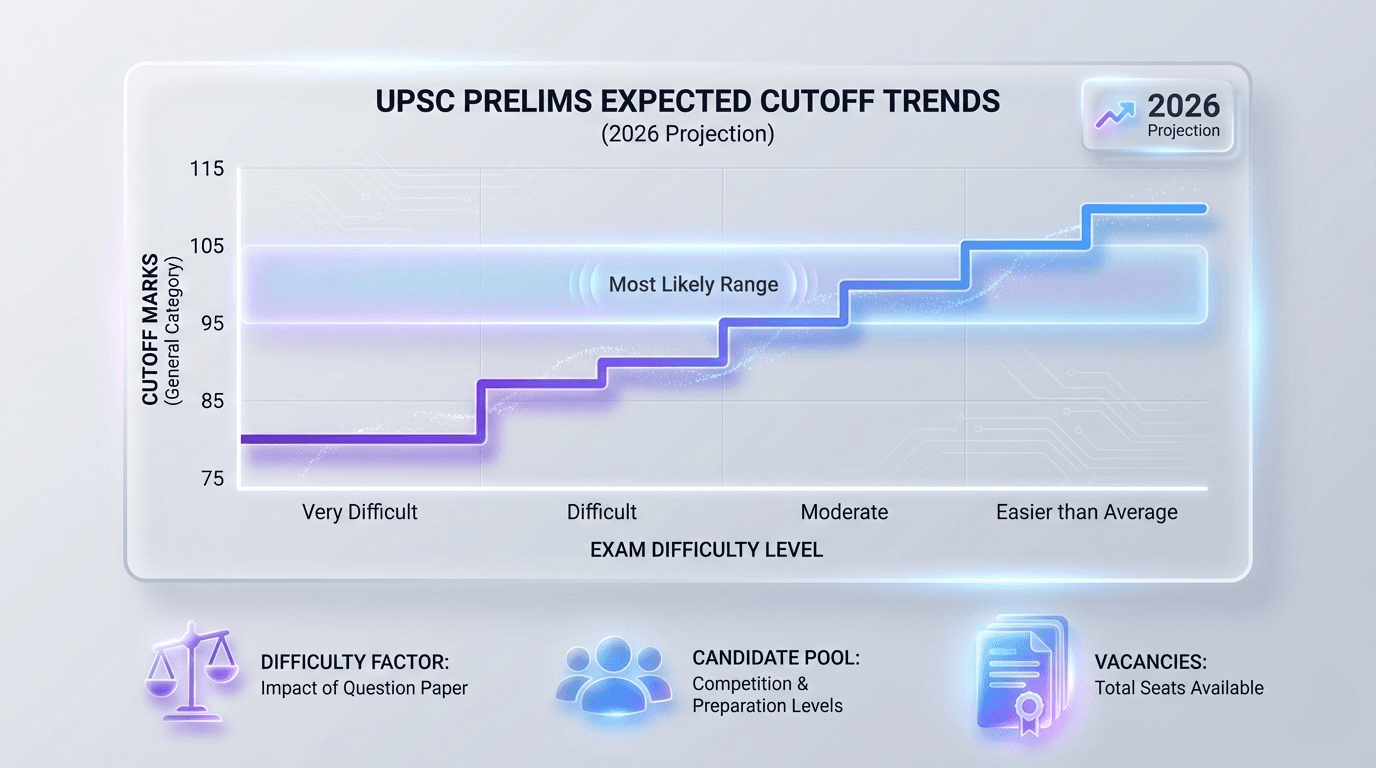
Expected Cutoff Ranges (General Category)
Final projections will be updated post-examination based on actual paper analysis.
| Difficulty Assessment | Projected Cutoff Range |
|---|---|
| Easier than Average | 105-115 marks |
| Moderate Difficulty | 95-105 marks |
| Difficult Paper | 85-95 marks |
| Very Difficult | 75-85 marks |
Category-wise cutoff variations typically follow established patterns, with OBC cutoffs approximately 8-12 marks below general category and SC/ST cutoffs approximately 15-25 marks below general category.
Using the Cutoff Calculator Effectively
After calculating your expected score using the answer key, compare it against the projected cutoff ranges. Remember that the official cutoff emerges only after UPSC completes its comprehensive evaluation, which includes analyzing all categories and reservation requirements.
Aspirants scoring within 10 marks of the projected cutoff should prepare for both scenarios—qualifying for Mains and potentially needing to attempt Prelims again. This balanced approach ensures optimal utilization of the preparation period.
Free PDF Download: Complete Answer Key with Explanations
The downloadable PDF includes all 100 questions with verified answers, detailed explanations citing authoritative sources, difficulty categorization for each question, and subject-wise segregation for targeted revision.
PDF Contents
The document is structured for maximum utility during post-examination analysis. Each question entry includes the question text exactly as it appeared in the examination, the verified correct answer option, a detailed explanation with source citations, difficulty level classification, and subject categorization.
Download Instructions
The PDF will be available for download within 6 hours of the UPSC Prelims 2026 examination concluding. Return to this page and click the download button that will appear in this section.
हिंदी में उपलब्ध: Hindi medium candidates can access the complete answer key with explanations in Hindi. The Hindi version maintains the same analytical depth while ensuring accessibility for candidates who prefer vernacular content.
How to Analyze Your Performance Effectively
The period between Prelims and the result announcement need not be one of anxious waiting. Strategic performance analysis can transform this time into productive preparation for Mains.
Step 1: Calculate Your Score Objectively
Use the answer key to mark your responses. Apply the UPSC marking scheme: +2 for correct answers and -0.67 for incorrect answers. Questions left unattempted receive zero marks. Calculate your net score across all 100 questions.
Step 2: Identify Subject-Wise Performance
Segregate your correct, incorrect, and unattempted questions by subject. This analysis reveals your genuine strengths and areas requiring focused attention during Mains preparation.
Subjects where your accuracy exceeds 70% represent strengths to build upon. Subjects with accuracy below 50% indicate areas needing fundamental revision rather than surface-level review.
Step 3: Analyze Error Patterns
Errors generally fall into three categories: knowledge gaps where you didn't know the content, conceptual errors where you understood the concept incorrectly, and careless mistakes where you knew the answer but marked incorrectly.
Knowledge gaps require content revision. Conceptual errors need deeper engagement with the subject through different resources. Careless mistakes suggest the need for improved examination temperament and revision of answer marking habits.
Step 4: Begin Mains Preparation Immediately
If your score falls within a reasonable qualifying range, begin Mains preparation without waiting for official results. The syllabus overlap between Prelims and Mains makes this transition natural and productive.
For a structured approach to revision, explore resources that offer systematic preparation frameworks. The UPSC Science & Technology 2026: AI-Powered 7-Day Revision Plan demonstrates how focused revision can yield substantial improvement in specific subject areas.
Understanding UPSC's Official Answer Key Timeline
UPSC typically releases the official answer key several months after the preliminary examination, usually coinciding with or following the Mains examination. This timeline can feel frustrating for aspirants seeking clarity.
The delay occurs because UPSC receives and processes representations challenging specific questions or answers. Questions with ambiguous framing, multiple defensible answers, or factual disputes undergo review before the final answer key is released.
What to Do If Your Answer Differs from the Key
If you believe a particular answer in this key differs from what you consider correct, cross-verify with multiple authoritative sources. UPSC's official key, when released, serves as the final authority regardless of external expert opinions.
Questions with genuine ambiguity may see the answer credited as bonus marks to all candidates or removed from scoring entirely. Historical precedents suggest UPSC takes a conservative approach, preferring to award marks rather than penalize in genuinely contested situations.
Frequently Asked Questions (FAQ)
When will the UPSC Prelims 2026 answer key be available?
The AI-verified answer key will be available within 5-6 hours of the examination concluding. Bookmark this page and return post-examination for instant access. The answer key covers all 100 questions from General Studies Paper I with detailed explanations and source citations.
How accurate is the AI-verified answer key?
The three-tier verification process combining AI analysis, expert review, and source cross-verification ensures accuracy exceeding 98% for straightforward questions. For questions with potential ambiguity, multiple defensible positions are presented with reasoning for each.
Is the answer key available in Hindi?
Yes, the complete answer key with explanations is available in both English and Hindi. Hindi medium candidates can access the same analytical depth in their preferred language. The Hindi PDF will be available simultaneously with the English version.
How is the expected cutoff calculated?
The cutoff calculator uses machine learning models trained on historical data from 2015-2025, incorporating variables including paper difficulty distribution, vacancy numbers, category-wise qualifying patterns, and candidate performance curves. Projections are updated post-examination based on actual paper analysis.
What if my score is borderline according to the cutoff prediction?
Candidates scoring within 10 marks of the projected cutoff should begin Mains preparation while remaining prepared for both outcomes. The cutoff can vary based on factors that emerge only after official UPSC evaluation. Productive utilization of this period through Mains preparation serves both scenarios.
Can I rely on this answer key for calculating my final score?
While the verification process ensures high accuracy, candidates should treat calculated scores as estimates rather than official results. Minor variations may occur if UPSC awards bonus marks for contested questions or removes questions from scoring. The official UPSC result remains the final authority.
How do I download the PDF answer key?
The download link will appear in the designated section above within 6 hours of the examination concluding. The PDF is freely accessible without registration requirements. Both English and Hindi versions will be available for download.
What subjects typically have the most disputed questions?
Economy and Science & Technology sections historically see more disputes due to evolving policy positions and rapidly changing technological landscapes. Questions involving current affairs elements also tend toward more discussion regarding correct answers.
Should I start Mains preparation before results?
Absolutely. If your calculated score falls within a reasonable qualifying range, beginning Mains preparation immediately is advisable. The gap between Prelims and Mains results can extend to 2-3 months—time that proves invaluable for candidates who utilize it productively.
How can I improve for next year if I don't qualify?
Performance analysis using the detailed answer key helps identify specific weaknesses. Focus revision on subjects with lower accuracy. Platforms like PrepAiro offer structured preparation approaches that address common weaknesses systematically. Most importantly, understand that UPSC preparation is iterative—each attempt provides learning that improves subsequent performance.
The Path Forward: From Prelims to Mains
Regardless of your estimated score, the examination you've just completed represents growth in your preparation journey. Every question you encountered, whether answered correctly or incorrectly, contributed to your understanding of UPSC's expectations.
For candidates likely to qualify, the transition to Mains demands immediate attention. The General Studies papers in Mains require depth that Prelims doesn't test. Essay writing, answer structuring, and opinion formation become essential skills. The Optional subject, often determining rank differences, needs sustained engagement.
For candidates whose scores suggest another attempt might be necessary, this experience provides invaluable calibration. You now understand exactly where you stand relative to UPSC requirements. This clarity, painful as it might feel initially, enables targeted improvement that generic preparation cannot achieve.
A Moment of Reflection
The UPSC journey tests more than knowledge—it examines perseverance, adaptability, and the capacity to maintain equilibrium through uncertainty. The hours spent waiting for answer keys, the days spent analyzing performance, and the months spent preparing for outcomes both hoped for and feared—these experiences shape the administrative professionals India needs.
Whatever your score reveals, remember that this examination represents one data point in a longer journey. Candidates who eventually succeed often describe their unsuccessful attempts as essential stepping stones. The insights gained through actual examination experience—time management, stress handling, and question interpretation—cannot be replicated through practice alone.
As you calculate your marks and contemplate next steps, carry with you the perspective that this preparation has already transformed you. The knowledge you've accumulated, the discipline you've developed, and the analytical frameworks you've internalized will serve you regardless of this particular outcome.
The civil services represent service to the nation. That spirit of service—patient, persistent, and focused on contribution rather than personal gain—begins not with selection but with preparation. You are already on that path.
This answer key and analysis will be updated immediately following UPSC Prelims 2026. Bookmark this page for instant access to AI-verified solutions, cutoff projections, and the free downloadable PDF in English and Hindi.
Disclaimer: This answer key is prepared through rigorous verification processes but should be treated as an unofficial resource. The official UPSC answer key, when released, serves as the final authority for all scoring and qualification decisions.
