UPSC Polity Strategy 2026: Topic-Wise PYQ Analysis (2014-2024) [88 Questions]
8 min read
Jan 14, 2026
Why Indian Polity is Crucial for UPSC Prelims Success
- A High-Scoring Subject: Indian Polity is one of the most predictable and high-scoring subjects in the UPSC Prelims. A well-executed Polity preparation strategy can significantly boost your overall score.
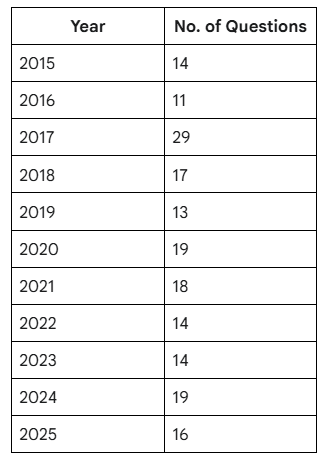
- Significant Weightage: On average, around 15 questions are asked from this section.
- Non-Negotiable: A strong grasp of Polity is crucial for clearing the cut-off.
Number of Question from Polity and Governance (including current affairs) from 2015 to 2025
Complete Topic-wise PYQ Analysis (2015-2025)
A data-backed strategy starts with understanding which topics are most important. Here's a breakdown of the number of questions asked from key topics over the last decade.

1. High-Priority Topics (Must Master - 88 Questions)
Mastering these topics is non-negotiable for a high score.
Parliament & State Legislature (30 Questions): Focus on parliamentary proceedings, the passage of bills, the composition of Lok Sabha and Rajya Sabha, and the roles of the Speaker and Chairman.
Governance & Current Affairs (29 Questions): This area is mostly dynamic. Pay attention to administrative reforms, e-governance, transparency initiatives like the RTI Act, and recent government policy implementations.
Fundamental Rights, Duties & DPSP (29 Questions): Thoroughly cover Articles 12-35 (Fundamental Rights), Article 51A (Fundamental Duties), and Articles 36-51 (Directive Principles). Also, stay updated on recent Supreme Court judgments.
2. Medium-Priority Topics (Strong Command Needed - 45 Questions)
These topics are essential for boosting your score beyond the cut-off.
Government Schemes & Policies (19 Questions): Focus on flagship central government programs and social sector schemes related to health, education, and women.
Union & State Executive (15 Questions): Study the powers and roles of the President and Governor, the Council of Ministers, and the Attorney General.
Political System of India (11 Questions): Understand the federal structure, Centre-State relations, the party system, and the anti-defection law.
3. Foundation Topics (Essential Understanding - 34 Questions)
These topics form the backbone of the subject and should be covered efficiently.
Indian Judiciary (9 Questions): Understand the structure of the Supreme Court and High Courts, judicial review, and the concept of Public Interest Litigation (PIL).
Constitutional & Statutory Bodies (9 Questions): Learn the powers, functions, and constitutional provisions of bodies like the UPSC, Election Commission, and CAG, as well as statutory bodies like the NHRC and Lokpal.
Centre-State Relations & Emergency (7 Questions): Pay special attention to the provisions for President's Rule (Article 356) and the functions of the Finance Commission (Article 280).
4. Basic Topics (Cover Efficiently - 17 Questions)
These topics have a lower weightage but are easy to score if covered properly.
Local Government & Scheduled Areas (6 Questions)
Constitutional Philosophy & Preamble (6 Questions)
Basic Structure & Amendments (6 Questions)
Elections & ECI (4 Questions)
Evolution & Making of Constitution (3 Questions)
Citizenship (1 Question)
Understanding the Nature of UPSC Polity Questions
Difficulty Level: Questions are generally on the easier to medium side. A high accuracy rate (90%+) in this section is highly achievable and should be your goal.
Factual Nature: Questions are highly factual, demanding multiple rigorous revisions to ensure retention.
Current Affairs Connection: A significant portion of questions (15-20%) are directly or indirectly linked to current events. Topics like Governance, Schemes & Policies, and even static areas like the role of the Governor or Speaker, are often inspired by recent news.
Your Preparation Arsenal: The Right Resources
For UPSC preparation, selecting the right study material is half the battle won. Around 70% of the questions can be tackled directly from your primary sources. The remaining questions are covered by current affairs sources, with a small percentage requiring deeper reading from other reference materials.
Primary Sources :
Class 11th NCERTs: Constitution at Work and Political Theory
Indian Polity by Laxmikant (the bible for UPSC Polity)
Current Affairs Sources :
The Hindu or Indian Express (for daily news)
Monthly Current Affairs Magazine
PRS Legislative Research (for understanding legislative bills)
Reference Sources :
DD Basu - Introduction to Constitution of India
Subhash Kashyap - Our Political System
5-Step Action Plan for Polity Mastery for Prelims 2026
Your preparation for Indian Polity should be strategic and disciplined. Follow these key action points to ensure you are on the right track for UPSC Prelims 2026.
1. Sources & Strategy
Integrate Your Reading: Club your study of the Class 11th NCERTs (Constitution at Work and Political Theory) with Indian Polity by Laxmikant. Start with the NCERTs to build a conceptual foundation, then move to Laxmikant for factual depth.
Stick to the Core: Do not deviate from these standard sources to cover random or difficult questions. The time and effort required for those questions is not worth the low return.
2. Focus & Accuracy
Prioritize Easy & Medium Questions: These are your non-negotiable questions and are key to clearing the cut-off. These can be easily handled from your standard sources.
Target High Accuracy: Aim for above 90% accuracy on these easy and medium-level questions. This will provide a significant boost to your overall score.
3. Strategic Note-Making
NCERT Notes: It is highly recommended to make concise notes of the NCERTs.
Tabular Notes for Facts: For highly factual topics like Constitutional and Statutory bodies, make notes in a tabular format from Laxmikant for quick and effective revision.
Value Addition: Consolidate any value addition from current affairs and other reference sources directly into your Laxmikant notes for seamless revision.
4. Revision & Consolidation
Factual Recall: Given the factual nature of the questions, 4-5 revisions of Laxmikant are recommended to ensure you can recall information accurately under exam pressure.
Current Affairs Integration: Regularly follow a monthly current affairs magazine to cover major current affairs-oriented topics like Governance and Government Schemes & Policies. Integrate this information with your static notes.
5. Practice & Mocks
Mock Tests are Crucial: To ensure effective revision and value addition, give at least 7-8 mock tests for Polity. This should include both sectional and full-length tests.
Boost Retention: Attempting questions in mocks often helps you recall the information in the actual exam, especially in the Polity and Governance sections.
Take Your Preparation to the Next Level
Ready to put this strategy into action? Our AI-powered UPSC preparation app can help you execute this plan perfectly. With features like personalized study schedules, revision reminders, and a vast question bank based on Polity PYQ analysis, you can optimize your preparation and achieve your target accuracy.
Download PrepAiro - Our AI Powered UPSC Prep App Today!
SAMPLE DAILY POLITY SLOT (2 hours):
5:00-5:30 PM: Read 1 chapter Laxmikant
5:30-6:00 PM: Make bullet notes in margin
6:00-6:30 PM: Solve 10 PYQs from that chapter
6:30-7:00 PM: Link with today's newspaper current affairs
Weekly: Sunday mock test (15 Polity questions in 20 minutes)
TOP 5 POLITY PREPARATION MISTAKES:
1. Reading Laxmikant only once (need minimum 3 readings)
2. Ignoring Governance section (29 questions in 10 years!)
3. Not solving PYQs topic-wise
4. Memorizing without understanding Article logic
5. Skipping Constitutional Bodies (9 questions = easy marks)
Polity Previous Year Questions (PYQs) — Examples & Answers
Prelims PYQs (Multiple Choice)
Delimitation Commission
Q: How many Delimitation Commissions have been constituted by the Government of India till December 2023?
Options:
(a) One (b) Two (c) Three (d) Four
Answer: (d) Four
Explanation: India has constituted four Delimitation Commissions (1952, 1963, 1973, 2002).
Eighth Schedule to the Constitution
Q: The Constitution (71st Amendment) Act, 1992 amends the Eighth Schedule to include which of the following languages?
Konkani
Manipuri
Nepali
Maithili
Options:
(a) 1, 2 and 3 (b) 1, 2 and 4 (c) 1, 3 and 4 (d) 2, 3 and 4
Answer: (a) 1, 2 and 3
Explanation: Konkani, Manipuri and Nepali were added; Maithili was added later by the 92nd Amendment.
Panchayats (UPSC 2025 Prelims)
Q: Consider the following statements:
I. Panchayats at the intermediate level exist in all States.
II. To be eligible to be a Member of a Panchayat at the intermediate level, a person should attain the age of thirty years.
III. The Chief Minister of a State constitutes a commission to review the internal position of Panchayats.
Which of the statements given above are not correct?
(a) I and II only (b) II and III only (c) I and III only (d) I, II and III
Answer: (d) I, II and III
Explanation:
Intermediate Panchayats may not be formed in States with population ≤20 lakhs.
Minimum age for Panchayat membership is 21 years.
No Constitutional provision empowers the CM alone to constitute such a review commission.
Mains PYQs (Analytical)
Role of Election Commission of India
Q: Discuss the role of the Election Commission of India in ensuring free and fair elections.
Answer Guidance:
Constitutional basis under Article 324 and autonomy of the Commission.
Functions include enforcement of Model Code of Conduct, oversight of election processes, and monitoring expenses.
Challenges in maintaining independence and adapting to evolving electoral issues.
Use this question to link constitutional provisions with real governance analysis.
Doctrine of Basic Structure (example theme)
Q: Explain the doctrine of basic structure of the Constitution. How does it balance Parliament’s amending power and judicial review?
Answer Guidance:
The Supreme Court in Kesavananda Bharati v. State of Kerala held that while Parliament can amend the Constitution under Article 368, it cannot alter its basic structure.
This protects core principles like democracy, secularism, federalism, and rule of law.
(You can cite this example to show how doctrine-oriented questions are framed in Mains.)
How to Use These PYQs in Your Preparation
Topic-wise Learning: Match each PYQ with its constitutional article or concept and build a summarized note.
Practice + Revision: Solve PYQs regularly and revisit explanations to strengthen conceptual clarity.
Analytical Writing for Mains: For analytical questions (like roles of constitutional bodies or doctrinal questions), practice structured answers — introduction, body (with constitutional basis and recent developments), and conclusion.
Frequently Asked Questions
Q1: Which topics should I prioritize to get the maximum score in Polity?
A: Your preparation should be tiered. According to the 10-year analysis, you must master the High-Priority Topics first, as they account for the most questions (88 in the last decade). These are:
Parliament & State Legislature (30 Questions)- Governance & Current Affairs (29 Questions)
- Fundamental Rights, Duties & DPSP (29 Questions)
Once you have a strong command of these, move to the Medium-Priority topics like Government Schemes and the Union & State Executive to secure your score.
Q2: Are the NCERT and Laxmikant enough to cover the Polity syllabus?
A: Yes, for about 70-80% of the paper. The provided strategy emphasizes that your Primary Sources (Class 11th NCERTs and Laxmikant) are the core of your preparation. Most questions, especially the "easy" and "medium" ones, can be directly answered from these books. For the remaining portion, you must integrate a daily newspaper and a monthly magazine to cover the current affairs linkage, particularly for topics like Governance and Schemes. Deeper reference books like D.D. Basu are not required unless you have extra time.
Q3: What is the most effective way to make notes for Indian Polity?
A: The strategy advises against re-writing the entire book. Instead, focus on strategic and concise note-making:
- Make notes from NCERTs as they build your foundational understanding.
- For Laxmikant, use tabular notes for factual topics like Constitutional and Statutory bodies to make revision easier.
- Consolidate value-added points from current affairs or mock tests directly into the margins or on sticky notes within your Laxmikant book. This creates a single, integrated source for revision.
Q4: How many revisions are necessary for a subject as factual as Polity?
A: Given that the questions are highly factual and demand precise recall, a minimum of 4-5 rigorous revisions of Laxmikant is recommended. This ensures that you can remember specific details accurately under exam pressure and achieve the target accuracy of over 90% in the easy and medium-level questions.
Q5: How do I handle the current affairs questions in Polity?
A: A significant portion of questions (around 15-20%) are linked to current events. Your strategy should be to:
Read a good newspaper daily (The Hindu or Indian Express).- Follow a monthly current affairs magazine to get consolidated information on topics like Governance and Government Schemes.
- Use resources like PRS Legislative Research to understand new bills and acts.
- Crucially, integrate this current knowledge with your static notes. If the Governor's role is in the news, revise the "Governor" chapter from Laxmikant.
Q6: What kind of accuracy should I aim for in the Polity section?
A: The questions in Indian Polity are generally considered to be on the easier to medium side of the difficulty spectrum. Therefore, this is a high-scoring section where you cannot afford to make silly mistakes. You should aim for a very high accuracy rate of 90% or more on the questions you attempt. This will provide a solid foundation for your overall score and help you comfortably clear the cutoff.
