10-Year CSAT PYQ Analysis: Topic-Wise Weightage Every Aspirant Must Know
6 min read
Feb 18, 2026
Most UPSC aspirants treat CSAT as an afterthought — something to "manage" in the last two weeks before Prelims. That's a costly mistake. Every year, a non-trivial number of well-prepared candidates fail to clear the 33% cutoff because they never bothered to understand what CSAT actually tests.
This analysis breaks down 10 years of CSAT Paper II (2014–2024) by topic, so you can stop guessing and start preparing with precision.
What Is CSAT, Really?
CSAT (Civil Services Aptitude Test) is Paper II of UPSC Prelims. It carries 200 marks, is objective in nature, and has a qualifying cutoff of 33% — meaning you need to get approximately 66 marks right to stay in the race. Negative marking applies at ⅓ per wrong answer.
It is not a cakewalk. It is also not a full-preparation paper like GS. The sweet spot is strategic preparation — and that starts with understanding where the marks actually come from.
The 6 Core Topics in CSAT (and Their 10-Year Weightage)
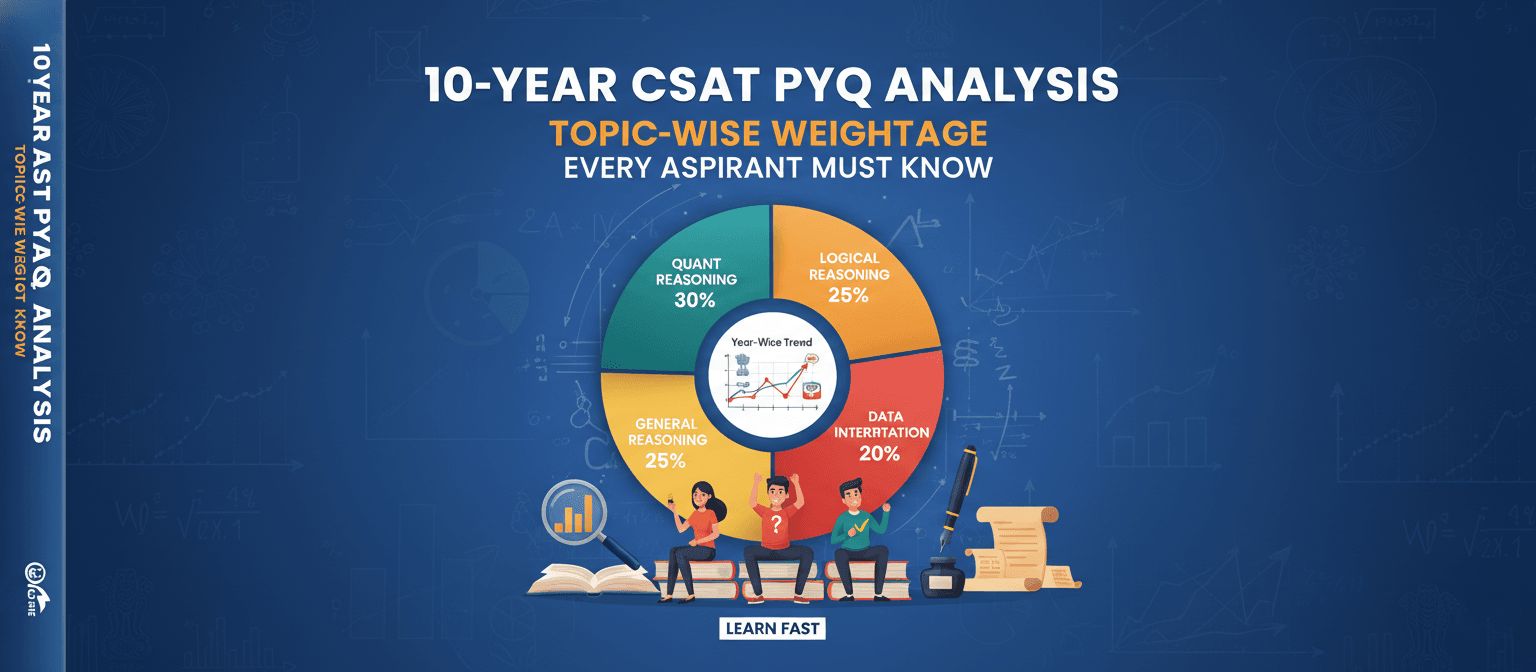
Based on a comprehensive analysis of UPSC CSAT question papers from 2014 to 2024, here is how the 80 questions are typically distributed:
| Topic | Approx. Questions | % Weightage |
|---|---|---|
| Reading Comprehension | 26–32 | 33–40% |
| Basic Numeracy & Data Interpretation | 18–22 | 22–27% |
| Logical Reasoning & Analytical Ability | 12–16 | 15–20% |
| General Mental Ability | 6–10 | 8–12% |
| Decision Making & Problem Solving | 4–6 | 5–8% |
| Interpersonal Skills / Communication | 2–4 | 3–5% |
These are approximate ranges derived from year-wise paper breakdowns. The exact split varies, but the broad pattern has remained remarkably consistent over the decade.
Reading Comprehension: The Non-Negotiable Core
Reading Comprehension (RC) is unambiguously the highest-weightage topic in CSAT — it consistently accounts for 35–40% of the paper. Over 10 years, RC passages have ranged from philosophy and science to governance and ecology.
Key observations:
- Passages are typically 300–600 words, followed by 3–5 inference-based questions
- Questions test the ability to identify the author's tone, central idea, and implied meaning — not just factual recall
- Difficulty has gradually increased post-2018, with more abstract and nuanced passages
What this means for you: If you can consistently score 80%+ in RC, you've already secured around 25–28 marks — nearly half your qualifying target. This is the highest ROI topic in CSAT.
Basic Numeracy and Data Interpretation: The Make-or-Break Zone
Numeracy and DI together form the second-largest block — roughly 22–27% of the paper. This is where many humanities-background aspirants lose ground.
10-year topic breakdown within numeracy:
- Number system, HCF/LCM, percentages: consistent presence every year
- Profit & Loss, Time-Speed-Distance, Time & Work: appear in 8 out of 10 years
- Data Interpretation (tables, bar graphs, pie charts): 4–6 questions annually since 2016
- Ratio & Proportion, Averages: moderate but regular presence
Key insight: UPSC does not ask Class 12 math. The level is roughly Class 7–8, but with tricky framing. The challenge is speed and accuracy under pressure, not conceptual difficulty.
Logical Reasoning: Steady but Selective
Logical Reasoning accounts for approximately 15–20% of the paper and has remained fairly stable. Topics that recur:
- Coding-Decoding, Blood Relations, Direction Sense
- Syllogisms and Statement-Assumption questions
- Series completion (number and letter series)
- Venn Diagrams
One notable trend: pure puzzle-based questions (the type common in bank exams) are rare in UPSC CSAT. UPSC favors reasoning questions that require structured thinking rather than mechanical application of tricks.
General Mental Ability: Small but Scoreable
GMA covers roughly 8–12% of the paper — around 6–10 questions. These include:
- Clock and calendar problems
- Input-Output reasoning
- Order and ranking
These are typically among the quickest to solve and have high accuracy rates among well-prepared aspirants. Don't neglect them — they're easy marks on the table.
Decision Making: Unique to UPSC, Often Underestimated
UPSC includes 4–6 Decision Making questions that test situational judgment — essentially, "what would a good officer do in this situation?" These questions have no fixed formula and are evaluated on the basis of administrative sensibility and ethical reasoning.
Aspirants who have been following GS Paper IV (Ethics) tend to perform better here. The questions are also generally exempt from negative marking in many years — always verify this in the official instructions before the exam.
Year-Wise Trend: What Has Changed Since 2014?
A few structural shifts worth noting:
- 2014–2016: More emphasis on pure reasoning; DI was limited
- 2017–2019: RC volume increased; passages became denser
- 2020–2022: A noticeable uptick in Data Interpretation complexity; multi-graph questions appeared
- 2023–2024: RC continues to dominate; numeracy questions have become application-heavy rather than formula-based
The overall direction is clear: UPSC is testing whether you can think, not just calculate.
How PrepAiro Structures CSAT Preparation
At PrepAiro, CSAT isn't treated as a checkbox — it's integrated into the overall Prelims strategy. The platform's PYQ analysis engine maps each CSAT question to its topic cluster, difficulty band, and year of appearance, giving you a data-backed preparation plan rather than generic advice.
If you're starting from scratch or recalibrating after a previous attempt, begin with RC and Numeracy. Together, they cover nearly 60% of the paper and offer the most predictable return on preparation time.
The 33% Strategy: A Practical Breakdown
Here's a simple approach to hit 66 marks with a margin of safety:
- RC (target: 22/32 correct): ~29 marks
- Numeracy + DI (target: 12/20 correct): ~16 marks
- Reasoning (target: 7/14 correct): ~9 marks
- GMA (target: 5/8 correct): ~7 marks
That's approximately 61 marks from selective accuracy — without attempting every question. Add Decision Making and you're comfortably above the cutoff.
Final Takeaway
CSAT rewards those who prepare intelligently, not exhaustively. The 10-year data tells a consistent story: master Reading Comprehension, build solid numeracy foundations, and don't ignore DI. Everything else is secondary.
Stop treating CSAT as an afterthought. Treat it as what it is — a paper where predictable patterns can be leveraged for a guaranteed qualifying score.
Analyze the PYQs. Find the patterns. Prepare accordingly.
For non-math aspirants struggling with the quantitative section of CSAT, check out this practical strategy guide for CSAT math here.
