UPSC 2026 में Crack करें 6 महीने में: AI-Personalized Study Plan with Daily Tasks & Progress Tracking [Step-by-Step Guide]
18 min read
Jan 30, 2026
Introduction: क्या 6 महीने में UPSC संभव है?
"सर, मेरे पास सिर्फ 6 महीने हैं... क्या UPSC हो पाएगा?"
यह सवाल हर साल लाखों aspirants के मन में आता है। और इसका honest answer है — हाँ, संभव है, लेकिन सिर्फ तभी जब आपकी strategy सही हो।
UPSC CSE 2024 में 13 लाख+ applications आईं, और final selection सिर्फ ~1,000 candidates का हुआ। यह competition brutal है। लेकिन एक interesting pattern है — toppers में से कई ने 6-8 महीने की focused preparation से ही success पाई है।
फर्क क्या था? Smart preparation + Personalized approach + Consistent execution।
इस comprehensive guide में हम आपको exactly वही framework देंगे जो आपको 6 महीने में UPSC 2026 के लिए exam-ready बना सके। यह generic advice नहीं है — यह एक AI-personalized study plan है जिसे आप अपनी strengths, weaknesses, और available time के according customize कर सकते हैं।
Why Traditional Study Plans Fail (और AI-Personalized Approach क्यों काम करता है)
Traditional Approach की Problems
अधिकांश UPSC study plans में एक fundamental flaw है — वे one-size-fits-all होते हैं।
एक working professional की preparation strategy वही नहीं हो सकती जो एक full-time aspirant की है। एक commerce background वाले student को polity differently approach करनी चाहिए बनिस्बत एक arts graduate के।
Traditional plans में क्या miss होता है:
- Individual learning pace को ignore करना
- Weak areas पर focused attention की कमी
- Real-time adjustment की flexibility न होना
- Progress tracking का absence
AI-Personalized Approach का Game-Changer Effect
Modern AI-driven preparation में आपका study plan adapt करता है:
- आपकी daily performance के based पर next day का schedule adjust होता है
- Weak topics पर automatically ज्यादा time allocate होता है
- Your optimal study hours identify होते हैं
- Revision intervals scientifically scheduled होते हैं (Spaced Repetition)
6-Month Master Framework: Phase-Wise Breakdown
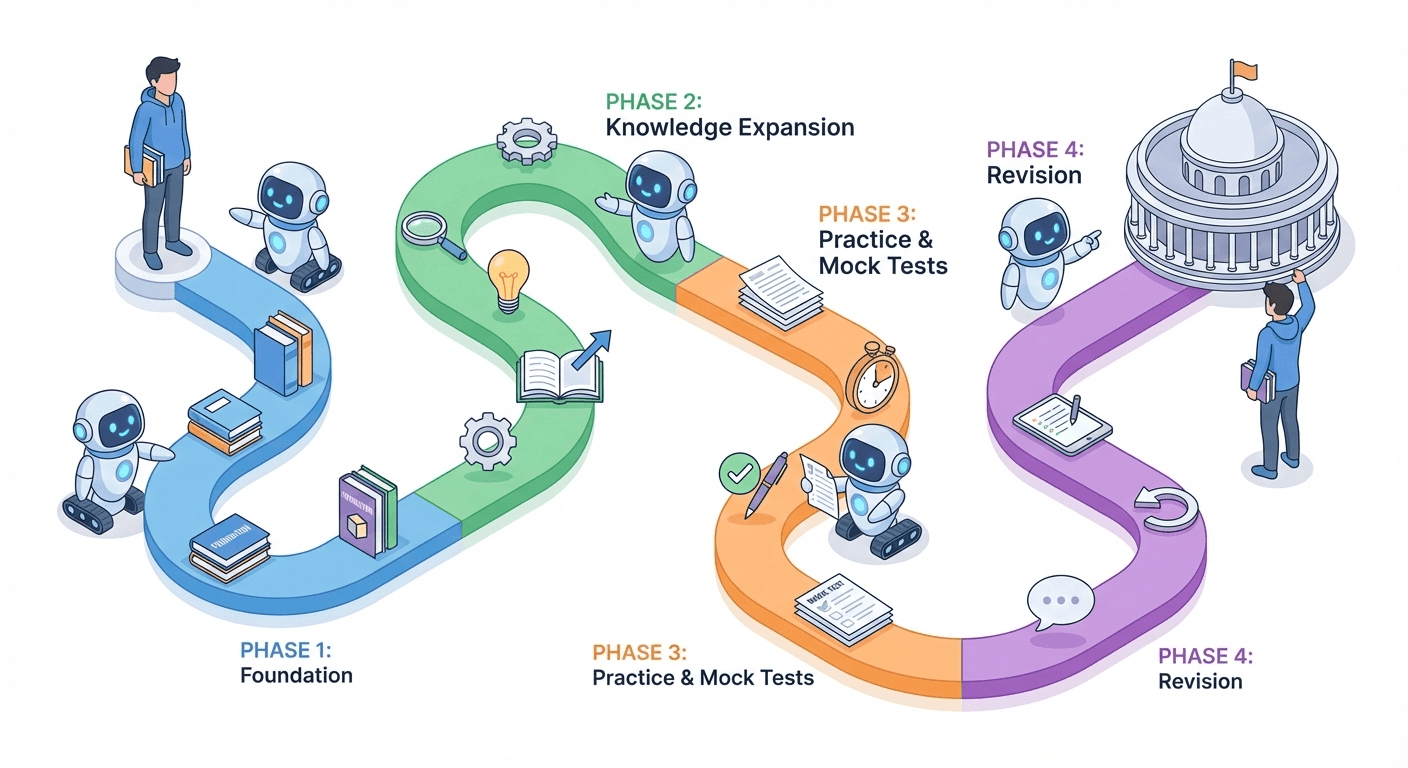
आइए पूरे 6 महीने को 4 strategic phases में divide करें:
Phase 1: Foundation Building (Week 1-6)
Objective: Core concepts की solid understanding develop करना
इस phase में focus रहेगा NCERTs और basic books पर। यहाँ rush करने की ज़रूरत नहीं है — conceptual clarity ही आगे की preparation का foundation है।
Daily Structure (6-8 hours effective study):
| Time Slot | Activity | Duration |
|---|---|---|
| Morning (6-9 AM) | Static Subject (Polity/Geography/History) | 3 hours |
| Mid-day (11 AM-1 PM) | Current Affairs + Newspaper Analysis | 2 hours |
| Evening (4-6 PM) | Second Subject + Notes Making | 2 hours |
| Night (9-10:30 PM) | Revision + Next Day Planning | 1.5 hours |
Week-wise Subject Distribution:
- Week 1-2: Indian Polity (Laxmikanth basics + NCERT Class 11)
- Week 3-4: Ancient & Medieval History (NCERT Class 6-12)
- Week 5-6: Geography (Physical + NCERT)
Key Milestone: Phase 1 के end तक, आपको Polity और History के basic concepts clear होने चाहिए।
Phase 2: Content Expansion (Week 7-14)
Objective: Syllabus coverage को accelerate करना
अब pace बढ़ाने का समय है। Foundation ready है, तो advanced concepts और detailed reading शुरू करें।
Subject-wise Weekly Targets:
- Week 7-8: Modern History (Spectrum/Bipin Chandra)
- Week 9-10: Indian Economy (Ramesh Singh basics + Budget Analysis)
- Week 11-12: Science & Technology + Environment
- Week 13-14: International Relations + Government Schemes
Daily Task Enhancement:
इस phase में answer writing practice शुरू करें — initially 1 answer per day, gradually 2-3 answers तक बढ़ाएं।
एक important principle: Reading without writing is incomplete preparation।
Phase 3: Integration & Practice (Week 15-20)
Objective: Knowledge को exam-applicable बनाना
यह phase preparation का turning point है। अब तक आपने content cover किया — अब उसे exam lens से देखना है।
Focus Areas:
- Interlinking Topics: Economy और Environment को connect करें, Polity और Governance को link करें
- PYQ Analysis: पिछले 10 साल के questions का pattern समझें
- Mock Tests: Weekly full-length tests शुरू करें
- Answer Writing: Daily 3-4 answers mandatory
Mock Test Strategy:
| Week | Test Type | Focus |
|---|---|---|
| 15-16 | Subject-wise tests | Individual subject mastery |
| 17-18 | Sectional tests | Multiple subjects combined |
| 19-20 | Full-length mocks | Complete paper simulation |
Critical Insight: Mock tests सिर्फ practice नहीं हैं — ये diagnostic tools हैं। हर test के बाद proper analysis करें:
- कौन से topics में consistently गलतियाँ हो रही हैं?
- Time management कैसा है?
- Silly mistakes का pattern क्या है?
Phase 4: Consolidation & Revision (Week 21-24)
Objective: Everything को exam-ready mode में लाना
Last 4 weeks में no new topics। सिर्फ revision, revision, और revision।
Revision Strategy:
- Week 21: Static subjects की rapid revision
- Week 22: Current Affairs compilation (last 1 year)
- Week 23: Mock tests + weak area focus
- Week 24: Light revision + mental preparation
Daily Schedule (Final Phase):
- Morning: 2 mock test papers (Prelims simulation)
- Afternoon: Answer analysis + correction
- Evening: Current Affairs rapid revision
- Night: Static subject quick notes review
Subject-wise AI-Optimized Strategy
Indian Polity & Governance
Time Allocation: 15% of total preparation time
Resource Stack:
- NCERT Class 11 (Indian Constitution at Work)
- M. Laxmikanth (Indian Polity)
- Current Affairs से governance updates
AI-Personalized Approach:
- पहले Constitutional Framework पढ़ें
- फिर Amendments और Recent Changes
- Last में Governance Issues और Case Studies
PYQ Insight (2019-2024):
- Fundamental Rights से average 3-4 questions
- Parliament Procedures trending topic
- Constitutional Bodies frequently asked
Indian Economy
Time Allocation: 18% of total preparation time
3-Layer Learning Method:
- Conceptual Layer: Basic economic concepts (GDP, Inflation, Fiscal Policy)
- Applied Layer: Budget analysis, Economic Survey insights
- Current Layer: RBI policies, Government schemes, Economic news
Weekly Economic Tracker Template:
| Day | Focus Area | Source |
|---|---|---|
| Monday | Banking & Finance news | The Hindu |
| Tuesday | Government schemes update | PIB |
| Wednesday | International economy | Economic Times |
| Thursday | Budget/Policy analysis | Ministry websites |
| Friday | Revision of week's updates | Notes |
History (Ancient, Medieval, Modern)
Time Allocation: 20% of total preparation time
Chronological vs Thematic Approach:
Modern History के लिए thematic approach ज्यादा effective है:
- National Movement themes (Moderate, Extremist, Gandhian)
- Socio-religious reforms
- Tribal and peasant movements
- Constitutional development
Ancient और Medieval के लिए chronological approach better works।
Geography
Time Allocation: 15% of total preparation time
Map-Based Learning:
Geography में maps आपके best friend हैं। हर concept को map पर visualize करें:
- Physical features
- Climate patterns
- Resource distribution
- Current affairs locations
AI-Enhanced Practice:
- Daily 15 minutes map practice
- Weekly map-based quiz
- Monthly comprehensive map test
Science & Technology
Time Allocation: 12% of total preparation time
Focus Framework:
- Space Technology (ISRO missions, recent launches)
- Biotechnology (Health applications, ethical issues)
- IT & Emerging Tech (AI, Blockchain, 5G)
- Defense Technology (Indigenous development)
Source Priority:
- Science section of The Hindu/Indian Express
- PIB Science releases
- ISRO, DRDO official updates
Environment & Ecology
Time Allocation: 10% of total preparation time
Integrated Approach:
Environment को standalone न पढ़ें — Economy, Geography, और Current Affairs के साथ integrate करें:
- Climate summits → International Relations
- Biodiversity loss → Geography + Economy
- Pollution control → Governance + Science
Daily Task System: Your Personal Execution Framework
Morning Routine (5:30 AM - 9:00 AM)
5:30 - 6:00 AM: Wake up, freshen up, light exercise
6:00 - 9:00 AM: Prime Study Session
- यह आपका most productive time है
- Heavy subjects यहीं पढ़ें (Polity, Economy, History)
- No phone, no distractions
- Pomodoro technique: 45 min study + 10 min break
Mid-Day Session (11:00 AM - 2:00 PM)
11:00 AM - 12:30 PM: Current Affairs
- Newspaper reading (The Hindu/Indian Express)
- Note-making with exam relevance filter
- Government notifications check
12:30 - 2:00 PM: Second Subject + Lunch Break
Afternoon Session (3:00 PM - 6:00 PM)
3:00 - 5:00 PM: Answer Writing Practice
- Start with 1 answer, build to 3-4
- Self-evaluation against model answers
- Time yourself (15 minutes per answer)
5:00 - 6:00 PM: Revision of morning session
Evening Session (7:00 PM - 10:00 PM)
7:00 - 8:30 PM: Third Subject or Optional
8:30 - 9:30 PM: Light Reading/Current Affairs video
9:30 - 10:00 PM: Next Day Planning
- Tasks list बनाएं
- Priority set करें
- Resources ready रखें
Progress Tracking System: Measure What Matters
Weekly Progress Metrics
हर Sunday को अपनी progress evaluate करें:
Quantitative Metrics:
- Hours studied (target: 50+ hours/week)
- Topics covered vs planned
- Mock test scores trend
- Answers written count
Qualitative Metrics:
- Conceptual clarity level (self-rate 1-10)
- Revision quality
- Weak areas identified and addressed
- Stress and motivation levels
Monthly Review Framework
End of Each Month, Ask Yourself:
- क्या planned syllabus complete हुआ?
- Mock test scores improve हो रहे हैं?
- कौन से subjects में confidence बढ़ा?
- Weak areas पर progress कैसी है?
- Time management effective है?
The Traffic Light System
अपने topics को categorize करें:
- 🟢 Green: Well-prepared, just need maintenance revision
- 🟡 Yellow: Decent understanding, needs more practice
- 🔴 Red: Weak area, needs focused attention
AI-personalized plans में यह automatic होता है — PrepAiro जैसे platforms आपकी performance track करके weak areas identify करते हैं और accordingly study plan adjust करते हैं।
Common Mistakes to Avoid (और उनके Solutions)
Mistake 1: Information Overload
Problem: बहुत सारे resources से पढ़ना Solution: One source, one topic principle follow करें
Mistake 2: Neglecting Revision
Problem: नया पढ़ने की rush में पुराना भूल जाना Solution: 3-2-1 Revision Rule:
- हर topic को 3 बार revise करें
- 2 different formats में (notes + mock)
- 1 final revision exam से पहले
Mistake 3: Ignoring Answer Writing
Problem: सिर्फ reading पर focus Solution: Week 3 से answer writing start करें, कभी skip न करें
Mistake 4: Poor Current Affairs Management
Problem: Random news reading without filter Solution: UPSC-relevance filter apply करें — हर news item को syllabus से connect करें
Mistake 5: No Mock Test Analysis
Problem: Test देकर score देखकर छोड़ देना Solution: 5-Step Mock Analysis:
- Wrong answers की list बनाएं
- Mistakes को categorize करें (conceptual/silly/time)
- Source chapters identify करें
- Revision schedule में add करें
- Similar questions practice करें
Working Professionals के लिए Modified Plan
अगर आप job करते हुए prepare कर रहे हैं, तो यह modified framework follow करें:
Realistic Time Availability
- Weekdays: 3-4 hours (morning + night)
- Weekends: 8-10 hours
Prioritization Strategy
- High-weightage topics पर focus करें
- Selective study — सब कुछ पढ़ने की कोशिश न करें
- Quality over quantity — 2 hours of focused study > 4 hours of distracted study
Weekend Optimization
Weekends को intensive sessions के लिए use करें:
- Mock tests
- Answer writing practice
- Revision marathons
- Weak area focus
Mental Health & Sustainability
UPSC एक marathon है, sprint नहीं। 6 महीने की intense preparation में burnout से बचना crucial है।
Daily Self-Care Non-Negotiables
- Sleep: 7 hours minimum (compromise नहीं)
- Exercise: 30 minutes daily (walk भी count होती है)
- Breaks: हर 2 hours में 15-minute break
- Social connection: दिन में कम से कम एक meaningful conversation
Stress Management Techniques
- Journaling: दिन के end में 5 minutes लिखें
- Meditation: सुबह 10 minutes
- Hobby time: हफ्ते में 2-3 hours
- Nature exposure: रोज़ कुछ समय बाहर निकलें
When to Take a Break
इन signs पर ध्यान दें:
- लगातार 3+ दिन focus नहीं हो पा रहा
- Irritability और mood swings
- Sleep quality deteriorating
- Concepts याद नहीं हो रहे
Solution: 1-2 days का complete break लें। यह time waste नहीं है — यह investment है।
Technology का Smart Use
Apps That Actually Help
- Note-making: Notion, OneNote (organized digital notes)
- Revision: Anki (flashcards with spaced repetition)
- Time tracking: Forest, Toggl (study hours log)
- News aggregation: Curated current affairs apps
AI-Powered Preparation
Modern AI tools आपकी preparation को significantly enhance कर सकते हैं:
- Personalized study schedules
- Adaptive difficulty quizzes
- Instant doubt resolution
- Performance analytics
Final 30 Days Strategy
Exam से 30 days पहले का approach completely different होना चाहिए:
Week 1 (Day 30-24)
- Complete syllabus की rapid revision
- Daily 2 mock tests
- No new topics
Week 2 (Day 23-17)
- Weak areas पर intensive focus
- PYQ-based practice
- Current affairs compilation revision
Week 3 (Day 16-10)
- Mock tests in exam conditions
- Time management practice
- Previous toppers' answer analysis
Week 4 (Day 9-1)
- Light revision only
- Confidence building
- Logistics preparation (admit card, center visit)
- Early sleep schedule
Last 3 Days: Minimal study, maximum rest। आपका brain consolidation कर रहा होता है।
Frequently Asked Questions (FAQs)
Q1: क्या सच में 6 महीने में UPSC crack हो सकता है?
Answer: हाँ, लेकिन conditions apply होती हैं। अगर आपके पास strong academic background है, daily 8+ hours दे सकते हैं, और smart strategy follow करते हैं, तो Prelims clear करना definitely possible है। Mains और Interview के लिए भी solid foundation बन सकता है।
Q2: Working professionals के लिए minimum कितने hours ज़रूरी हैं?
Answer: Minimum 4 hours daily consistent study ज़रूरी है। Weekends पर 8-10 hours देकर compensate करें। Total weekly target 35-40 hours होना चाहिए।
Q3: कौन सी books ज़रूरी हैं 6 months plan में?
Answer: Core books: NCERTs (Class 6-12 relevant subjects), Laxmikanth (Polity), Spectrum (Modern History), Ramesh Singh (Economy basics)। Supplementary reading current affairs से करें।
Q4: Mock tests कब से शुरू करें?
Answer: Subject-wise tests 2nd month से शुरू करें। Full-length mocks 4th month से। Last 2 months में intensive mock practice होनी चाहिए।
Q5: Current affairs के लिए कितना time देना चाहिए daily?
Answer: Daily 1.5-2 hours current affairs के लिए sufficient है। Focus quality पर रखें — हर news item को UPSC perspective से filter करें।
Q6: अगर किसी subject में बहुत weak हूं तो क्या करूं?
Answer: उस subject को extra 1 hour daily दें पहले 2 months में। Basic concepts के लिए YouTube lectures use करें। Progress track करें और gradually time reduce करें।
Q7: Answer writing practice के लिए best approach क्या है?
Answer: Start with 1 answer daily, build to 4-5. Model answers से compare करें। Time yourself — 15 minutes per 250-word answer। Weekly peer review helpful है।
Q8: AI-based study plans traditional plans से better क्यों हैं?
Answer: AI-based plans आपकी individual performance के according adapt होते हैं। Weak areas automatically identify होते हैं, revision scientifically scheduled होती है, और progress real-time track होती है।
Q9: Exam से 1 week पहले क्या करना चाहिए?
Answer: Heavy study avoid करें। Light revision, formula sheets review, और confidence building activities पर focus करें। Sleep schedule fix करें। Exam center visit करें।
Q10: अगर plan से behind हो जाऊं तो कैसे catch up करूं?
Answer: Panic न करें। Low-priority topics sacrifice करें। High-weightage areas पर focus रखें। Weekend intensive sessions schedule करें। Quality over quantity principle follow करें।
Conclusion: Your Journey Starts Now
6 महीने में UPSC crack करना challenging है — लेकिन impossible नहीं।
इस guide में दी गई strategy को सिर्फ पढ़ना enough नहीं है। असली transformation तब होगी जब आप आज से action लेना शुरू करेंगे।
एक small step से शुरू करें:
- अपना current level honestly assess करें
- अपनी daily routine में study hours fix करें
- Week 1 का plan बनाएं
- और सबसे important — शुरू करें
याद रखें, UPSC सिर्फ एक exam नहीं है — यह एक journey है जो आपको disciplined, knowledgeable, और resilient बनाती है। चाहे result कुछ भी हो, यह process आपको एक better version of yourself बनाएगी।
आपकी preparation में best wishes। The next 6 months could change your life — make them count।
यह भी पढ़ें
अगर आप Science & Technology को efficiently revise करना चाहते हैं, तो यह AI-powered 7-day revision plan आपके लिए helpful होगा:
👉 UPSC Science Technology 2026: AI-Powered 7-Day Revision Plan (Hindi)
Last Updated: January 2026
This guide is designed for UPSC CSE 2026 aspirants. Strategy may need adjustments based on official exam date announcements.
