Science & Tech for Prelims 2026: Space Missions, Defense Tech & Health Innovation Focus
10 min read
Jan 23, 2026
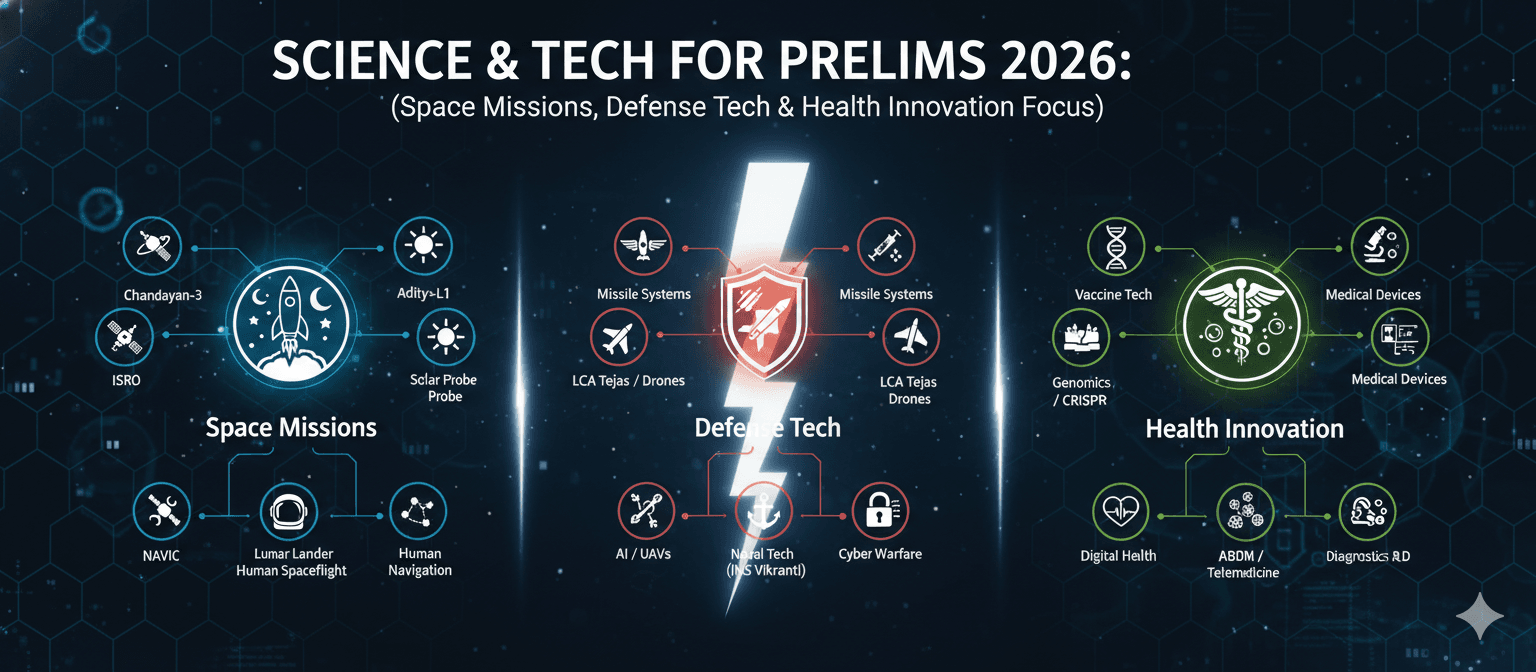
Why Science & Technology Matters for Prelims 2026
Science and Technology has evolved from a peripheral subject to a cornerstone of UPSC General Studies Paper I. Analysis of previous years reveals that UPSC consistently asks between 12 to 18 questions from this domain, making it a decisive factor in clearing the cutoff. What makes S&T particularly challenging—and rewarding—is its dynamic nature: questions blend foundational concepts with current developments, testing both your conceptual clarity and awareness of recent breakthroughs.
For Prelims 2026, scheduled for May 24th, the landscape has shifted considerably. India's space ambitions have accelerated with Gaganyaan approaching its historic uncrewed mission, defense indigenization has reached unprecedented levels with platforms like Tejas Mk2 and advanced Pinaka variants, and health innovations have transformed public healthcare delivery through digital missions and breakthrough therapies. Aspirants who approach S&T strategically—anchoring static concepts to recent headlines—find themselves better positioned than those who treat it as mere memorization.
The key challenge most aspirants face isn't a lack of resources but rather an overwhelming abundance of information without a clear framework. This guide addresses that gap by organizing S&T preparation into four actionable pillars: space technology, defense indigenization, health sector innovations, and emerging technologies like AI and quantum computing.
Space Technology: ISRO's Mission Calendar and Key Concepts
The Gaganyaan Programme: India's Human Spaceflight Dream
The Gaganyaan programme represents India's most ambitious space endeavor, aiming to demonstrate indigenous human spaceflight capability. With a revised budget of ₹20,193 crore and eight planned missions by December 2028, understanding this programme is non-negotiable for Prelims 2026.
The first uncrewed orbital mission, Gaganyaan-1, is scheduled for early 2026. This mission will carry Vyommitra, a half-humanoid robot designed to simulate astronaut conditions, providing critical data on life-support and environmental systems. The spacecraft will be launched using the Human-rated LVM3 (HLVM3) from Satish Dhawan Space Centre into a 170 x 408 km orbit. Key systems being validated include the Crew Module Propulsion System (CMPS) with 12 thrusters generating 100N force each, the parachute-based deceleration system developed by Aerial Delivery Research and Development Establishment, and the Environmental Control and Life Support Systems (ECLSS).
The programme gained significant momentum when Indian astronaut Shubhanshu Shukla joined the Axiom Mission 4 to the International Space Station, providing ISRO with practical experience in microgravity adaptation, spaceflight operations, and emergency protocols. This experience will directly inform crew training for subsequent Gaganyaan missions.
Chandrayaan and Beyond: Lunar and Planetary Missions
Building on Chandrayaan-3's historic south pole landing in August 2023, ISRO has an ambitious roadmap for lunar exploration. Chandrayaan-4 represents the next phase, and notably, ISRO and JAXA (Japan Aerospace Exploration Agency) are collaborating on the Lunar Polar Exploration Mission (LUPEX). This joint mission aims to explore the permanently shadowed regions of the Moon's south pole, searching for water ice—a crucial resource for future sustained lunar presence.
The Aditya-L1 mission continues its operations at the Lagrangian Point L1, studying the Sun's corona and providing valuable data on solar activity. Recent observations include powerful solar flares and rare plasma ejections in ultraviolet light—first-of-their-kind observations that enhance our understanding of space weather and its impact on Earth.
Space Docking Technology: SpaDeX Mission
Early 2025 saw ISRO successfully test space docking capabilities through the SpaDeX (Space Docking Experiment) mission. This technology is fundamental for future missions requiring module assembly in orbit, including the Bharatiya Antariksh Station. The ability to dock spacecraft autonomously positions India among a select group of nations with this capability.
Launch Vehicles: Understanding the Fleet
For examination purposes, understanding the distinction between ISRO's launch vehicles is essential. The Polar Satellite Launch Vehicle (PSLV) remains the workhorse for lighter payloads and polar orbits, while the Geosynchronous Satellite Launch Vehicle (GSLV) handles heavier communication satellites. The LVM3 (Launch Vehicle Mark 3), formerly called GSLV Mk III, represents India's heaviest launch vehicle, capable of placing 4-ton class satellites in Geosynchronous Transfer Orbit. The Human-rated variant (HLVM3) incorporates additional safety features required for crewed missions.
Additionally, the Small Satellite Launch Vehicle (SSLV) addresses the growing demand for launching small satellites on demand. A technology transfer agreement has been signed for SSLV production, marking a significant step toward commercialization of space launch services.
Bharatiya Antariksh Station: Vision 2035
India's Space Vision 2047 targets the establishment of the Bharatiya Antariksh Station by 2035 and landing an Indian on the Moon by 2040. The construction of BAS-1, the first module of the space station, marks a significant expansion of the Gaganyaan programme. Four missions under the current Gaganyaan plan are expected by 2026, followed by four additional technology demonstration missions by December 2028.
Defense Technology: Tracking Indigenization Progress
Understanding the Indigenization Framework
India's defense indigenization has transformed from a policy aspiration to a measurable reality. The Standing Committee on Defence, in its December 2025 report, noted that DRDO's indigenous research programs have enabled savings of ₹264,156 crore over the past five years. Currently, approximately 60% of India's arms and ammunition are produced domestically—a substantial increase from previous decades.
The framework operates through multiple mechanisms: Positive Indigenisation Lists mandate that over 5,600 items be sourced exclusively from domestic manufacturers; the Technology Development Fund (TDF) supports private industries and startups; and Defence Corridor initiatives in Uttar Pradesh and Tamil Nadu create concentrated manufacturing ecosystems.
Key Platforms and Systems
The Light Combat Aircraft Tejas represents Indian aeronautical engineering's flagship achievement. The Tejas Mk1 is operational with the Indian Air Force, while the Tejas Mk2, expected to be ordered in quantities of around 200 aircraft, will feature an indigenous Active Electronically Scanned Array (AESA) radar and Infrared Search and Track (IRST) system. The Advanced Medium Combat Aircraft (AMCA), a fifth-generation stealth fighter, is under development by the Aeronautical Development Agency.
The Pinaka Multi-Barrel Rocket Launcher system has demonstrated significant export success, with deliveries to Armenia. DRDO is developing extended-range variants: a 120-kilometer version and a 300-kilometer version, both expected for induction within 3-5 years. This system exemplifies the "Make in India, Make for the World" philosophy.
In missile technology, the Agni series (I through V) provides India's strategic deterrence capability. The K-6 submarine-launched hypersonic ballistic missile, with a range of 8,000 kilometers, is under development. The Akash surface-to-air missile system has seen successful deployments, while Project Kusha aims to develop an indigenous air defense system comparable to Russia's S-400.
The Arjun Main Battle Tank Mk1A incorporates lessons from extensive field trials, featuring improved firepower, mobility, and protection systems. In naval indigenization, Project 75 submarine program and indigenous aircraft carriers demonstrate India's shipbuilding capabilities.
Emerging Defense Technologies
DRDO has launched a pioneering deep-tech initiative focusing on quantum computing, blockchain, and artificial intelligence for military applications. The Technology Development Fund will finance five deep-tech projects, each receiving up to Rs 50 crore. This initiative is modeled on DARPA (US Defense Advanced Research Projects Agency) and aims to position India at the forefront of military technology innovation.
In December 2025, DRDO completed successful high-speed rocket-sled tests of the Fighter Aircraft Escape System at 800 km/h—critical validation for pilot safety systems. The development of CL-20, an advanced explosive 20% more powerful than HMX, at the High Energy Materials Research Laboratory demonstrates progress in specialized materials.
Health Sector Innovations: Digital Missions and Breakthrough Therapies
Ayushman Bharat Digital Mission: Transforming Healthcare Delivery
The Ayushman Bharat Digital Mission (ABDM) represents one of the world's most ambitious digital health transformations. By late 2025, over 78 crore Ayushman Bharat Health Accounts (ABHAs) have been created, with more than 55 crore health records linked across 36 states and 786 districts. The platform has over 3.63 lakh health facilities registered and 5.64 lakh healthcare professionals verified.
The ecosystem comprises four key components: Ayushman Arogya Mandirs providing comprehensive primary healthcare (over 1.81 lakh operational), Ayushman Bharat PM-JAY for health insurance coverage, PM-ABHIM for health infrastructure development, and the digital backbone connecting all elements.
Understanding ABDM's building blocks is essential for examination purposes. The Health ID (ABHA number) provides a unique 14-digit identifier for standardizing patient identification. The Health Facility Registry (HFR) and Health Professional Registry (HPR) create verified databases of healthcare providers. The platform's interoperability enables seamless data exchange across public and private healthcare systems.
Breakthrough Therapies: CAR-T and Beyond
India's first indigenous CAR-T (Chimeric Antigen Receptor T-cell) therapy, NexCAR19, marks a paradigm shift in cancer treatment. CAR-T therapy involves genetically modifying a patient's T-cells to recognize and attack cancer cells. While imported CAR-T therapies cost approximately $500,000, India's indigenous version is available at around $50,000—making advanced cancer treatment accessible to a broader population.
The National Biopharma Mission, supported by the World Bank, has catalyzed multiple innovations: indigenous MRI scanners developed by Bangalore-based startups at a fraction of imported costs, new antibiotics for UTI and pneumonia, vaccines for dengue and chikungunya clinically tested across India's genetic diversity, and India's first Hepatitis E vaccine development.
In the broader pharmaceutical landscape, India's position as the "pharmacy of the world" continues strengthening. Exports reached $4.96 billion in May 2025 alone, with vaccines surging 13.64% to $190 million. Post-pandemic API (Active Pharmaceutical Ingredient) self-reliance initiatives under PLI schemes have boosted domestic production across oncology, anti-diabetics, and CNS therapies.
AI in Healthcare: Diagnostics and Drug Discovery
AI integration in healthcare represents a convergence of technology and medicine that UPSC increasingly tests. Qure.ai's lung cancer detection suite, AI-driven diagnostic tools for tuberculosis screening in remote areas, and predictive cardiovascular risk scores developed by Apollo Hospitals in partnership with Microsoft AI demonstrate practical applications.
Globally, AI is projected to drive 30% of all new drug discoveries by 2025, cutting development timelines by up to 50%. Indian pharmaceutical companies like Sun Pharma and Dr. Reddy's Laboratories are deploying AI to tackle diseases with high national burdens, including tuberculosis and diabetes.
Public Health Achievements and Schemes
For Prelims preparation, understanding health scheme performance metrics matters. The Universal Immunisation Programme has achieved 98.6% Full Immunization Coverage as of late 2025. India has recorded a 90% success rate in tuberculosis treatment, with overall TB notification improving 63% over the decade 2014-2024. The U-WIN platform has digitized immunization tracking for over 7.90 crore beneficiaries with 29.22 crore administered vaccine doses recorded.
The eSanjeevani telemedicine service has emerged as one of the world's largest telemedicine platforms, facilitating over 41.93 crore teleconsultations and bridging healthcare access gaps in remote areas.
AI and Emerging Technologies: Building Foundational Understanding
IndiaAI Mission: The Seven Pillars
The IndiaAI Mission, implemented by MeitY with an allocation of ₹10,371 crore, operates through seven interconnected pillars that aspirants should understand:
The first pillar addresses compute infrastructure, providing high-end GPUs at subsidized rates of just ₹65 per hour. Over 38,000 GPUs have been onboarded, making high-performance computing accessible to startups and researchers who previously faced significant cost barriers.
The second pillar, AIKosh, develops large datasets for training AI models, integrating data from government and non-government sources. With over 5,500 datasets and 251 AI models across 20 sectors, it eliminates the need for developers to build basic modules from scratch.
The Indigenous Large Language Model initiative (third pillar) focuses on developing India's own Large Multimodal Models using Indian data and languages. Twelve startups have been selected, including Sarvam AI, BharatGen (IIT Bombay consortium), and Tech Mahindra Maker's Lab.
The fourth pillar addresses skilling, supporting 500 PhD fellows, 5,000 postgraduates, and 8,000 undergraduates. Data and AI Labs are being established in Tier 2 and Tier 3 cities through 31 launched labs with NIELIT and industry partners.
Startup financing (fifth pillar), application development (sixth pillar), and responsible AI governance (seventh pillar) complete the ecosystem. The governance pillar has initiated 13 projects focusing on machine unlearning, bias mitigation, privacy-preserving ML, and algorithmic auditing.
National Quantum Mission: Preparing for the Quantum Era
The National Quantum Mission (NQM), approved in April 2023 with a budget of ₹6,003 crore, positions India in the global quantum technology race. For examination purposes, understanding basic quantum concepts is essential.
Quantum computing fundamentally differs from classical computing. While classical computers use bits (0 or 1), quantum computers use qubits that can exist in superposition—both 0 and 1 simultaneously. This enables exponential computational power for specific problems. QpiAI, a Bangalore-based startup selected under NQM, has launched one of India's most powerful quantum computers.
Quantum communication leverages quantum mechanics for secure data transmission. Quantum Key Distribution (QKD) uses quantum properties to detect eavesdropping, while Post-Quantum Cryptography (PQC) develops encryption resistant to quantum attacks. These technologies are crucial for protecting India's digital infrastructure.
NQM's target areas include intermediate-scale quantum computers with 50-1000 qubits, satellite-based quantum communication over 2000 km, and magnetometer development for medical diagnostics and navigation.
Other Emerging Technologies: A Concise Overview
Beyond AI and quantum, several technologies warrant attention. Blockchain applications have expanded beyond cryptocurrencies to supply chain management, land records, and voting systems. The distinction between public and private blockchains, consensus mechanisms, and smart contracts forms the basic conceptual framework.
5G deployment in India enables applications requiring high bandwidth and low latency, while 6G research has begun globally. Understanding the technical differences—5G's millimeter wave spectrum versus 6G's terahertz frequencies—and applications like autonomous vehicles and remote surgery provides examination-relevant knowledge.
The Digital Personal Data Protection Act 2023 establishes India's data privacy framework, covering consent mechanisms, children's data protection, and cross-border data transfer restrictions. This legislation intersects with AI governance and digital health initiatives.
Strategic Preparation Framework
The Four-Pillar Approach
Effective S&T preparation requires a structured approach that balances static concepts with dynamic current affairs. The four pillars—space, defense, health, and emerging tech—provide natural organization for your notes and revision.
For each pillar, maintain a living document that connects foundational concepts to recent developments. For example, under space technology, link launch vehicle classifications (static) to specific missions like PSLV-C61/EOS-09 (dynamic). This integration helps in answering questions that test application rather than mere recall.
Many aspirants struggle with the vastness of S&T topics. A systematic approach involves prioritizing high-yield areas based on previous year question patterns while maintaining awareness of current developments through government sources like PIB, ISRO announcements, and ministry press releases.
Source Hierarchy for S&T Preparation
Primary sources should form the backbone of your preparation. For space technology, ISRO's official website and annual reports provide authoritative information. DRDO's publications cover defense technology developments. Ministry of Health and Family Welfare releases and the National Health Authority's ABDM documentation address health innovations. MeitY publications, including IndiaAI updates, cover emerging technologies.
NCERTs (Class IX-XII Physics, Biology) provide the static foundation, while Economic Survey chapters on S&T offer policy perspectives. Some aspirants find it easier to stay consistent using structured practice tools like PrepAiro that organize current affairs around examination requirements.
Common Pitfalls to Avoid
Three common mistakes undermine S&T preparation. First, treating S&T as a memorization exercise rather than understanding underlying principles leads to confusion when UPSC frames application-based questions. Second, neglecting recent developments while over-focusing on static content misses the dynamic nature of S&T questions. Third, information overload from multiple sources creates confusion rather than clarity—stick to authoritative primary sources.
The key is building mental models that connect concepts. Understanding why ISRO chose a polar orbit for Aditya-L1 (to avoid Earth's shadow and maintain continuous solar observation) demonstrates deeper comprehension than simply memorizing mission details.
Frequently Asked Questions
How many questions are typically asked from Science & Technology in UPSC Prelims?
Based on analysis of recent UPSC Prelims papers, Science and Technology contributes approximately 12-18 questions annually, representing roughly 12-18% of the total General Studies Paper I. The distribution varies each year, but space technology, biotechnology, and IT/digital technology consistently feature prominently. For Prelims 2026, expect continued emphasis on India's indigenous technological achievements across space, defense, and health sectors.
Should I focus more on static concepts or current affairs for S&T preparation?
The optimal approach integrates both dimensions. Static concepts—understanding how rockets work, what CRISPR does, how quantum computing differs from classical computing—provide the foundation. Current affairs—specific missions, policy initiatives, breakthrough developments—test your awareness and application ability. UPSC questions often blend both, asking about a recent development while testing underlying conceptual understanding. Aim for 60% current affairs integration with 40% static concept clarity.
What are the most important space missions to know for Prelims 2026?
Priority missions include Gaganyaan-1 (uncrewed test mission with Vyommitra, scheduled early 2026), Chandrayaan-4 and LUPEX (India-Japan lunar collaboration), continuing operations of Aditya-L1 at Lagrangian Point L1, and the SpaDeX space docking demonstration. Understanding the Bharatiya Antariksh Station roadmap and India's Space Vision 2047 targets (BAS by 2035, Indian on Moon by 2040) provides context for specific mission questions.
How do I remember all the defense platforms and their specifications?
Rather than memorizing specifications, focus on understanding platform categories and their strategic significance. Group systems by function: strategic deterrence (Agni missiles), tactical systems (Pinaka MBRL), platforms (Tejas aircraft, Arjun tank), and emerging technologies (hypersonic, drone systems). For each category, know 2-3 key systems with their primary purpose, developing agency (DRDO, HAL, etc.), and any recent milestones or exports. This framework-based approach is more exam-efficient than exhaustive memorization.
What health schemes and digital health initiatives should I prioritize?
The Ayushman Bharat ecosystem demands thorough understanding: its four components (Ayushman Arogya Mandirs, PM-JAY insurance, PM-ABHIM infrastructure, ABDM digital mission), key metrics (ABHA registrations, health records linked, teleconsultations conducted), and implementation mechanisms. Additionally, understand the CoWIN platform's role in vaccination, eSanjeevani telemedicine service, and U-WIN immunization tracking. For biotechnology, focus on CAR-T therapy, mRNA vaccine technology basics, and the National Biopharma Mission's achievements.
How important is understanding AI and quantum computing for UPSC?
Increasingly important. The IndiaAI Mission and National Quantum Mission represent significant government initiatives with policy implications. You need not understand technical mathematics, but grasp fundamental concepts: AI/ML basics, differences between neural networks and traditional programming, quantum superposition and entanglement principles, and quantum computing's potential applications in cryptography and drug discovery. Focus on India-specific initiatives, governance frameworks, and strategic implications rather than technical depth.
What government sources should I regularly follow for S&T updates?
Prioritize PIB (Press Information Bureau) releases from Ministry of Science & Technology, MeitY, Ministry of Health, and Department of Space. ISRO's official website provides mission updates. For current affairs integration, monthly compilations from authoritative sources help consolidate developments. Avoid information overload by focusing on examination-relevant developments rather than every scientific news item.
How do I approach S&T questions that seem completely unfamiliar in the examination?
UPSC sometimes introduces novel topics to test elimination skills. Apply these strategies: eliminate options with absolute statements ("always," "never," "only"); connect unfamiliar topics to known frameworks (if a question mentions an unknown satellite, apply your understanding of satellite types and orbits); use contextual clues from the question stem. Even unfamiliar questions often test foundational concepts in disguised forms.
Conclusion
Science and Technology preparation for Prelims 2026 need not feel overwhelming. By organizing your study around the four pillars of space technology, defense indigenization, health innovations, and emerging technologies, you create a mental architecture that accommodates both static concepts and dynamic developments. The key insight is that UPSC tests comprehension and application rather than exhaustive factual recall.
India stands at a remarkable technological inflection point. The Gaganyaan programme advances toward sending Indians to space, defense platforms increasingly bear the "Made in India" stamp, digital health infrastructure connects hundreds of millions of citizens, and AI and quantum initiatives position the country for future technological leadership. Understanding these developments isn't merely examination preparation—it's engaging with the transformation shaping the nation you aspire to serve.
The journey of S&T preparation mirrors the broader UPSC journey itself: steady, consistent effort compounds over time. Anchor your revision to authoritative sources, connect concepts to current developments, and trust the process. The marks you secure in this section could well be the margin that carries you to that Mains call-letter.
Stay curious about the world changing around you. That curiosity, channeled systematically, becomes examination success.
