Round Table Conferences 1930-1932: Complete Guide
5 min read
May 02, 2026
Introduction
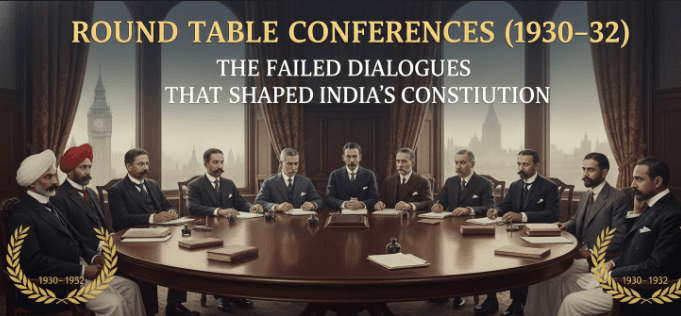
The Round Table Conferences were a series of high-level political negotiations organised by the British government in London between 1930 and 1932 to discuss constitutional reforms in India.
These conferences were a critical phase in India’s constitutional development, aiming to address demands for self-governance while safeguarding British imperial interests.
They reflected the growing pressure from Indian national movements and the need for a new framework of governance.
Background and Context
The conferences were convened in response to rising nationalist movements and the failure of earlier constitutional reforms.
- Simon Commission (1927) recommendations led to widespread protests as it lacked Indian representation
- Growing demand for Swaraj (self-rule) led by Indian leaders
- Launch of the Civil Disobedience Movement (1930) intensified political pressure
- British government sought a negotiated settlement through dialogue
Objectives of the Round Table Conferences
The primary aim was to discuss and formulate a constitutional framework for India.
- To review constitutional reforms introduced under the Government of India Act, 1919
- To discuss the possibility of federal structure in India
- To address representation of minorities, princely states, and different communities
- To negotiate terms of self-governance within the British Empire
First Round Table Conference (1930)
Held in London from November 1930 to January 1931, it marked the beginning of formal negotiations.
- Attended by British officials, Indian princes, and minority representatives
- Major Indian political party, Indian National Congress, did not participate
- Discussed the idea of an All-India Federation including princely states
- Focus on safeguarding minority rights and communal representation
Outcome:
- No major breakthrough due to absence of Congress
- However, laid groundwork for future discussions
Second Round Table Conference (1931)
This conference was more significant due to participation of major political actors.
- Held from September to December 1931
- Mahatma Gandhi attended as the sole representative of the Congress after the Gandhi-Irwin Pact
Key issues discussed:
- Federal structure
- Minority representation (especially Muslims, Depressed Classes, Sikhs)
- Provincial autonomy
Key Developments:
- Sharp disagreements between Gandhi and Dr B.R. Ambedkar on representation of Depressed Classes
- Communal issues dominated discussions
- Lack of consensus on power-sharing
Outcome:
- Conference ended without agreement
- British government retained control over final decisions
Third Round Table Conference (1932)
The final conference saw reduced participation and significance.
- Held from November to December 1932
- Congress again did not participate
- Focus shifted to finalising constitutional details
Outcome:
- Discussions influenced the drafting of the Government of India Act, 1935
- No substantial negotiations with major nationalist leaders
Key Features Across the Conferences
- Introduction of the concept of Federal Structure
- Emphasis on Provincial Autonomy
- Debate over Separate Electorates for minorities
- Inclusion of Princely States in governance framework
- Recognition of India's diversity in political representation
Major Issues and Debates
-
Federalism
- Proposal to create a federation of British Indian provinces and princely states
- Princes were hesitant to join, fearing loss of autonomy
-
Minority Representation
- Demand for separate electorates by various communities
- Led to tensions between nationalist unity and communal safeguards
-
Role of Congress
- Absence in first and third conferences weakened negotiations
- Limited influence even during participation in second conference
Summary Table: Round Table Conferences
| Conference | Year | Key Participants | Major Focus | Outcome |
|---|---|---|---|---|
| First | 1930–31 | British officials, princes, minorities | Federal structure, minority rights | No major agreement |
| Second | 1931 | Gandhi, British govt, minorities | Representation, autonomy | Deadlock on communal issues |
| Third | 1932 | British officials, limited Indian participation | Finalising reforms | Led to Govt. of India Act 1935 |
Significance of the Round Table Conferences
- Marked a shift towards constitutional negotiations rather than unilateral British decisions
- Highlighted deep divisions on communal representation
- Provided foundation for the Government of India Act, 1935
- Demonstrated limitations of negotiations without inclusive participation
Conclusion
The Round Table Conferences represented a crucial yet complex phase in India’s constitutional evolution.
While they failed to achieve consensus or immediate self-governance, they exposed the competing interests within Indian society and between India and Britain.
Ultimately, these conferences shaped the framework of future constitutional reforms, even though they fell short of fulfilling nationalist aspirations.
You might also like: How PrepAiro’s Micro-Learning System is Redefining UPSC Preparation
