Resource Minimalism for UPSC: Quality Over Quantity Approach 2026
12 min read
Jan 26, 2026
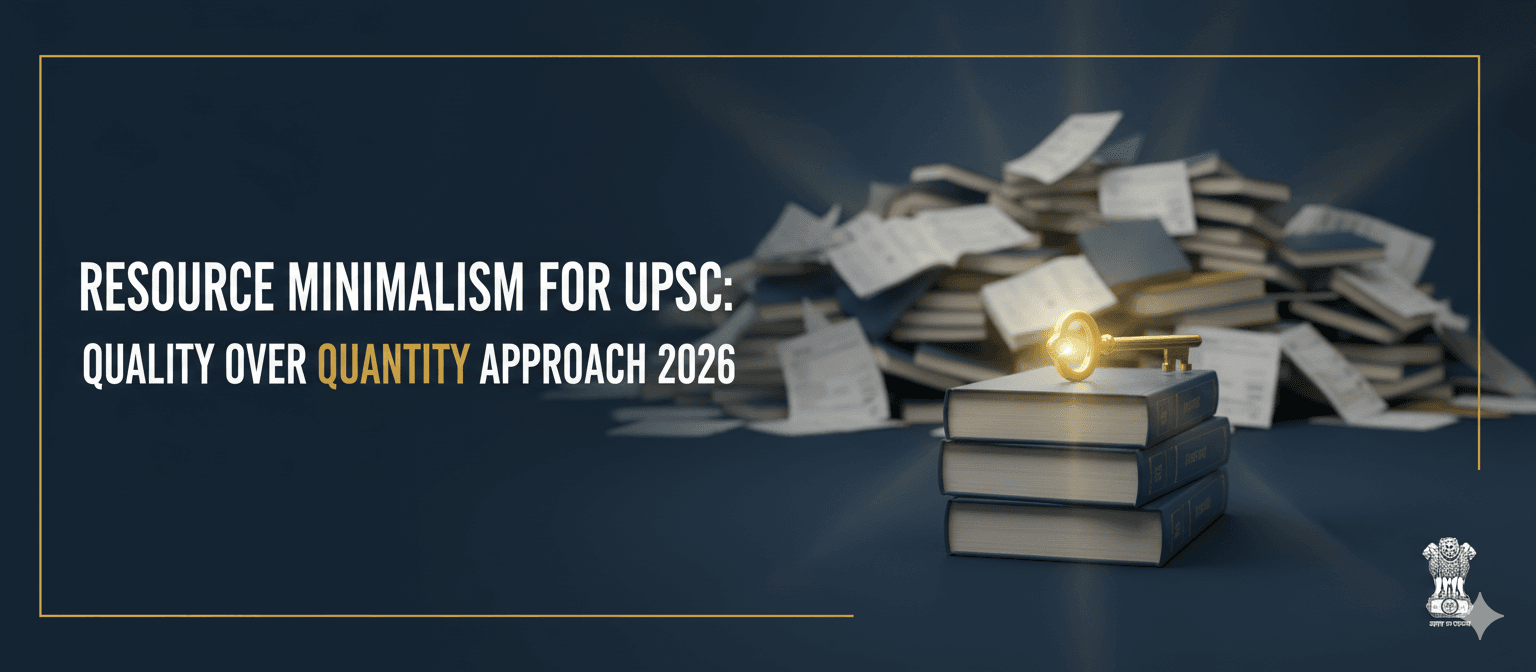
There is a peculiar anxiety that grips almost every UPSC aspirant at some point during their preparation journey. It manifests as an unshakeable feeling that somewhere out there exists a book, a set of notes, or a resource that holds the key to cracking the examination. This anxiety drives aspirants to accumulate materials far beyond what any single person could meaningfully engage with in a 12 to 18 month preparation cycle.
The reality, however, tells a different story. When you examine the preparation journeys of successful candidates, a consistent pattern emerges. Most toppers rely on a surprisingly limited set of resources, returning to the same materials repeatedly rather than constantly expanding their reading lists. This approach, which can be termed resource minimalism, represents not a shortcut but rather a strategically sound methodology grounded in how human memory and comprehension actually function.
This guide examines the principles behind resource minimalism for UPSC 2026, offering a framework for identifying core books, avoiding the trap of resource hoarding, implementing an effective multiple reading strategy, and building revision-friendly note systems that serve you throughout your preparation.
The Hidden Cost of Resource Hoarding
Before examining what resource minimalism looks like in practice, it helps to understand why the opposite approach creates problems. Resource hoarding is not merely inefficient. It actively undermines preparation in several interconnected ways.
When aspirants collect multiple books for the same subject, they face a cognitive burden that extends beyond the time required to read them. Different authors present concepts using different frameworks, terminology, and organizational structures. The mind must constantly reconcile these differences, which creates confusion rather than clarity. An aspirant studying Polity from three different sources will encounter three slightly different explanations of, say, the amendment procedure, and instead of developing crystal-clear understanding, they develop a muddled composite that fails them during the pressure of examination.
There is also the psychological dimension. A growing pile of unread materials creates what researchers call the Zeigarnik effect, where incomplete tasks occupy mental bandwidth and generate persistent low-grade anxiety. This anxiety compounds the already substantial stress of UPSC preparation, contributing to the burnout that derails so many promising aspirants.
Perhaps most critically, resource hoarding creates an illusion of progress. Acquiring a new book or downloading a new set of notes feels productive, but it substitutes the appearance of preparation for actual preparation. The aspirant who spends Sunday researching which Economics book to buy could have spent that time deepening their understanding of the material already at hand.
Principles of Core Book Identification
The foundation of resource minimalism lies in identifying a core set of materials for each subject and committing to them. This requires both discipline and a clear understanding of what makes a book suitable as a primary resource.
A core book for UPSC preparation should meet several criteria. It must align comprehensively with the syllabus, covering the topics UPSC actually tests rather than offering exhaustive academic treatment of tangential areas. It should present information in a manner that facilitates both understanding and retention, with clear explanations and logical organization. It should have demonstrated relevance to the examination, either through direct correlation with past questions or through endorsement by successful candidates. And it should be something you can realistically complete and revise multiple times within your preparation timeline.
Subject-Wise Core Resource Framework
For each major subject, the minimalist approach involves selecting one primary source and treating everything else as supplementary reference material that you consult only when the primary source leaves specific gaps.
Indian Polity and Governance forms the backbone of both Prelims and Mains. The NCERT Political Science textbooks for Classes 11 and 12 provide the conceptual foundation, explaining the philosophy behind constitutional provisions. M. Laxmikanth's Indian Polity serves as the definitive core text, comprehensive enough to address virtually any question UPSC poses on this subject. The key is to resist the temptation to add multiple other books. When you encounter a question that Laxmikanth does not address, the answer almost certainly lies in current affairs or original government documents rather than in another Polity textbook.
Modern Indian History can be adequately covered with NCERTs supplemented by Spectrum's Brief History of Modern India. The Spectrum book traces India's freedom struggle with sufficient depth for both stages of the examination. Ancient and Medieval History receive proportionally fewer questions and can be addressed through specialized NCERTs and standard reference texts like R.S. Sharma for Ancient India. Art and Culture, which appears across both Prelims and Mains, is best approached through Nitin Singhania's text after establishing basics through the NCERT on Indian Art.
Geography requires a more layered approach given its division into Physical and Human Geography, Indian Geography, and World Geography. NCERT textbooks from Classes 6 through 12 provide essential foundations. G.C. Leong's Certificate Physical and Human Geography offers deeper treatment of physical concepts like geomorphology and climatology. For Indian Geography specifically, a focused text like Majid Husain's work covers the regional and resource dimensions. The critical companion here is an atlas, used not just for map questions but as a tool for understanding spatial relationships that textual description cannot adequately convey.
Indian Economy presents unique challenges because theoretical frameworks must be applied to a constantly changing landscape. The NCERT Economics textbooks for Classes 11 and 12 explain foundational concepts like GDP, inflation, and fiscal policy. Ramesh Singh's Indian Economy serves as the standard comprehensive text. However, Economy more than any other subject requires supplementation with current developments, primarily through the Economic Survey and careful newspaper reading.
Environment and Ecology appears across both stages with increasing frequency. R. Rajagopalan's Environment text has become the standard reference for UPSC-specific preparation. NCERTs in Biology provide the scientific foundation. This subject particularly rewards integration with current affairs, given UPSC's interest in contemporary environmental developments, climate negotiations, and conservation initiatives.
Science and Technology cannot be approached through any single comprehensive book because UPSC's questions draw from such diverse domains. NCERT Science textbooks from Classes 6 through 10 establish basic scientific literacy. Beyond this, regular engagement with science sections of newspapers and magazines like Science Reporter becomes essential. The goal is not encyclopedic knowledge but rather understanding of principles and awareness of significant developments.
Ethics, Integrity, and Aptitude for GS Paper IV requires a philosophical grounding combined with case study practice. G. Subba Rao's Ethics text provides theoretical frameworks. The Second Administrative Reforms Commission Report on Ethics in Governance offers practical context. However, this paper particularly rewards application over accumulation, making case study practice more valuable than additional reading.
The Multiple Reading Strategy
Identifying core books constitutes only the first step. The real power of resource minimalism emerges through the multiple reading strategy, which recognizes that genuine understanding requires engaging with material repeatedly rather than once.
This approach involves reading each core book at least three times, with each reading serving a distinct purpose.
The First Reading focuses purely on comprehension. You read to understand what the author is saying, without worrying about retention or note-making. This reading establishes the cognitive framework into which subsequent readings will deposit increasingly detailed understanding. During this phase, you read at your natural pace, pausing when concepts require reflection but not stopping to memorize or take notes. The goal is to complete the book with a general understanding of its structure and content.
The Second Reading shifts toward analysis and integration. Now that you understand the terrain, you read more slowly, actively engaging with the material. This is when note-making occurs, though notes at this stage focus on concepts and connections rather than comprehensive transcription. During the second reading, you begin connecting material to other subjects and to current affairs. The constitutional provisions you encountered during first reading now connect to newspaper articles about recent Supreme Court judgments. The economic concepts link to Budget announcements and policy discussions.
The Third Reading serves consolidation and revision. By this point, the material is familiar, and you can move quickly, reinforcing memory and identifying areas where understanding remains weak. This reading typically occurs closer to the examination and may be supplemented by engagement with practice questions that test whether your understanding has genuinely solidified.
Some aspirants find it helpful to space these readings across their preparation timeline. For instance, completing first readings of all subjects during the first few months, then conducting second readings while integrating current affairs, and reserving third readings for the final revision phase. Others prefer subject-by-subject approaches. The specific scheduling matters less than the commitment to multiple engagements with core material.
Building Revision-Friendly Note Systems
The note system you develop serves as the interface between your books and your examination performance. A well-designed note system enables rapid revision, facilitates connection-making between concepts, and provides the condensed material you will engage with during final preparation when re-reading entire books becomes impractical.
Effective UPSC notes share several characteristics. They are significantly shorter than the source material, capturing essence rather than detail. They are organized for retrieval, allowing you to quickly locate information when needed. They maintain connections to the source, enabling you to return to the original for deeper engagement when necessary. And they evolve over time, incorporating new insights from current affairs and practice question analysis.
Note Architecture
The most effective approach involves creating a tiered system of notes at different levels of detail.
Comprehensive Subject Notes contain the full range of concepts from your core book, organized according to the UPSC syllabus rather than the book's internal organization. These notes serve as your primary reference throughout preparation, updated as you encounter relevant current affairs or gain new insights from practice questions.
Revision Sheets condense each topic into one or two pages, containing only the most essential points, key facts, and examination-relevant details. These serve as your primary material during final revision phases when time constraints preclude engaging with longer notes.
Flash Cards or Quick Facts capture isolated pieces of information that require memorization, such as dates, names, article numbers, or statistical data. These support spaced repetition practice in the weeks before examination.
Integration with Practice
Notes gain their greatest value when integrated with practice question analysis. When you encounter a question in mock tests or previous year papers that you answered incorrectly or incompletely, the correction should flow back into your notes. Some aspirants find it useful to maintain structured practice tools like PrepAiro alongside their notes, which helps identify patterns in their errors and track improvement over time. This creates a feedback loop where practice informs note refinement, and improved notes enable better subsequent practice performance.
The key is treating notes as living documents rather than static transcriptions. An aspirant who creates notes in month three and never updates them has missed the point. Your notes should look substantially different in month twelve than they did at creation, enriched by nearly a year of engagement with current affairs, practice questions, and deepening understanding.
Managing the Urge to Accumulate
Even aspirants intellectually committed to resource minimalism will experience periodic urges to expand their reading lists. These urges intensify at certain predictable moments: after encountering a difficult practice question, after seeing peers discuss unfamiliar materials, or during the anxiety-laden pre-examination phase.
Developing strategies for managing these urges protects your preparation from disruption.
When you encounter a question you cannot answer from your existing resources, the first response should be careful analysis rather than resource expansion. Often, the question tests application of concepts you already possess, and the failure lies in connection-making rather than content gaps. When genuine gaps exist, they can frequently be addressed through targeted research on specific topics rather than acquisition of entire new books.
When peers discuss materials you have not read, remember that peer preparation strategies often reflect their own anxieties and circumstances rather than optimal approaches. The aspirant enthusiastically recommending a new book may be exhibiting the very resource hoarding behavior that undermines preparation. Evaluate recommendations against your own system and incorporate only what genuinely fills identified gaps.
During pre-examination anxiety, the urge to read something new is particularly dangerous because time constraints make genuine engagement impossible. Reading a new book superficially in the final weeks provides psychological comfort but undermines performance. This is precisely when commitment to revision of mastered material most clearly separates successful candidates from others.
The Role of Current Affairs
Resource minimalism might seem incompatible with the vast and constantly expanding domain of current affairs. However, the minimalist principles apply here as well, though with modifications suited to the domain's dynamic nature.
For current affairs, minimalism means selecting limited, reliable sources and engaging with them consistently rather than sporadically consuming material from multiple sources. A focused approach involving daily engagement with one quality newspaper, supplemented by monthly consolidation through a reliable magazine and government sources like PIB, serves most aspirants better than scattered consumption of multiple newspapers, websites, and social media feeds.
The key is building systems that convert current affairs consumption into examinable knowledge. This means not just reading but actively connecting developments to static subject knowledge, identifying UPSC-relevant angles, and integrating insights into your subject notes. An hour of focused current affairs engagement with active processing yields more examination value than three hours of passive reading.
Frequently Asked Questions
How many books should I read for each UPSC subject?
For most subjects, one comprehensive core book supplemented by NCERTs provides sufficient coverage. The goal is mastery of selected resources rather than survey-level familiarity with multiple books. Adding resources should occur only when specific, identified gaps cannot be addressed through your primary materials.
Is it possible to clear UPSC with limited resources?
Multiple toppers have cleared UPSC using remarkably limited resource sets, typically fewer than fifteen core books across all subjects. The common element among successful candidates is not breadth of reading but depth of engagement, including thorough understanding, effective revision, and integration with current affairs.
How do I know if my resources are sufficient?
Previous Year Questions provide the most reliable test. If you can address most PYQs from the past decade using your current resources, your coverage is likely adequate. Gaps revealed through PYQ analysis indicate where targeted supplementation might help, though even these gaps often reflect application failures rather than content deficiencies.
What should I do if I have already accumulated too many resources?
Conduct an honest assessment of what you have genuinely engaged with versus what sits unread. Archive materials you have not touched and commit to your core set. The psychological relief of reducing visible obligations often improves focus and productivity. You can always return to archived materials later if genuine need emerges.
How can I resist peer pressure to expand my resources?
Remind yourself that preparation strategy must be personalized to individual learning styles, available time, and existing knowledge. What works for one aspirant may not suit another. Trust your system while remaining open to evidence-based refinement. If peers achieve results using approaches different from yours, examine whether their methods address genuine weaknesses in your preparation rather than simply offering different paths to the same destination.
How do I handle subjects where I need additional conceptual clarity?
Targeted supplementation for specific concepts differs from wholesale resource expansion. If a particular economic concept remains unclear after engaging with your core book, consulting an alternate explanation for that specific topic is reasonable. This differs from acquiring an entirely new Economics book because you struggled with one concept.
When should I make my final notes for revision?
Note-making should begin during your second reading of core books, typically several months into preparation. However, notes should continue evolving throughout your preparation. Final revision notes, condensed further from your comprehensive subject notes, can be prepared three to four months before the examination, with ongoing refinement until the final weeks.
Reflections on Sustainable Preparation
The UPSC examination tests not just knowledge but the capacity to acquire, organize, and deploy knowledge effectively under constraints. Resource minimalism, properly understood, represents training for exactly this capacity. By limiting inputs, you develop the discernment to identify what truly matters. By engaging repeatedly with selected materials, you develop depth that superficial breadth can never provide. By building systems for notes and revision, you develop the organizational skills that will serve you throughout a career in public service.
There is also something to be said for the psychological sustainability of this approach. The aspirant who trusts their limited, curated resource set experiences less anxiety than one who perpetually feels behind on an ever-expanding reading list. This reduced anxiety supports the consistency that ultimately determines examination outcomes. Burnout claims many talented aspirants not because the material is too difficult but because the approach is too exhausting.
Perhaps most importantly, resource minimalism respects the reality that understanding develops through return rather than coverage. Every educator knows that students who engage deeply with limited material outperform those who skim broadly. The examination may test a vast syllabus, but successful candidates address that vastness through deep understanding of fundamentals rather than superficial familiarity with everything.
As you plan your UPSC 2026 preparation, consider whether your resource accumulation serves genuine learning or merely provides comfort against anxiety. The books that will carry you to success are likely already on your shelf or readily available. What remains is the harder work of genuine engagement, the discipline of repeated return, and the patience to trust that depth creates its own coverage. In this journey, less truly becomes more.
