Oman Becomes India’s Top LNG Supplier: Hormuz Explained
10 min read
Oct 16, 2026
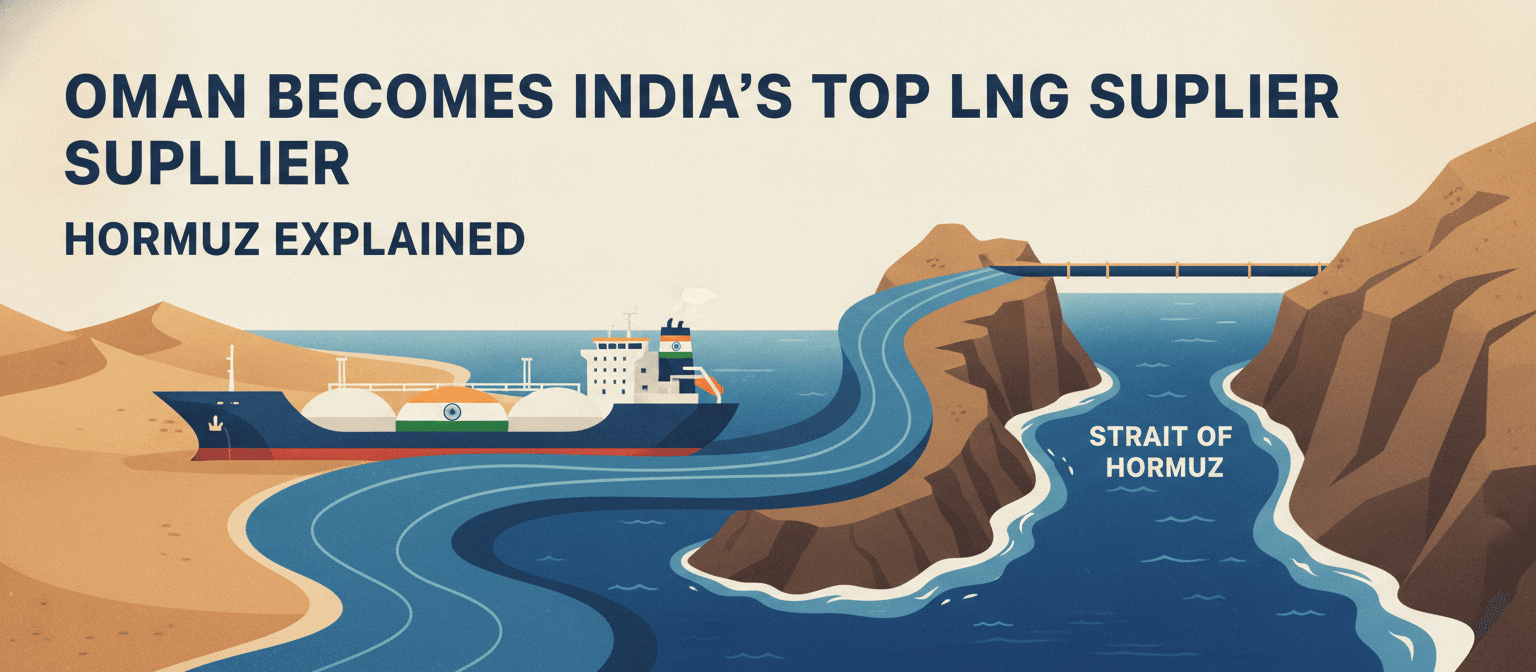
India’s liquefied natural gas imports have acquired a new geopolitical pattern. In September 2026, Oman overtook the United States to become India’s largest LNG supplier for the month, with Nigeria ranking second. The change reflects more than a new trade statistic. It shows how geography, conflict risk, shipping costs and available export capacity influence India’s access to natural gas.
Oman’s LNG export terminal sits outside the Strait of Hormuz, while Qatar’s major facilities depend on passage through the strait. But that advantage does not make Oman immune to regional instability or capable of replacing Qatar on its own. For UPSC, the story connects energy security in GS III with maritime geography and India’s relations with West Asia in GS II.
What Do the September 2026 LNG Import Figures Show?
According to maritime intelligence data from Kpler reported by Business Today, Oman supplied approximately 585,000 tonnes of LNG in September, representing 27% of India’s imports in that dataset. Omani shipments increased 11.6% compared with August. Nigeria ranked second, while the United States slipped to third after its volumes declined roughly 59%, leaving it with a 16% share. Qatar accounted for just 4.3%.
The same Kpler based report put India’s total September LNG imports at 2.17 million tonnes, approximately 14% below August. Other reporting used somewhat different tracking totals, so these figures should be read as a consistent estimate from one provider, not mixed indiscriminately with another dataset.
Importantly, Oman was the largest supplier in September, not necessarily across the entire year. The Indian Express reported that the US remained India’s leading supplier over May to September, with a 28.7% share of 11.87 million tonnes imported during that period. One monthly ranking reveals a shift in purchasing patterns, not a permanent change in India’s long term energy partnerships.
Why the Strait of Hormuz Matters More Than Distance
The Strait of Hormuz connects the Persian Gulf with the Gulf of Oman and Arabian Sea. Commercial shipments from Qatar’s Ras Laffan facilities must pass through this narrow maritime corridor before entering the Indian Ocean. Ships can face delays, higher insurance premiums or attacks when regional security deteriorates.
The US Energy Information Administration estimated that roughly 20% of global LNG trade passed through Hormuz in 2024, largely from Qatar. Most of that trade was directed toward Asian markets. For India, a problem at Hormuz therefore creates both a physical supply risk and a global price risk, even when some alternative cargoes remain available.
Oman has a distinct advantage. Oman LNG identifies its liquefaction complex at Qalhat near Sur, on the coast facing the Arabian Sea. LNG carriers departing Qalhat can sail toward India without crossing the Strait of Hormuz. This avoids the specific bottleneck that constrains exports from inside the Persian Gulf.
Avoiding Hormuz is not the same as avoiding all conflict risk. Oman’s coastline and nearby shipping lanes remain exposed to wider regional instability. The important advantage is route diversification, not a guarantee of safety.
Qatar’s Ras Laffan Disruption Changed the Market
Qatar was historically a foundational supplier to India, with major LNG infrastructure at Ras Laffan Industrial City. The 2026 conflict transformed the reliability of those flows. In March, Iranian strikes damaged facilities at Ras Laffan, while restricted transit through Hormuz compounded the disruption.
Reuters reported in March that the attacks knocked out about 17% of Qatar’s LNG export capacity, according to QatarEnergy’s chief executive, with repairs potentially taking several years. A Reuters analysis in October found that Qatar’s exports remained severely curtailed despite a partial recovery in oil traffic through Hormuz.
LNG systems are harder to restart than ordinary oil shipping. Offshore gas production, processing, liquefaction trains, storage and specialised carriers must function together. In addition, vessels need reliable passage in both directions, not merely a temporary opening for a few ships. Qatar’s continuing constraints therefore affect global prices even if India sources more from Oman or Nigeria.
Why US Cargoes Fell Despite America’s Large LNG Industry
The September figures do not mean that the United States stopped exporting LNG or became an unreliable producer. The US remains one of the world’s largest exporters, but its cargoes compete in a global market. Buyers in Europe and North Asia can attract flexible shipments by paying higher prices when supplies are tight.
A US cargo typically travels considerably farther to India than an Omani cargo. Freight costs, vessel availability, delivery windows and contractual terms can consequently favour closer suppliers. The US Energy Information Administration noted in 2026 that Asian and European importers were competing for available LNG following the disruption of Gulf exports.
India also responds to price. When spot LNG becomes expensive, buyers may reduce discretionary purchases or switch fuels where technology and regulations allow. This helps explain why a new monthly supplier leader can coexist with a fall in total imports. Diversification does not automatically mean adequate or affordable supply.
Sohar Port: Oman’s Strategic Value Goes Beyond LNG
Oman’s importance is not limited to the Qalhat terminal. Its ports provide India with alternative trade and logistics connections to West Asia. The distinction between facilities is crucial: Qalhat is the LNG export site; Sohar is a separate port and industrial logistics hub. Expanding operations at Sohar does not, by itself, create additional Omani LNG production.
In September 2026, Business Standard reported that Sohar Port representatives were discussing terminal and captive berth opportunities with Indian logistics companies. Its deputy chief executive said feeder shipping services between India and Sohar had quadrupled after the West Asia crisis began. Sohar has become useful for moving Indian cargo onward to Gulf markets through alternative maritime and road connections.
For India, such investment opportunities could improve trade resilience, provide access to regional distribution networks and deepen commercial presence on the Gulf of Oman. These are prospective benefits, not evidence that an Indian company has already acquired a new terminal or that Sohar can replace LNG infrastructure at Ras Laffan.
India Oman CEPA: Trade Partnership Meets Energy Security
The India Oman Comprehensive Economic Partnership Agreement was signed on 18 December 2025 and entered into force on 1 June 2026, not in 2024. The Government of India’s announcement describes broader cooperation covering goods, services, investment opportunities and trade facilitation.
The agreement can make Oman a stronger commercial and logistics partner. Reduced trade barriers, improved business access and cooperation across sectors may support Indian companies seeking to operate in ports, logistics and associated industries. Its strategic value lies in complementing energy diplomacy with an economic relationship that extends beyond gas purchases.
However, a free trade agreement does not automatically reserve LNG cargoes for India. Gas supply security still requires commercial contracts, liquefaction capacity, shipping availability and predictable delivery routes. Keeping those mechanisms separate is important for an accurate GS II answer.
Bharat Maritime Insurance Pool: Covering the Shipping Risk
Geopolitical disruption raises costs even when a ship is physically able to sail. War risk insurers may increase premiums or limit coverage, making cargo movement expensive or commercially unattractive.
India responded by establishing the Bharat Maritime Insurance Pool. Approved in April and launched on 12 May 2026, the pool has an underwriting capacity of approximately USD 1.5 billion, supported by a ₹12,980 crore sovereign guarantee. It covers categories including hull and machinery, cargo, protection and indemnity, and war risks for eligible vessels and trade connected to India.
A September government backgrounder reported that the mechanism had already issued thousands of war risk policies. It is therefore an operational policy instrument, not merely a proposal.
The pool addresses the financial consequences of maritime risk, while Oman’s location helps reduce exposure to a particular physical chokepoint. Neither can repair Qatar’s damaged liquefaction trains or eliminate hostile attacks. Energy security needs both route choices and credible risk financing.
What Should India’s LNG Diversification Strategy Include?
First, India should diversify routes as well as countries. A portfolio concentrated among several exporters inside the same vulnerable strait may still face simultaneous disruption. Oman, Nigeria, the United States and other viable suppliers offer different geographic and commercial exposures.
Second, gas buyers need a balanced mix of long term contracts and flexible cargoes. Contracted deliveries can improve planning and reduce some exposure to volatile spot markets, while flexibility helps adjust to unexpected demand or supply disruptions. Pricing formulas and destination restrictions must be examined, not simply the nationality of the seller.
Third, stronger receiving infrastructure, domestic pipeline links and carefully assessed gas storage or balancing options can reduce the consequences of cargo delays. Expanded terminals alone will not provide security if imported gas is unaffordable or cannot reach consumers.
Fourth, India should connect port diplomacy, insurance capacity and maritime surveillance with its gas procurement decisions. A robust supply agreement is less valuable if its cargo cannot sail or secure viable insurance.
Finally, energy planning must protect affordability. Fertiliser producers, city gas networks and some industrial consumers are sensitive to imported gas prices. Diversification should therefore be judged by reliable delivered supply and economic resilience, not merely a larger number of flags on a supplier list.
UPSC Prelims, GS III and GS II: Essential Connections
For Prelims, locate the Strait of Hormuz, Persian Gulf, Gulf of Oman, Qalhat, Sohar and Ras Laffan. Distinguish LNG, which is predominantly methane cooled for transport, from liquefied petroleum gas (LPG), mainly propane and butane. Remember that the India Oman CEPA entered into force in June 2026 and the Bharat Maritime Insurance Pool launched in May 2026.
For GS III, examine import dependence, price shocks, energy infrastructure, global supply concentration, shipping insurance and supply chain resilience. For GS II, focus on India’s relations with Oman and Qatar, maritime security and the link between trade agreements and strategic partnerships. An Essay can explore whether national security now depends as much on ports, insurance and supply chains as on conventional military capability.
Conclusion
Oman’s 27% share of India’s September 2026 LNG imports shows how geography can influence energy trade during a crisis. Qalhat’s location outside Hormuz provides a real shipping advantage, while Qatar’s damaged infrastructure and global competition for US cargoes expose the limitations of relying on a few established suppliers. Sohar’s investment opportunities, the India Oman CEPA and the Bharat Maritime Insurance Pool add complementary economic and maritime tools.
The lasting lesson is that energy security is not simply buying gas from more countries. It is securing reliable, affordable cargoes through multiple routes, supported by resilient infrastructure and financial protection.
