Free GRE Practice Tests vs Paid: What's the Difference?
11 min read
Jan 20, 2026
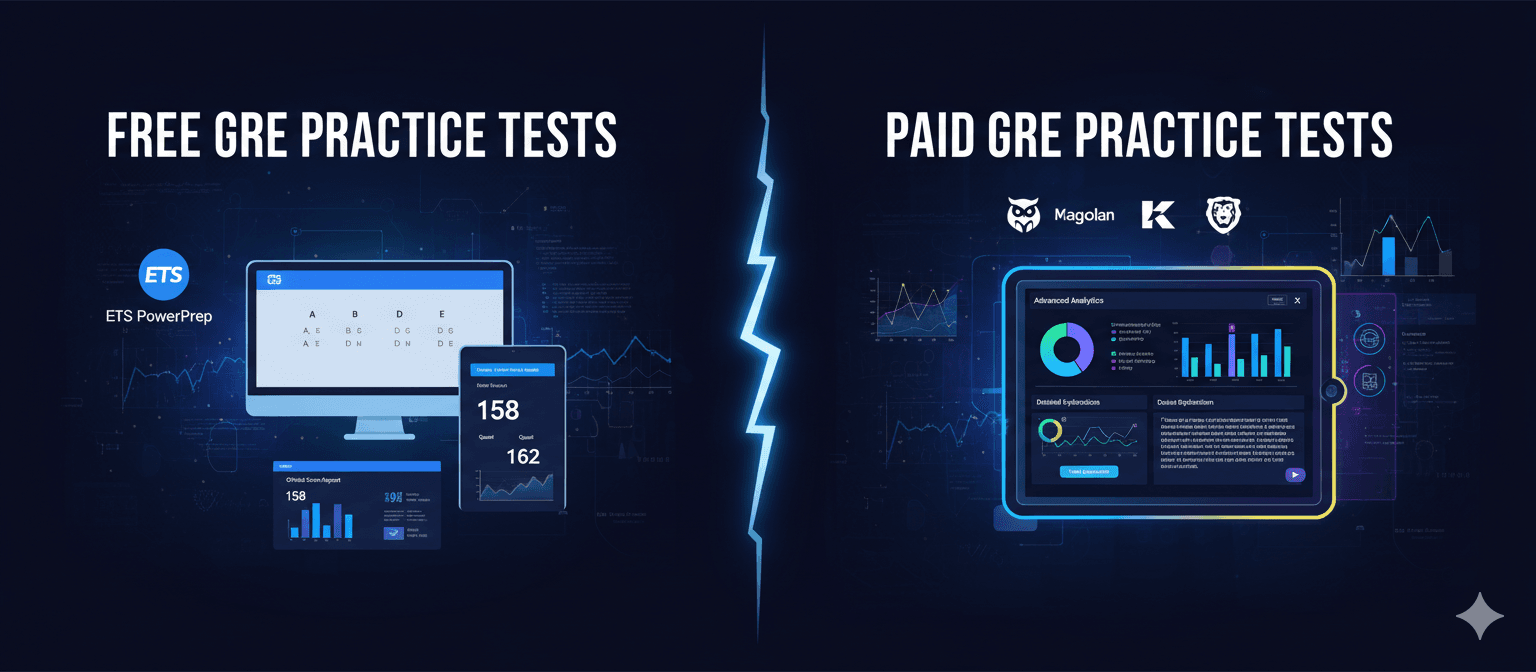
Here's what most GRE guides won't tell you: taking more practice tests doesn't automatically improve your score. The difference between students who see dramatic improvement and those who plateau isn't whether they used free or paid resources—it's how they used them.
Research from cognitive science reveals something counterintuitive about test preparation. According to studies published in Psychological Science, the act of taking a test enhances long-term retention more than additional studying of the same material. This phenomenon, called the "testing effect," means that your practice tests aren't just measuring your knowledge—they're fundamentally changing how you learn.
But here's the catch: this benefit only kicks in when you engage in deliberate retrieval practice and systematic review. A free practice test used strategically can outperform an expensive course used passively.
So let's cut through the noise and understand what actually matters when choosing between free GRE practice tests and paid options.
The Real Landscape of Free GRE Practice Tests
Before comparing costs, you need to understand what "free" actually gets you in 2025.
ETS POWERPREP: The Gold Standard (Free)
ETS, the organization that creates the GRE, offers two free POWERPREP Online practice tests. These aren't watered-down samples—they use retired questions from actual GRE exams and run on the same adaptive algorithm as the real test.
What you get for free:
- Two complete, computer-adaptive practice tests
- Authentic interface matching test-day experience
- Section-level adaptivity (your first-section performance determines second-section difficulty)
- Basic score estimates
What you don't get:
- Detailed performance analytics
- Question-by-question explanations
- Weak area identification
- Score prediction accuracy refinements
The critical limitation? POWERPREP's free tests don't tell you why you got questions wrong. You're left to figure out your knowledge gaps on your own—which most students fail to do effectively.
Third-Party Free Options
Several reputable companies offer free GRE practice tests:
Magoosh provides one free full-length adaptive test with AI essay analysis and a strengths-and-weaknesses breakdown by question type. This actually edges out POWERPREP in analytics for a free offering.
Manhattan Prep offers one free adaptive test with detailed score reports. You can purchase five additional tests for $50 if you want more without committing to a full course.
Kaplan provides one free test with a detailed score report—but be aware that Kaplan tests are widely considered harder than the actual GRE. Your scores will likely run lower, which can be demoralizing if you don't expect it.
Princeton Review includes a free test plus access to 2-hour strategy sessions—useful for understanding test structure before diving into content review.
The Hidden Problem with Free Tests
Here's where most students go wrong: they burn through all available free tests in their first two weeks of studying, then have nothing left for realistic practice closer to test day.
Free tests are limited resources. ETS gives you two. Each third-party provider gives you one, maybe two. That's roughly 6-8 full-length tests total before you need to start paying—or start seeing repeat questions.
The strategic approach? Save your free official POWERPREP tests for the final 2-3 weeks before your exam. Use third-party free tests earlier in your prep to establish baselines and identify weak areas.
What Paid GRE Prep Actually Offers
Paid options span from $8/month to $2,400+ for premium tutoring packages. Understanding what you're buying at each tier helps you make an informed decision.
Budget Tier ($8-$50/month)
GregMat ($7.99/month) has disrupted the GRE prep industry by offering 10+ live classes weekly, comprehensive study plans, and an engaged community for less than the cost of a streaming subscription. The catch? It's primarily video-based learning with community support rather than personalized adaptive practice.
Manhattan Prep Additional Tests ($50 for 6 tests) gives you more high-quality practice tests if you've exhausted free options. These tests are updated for the shorter 2025 GRE format and include detailed explanations.
Mid-Range Tier ($149-$500)
Magoosh ($149-$299) offers 1,600+ practice questions, 200+ video lessons, and a 5-point score improvement guarantee. The self-paced format works well for disciplined studiers. Where it falls short: no live instruction and limited personalization.
Kaplan Self-Paced ($450-$500) provides 13 full-length practice tests, 2,500+ practice questions, and access to their GRE Channel for on-demand video lessons. The sheer volume of practice material is a significant advantage over budget options.
Premium Tier ($900-$2,400)
Princeton Review 10 Points+ ($899) guarantees a 10-point score improvement or your money back—if you complete all course requirements. You get 8 practice tests, 45 hours of live instruction, and adaptive drills.
Princeton Review 162+ ($2,399) guarantees you'll score 162 or higher (or improve by 6+ points). This includes everything in the 10 Points+ package plus intensive tutoring support. At this price point, you're paying for accountability and expert guidance as much as content.
What Premium Price Tags Actually Buy
The jump from free to paid doesn't primarily get you more questions—it gets you three things:
Analytics that identify patterns. Free tests tell you that you missed 8 questions in Quantitative Reasoning. Paid platforms tell you that you consistently miss geometry questions involving inscribed circles, that you run out of time on data interpretation passages, and that your accuracy drops after the 15-minute mark.
Adaptive learning paths. Instead of working through material linearly, paid platforms adjust difficulty based on your performance. Struggle with algebra? The system serves you more algebra until you demonstrate mastery.
Accountability structures. Score guarantees, live classes, and scheduled assessments create external motivation that self-paced free study lacks.
The Science Behind Effective Practice Testing
Here's where understanding cognitive science helps you maximize any resource—free or paid.
The Testing Effect
Roediger and Karpicke's landmark research demonstrated that students who took practice tests remembered significantly more material after one week than students who spent the same time re-studying. The key insight: retrieval practice strengthens memory more than passive review.
What this means for your prep: Don't just take practice tests—actively struggle to recall information. The difficulty of retrieval is what creates durable learning.
Spaced Repetition
Research shows that spacing out your practice over time produces stronger long-term retention than cramming. A 2008 study found that vocabulary retention improved by nearly 80% when using spaced repetition compared to massed practice.
What this means for your prep: Take practice tests at increasing intervals. Test yourself on weak areas repeatedly over weeks, not in a single marathon session.
The Feedback Gap
Here's where free resources often fail: without understanding why you got a question wrong, you're likely to make the same mistake again. Studies show that immediate, specific feedback dramatically improves learning—but most free tests provide minimal or no feedback.
This is the genuine advantage of paid platforms. Not more questions, but better feedback loops.
Decision Framework: When Free Is Enough vs. When to Invest
Rather than giving you a simple "free is good enough" or "paid is worth it," let's build a framework based on your actual situation.
Choose Free Resources If:
You're a strong baseline scorer (155+). If your diagnostic test shows you're already near your target score, you likely need focused practice on specific weaknesses rather than comprehensive instruction. Free tests plus targeted self-study can be highly effective.
You're a disciplined self-studier. Free resources require you to create your own study plan, track your own progress, and identify your own weaknesses. If you've successfully prepared for standardized tests before without external structure, you can likely do it again.
You have 3+ months to prepare. Longer timelines allow you to learn from mistakes gradually. Free resources become limiting when you need rapid, focused improvement.
Budget is a genuine constraint. Graduate school is expensive. If investing in GRE prep means taking on additional debt, free resources used strategically can still get you to competitive scores.
Invest in Paid Resources If:
You need significant score improvement (10+ points). Large score jumps typically require identifying and fixing systematic weaknesses. The analytics in paid platforms make this process faster and more reliable.
You're time-constrained (under 6 weeks). Paid platforms with structured study plans help you maximize limited preparation time. The efficiency gains can justify the cost.
You've plateaued with self-study. If you've been preparing for months but your scores have stopped improving, you likely need external feedback to identify blind spots.
You struggle with accountability. Live classes, scheduled tests, and score guarantees create external pressure that can motivate progress.
Your target programs are highly competitive. If you're applying to programs where applicants average 325+, the marginal score points from premium prep may directly impact your admission chances.
Maximizing Whatever Resources You Choose
Whether you stick with free tests or invest in paid prep, these strategies improve outcomes:
Before Each Practice Test
Set a specific focus area. Don't just "take a practice test"—decide you're focusing on time management, or testing your new approach to reading comprehension, or practicing the skip-and-return strategy for hard questions.
Simulate test conditions. Find a quiet space, use only a basic calculator, time yourself accurately. The closer your practice environment matches test day, the better your scores will transfer.
During Each Practice Test
Track time at question level, not just section level. Note which questions consumed disproportionate time. This data is often more valuable than knowing which questions you missed.
Mark questions you're uncertain about, even if you answer them correctly. Lucky guesses don't indicate true mastery.
After Each Practice Test
This is where most students fail—and where paid platforms provide genuine value. If you're using free resources, you need to do this work yourself:
Error categorization. Don't just mark questions as "wrong." Categorize errors: content gap (didn't know the underlying concept), careless error (knew it but made a mistake), strategic error (used the wrong approach), or time pressure error (ran out of time).
Pattern identification. After several tests, look for patterns. Do you consistently miss the same question types? Do errors cluster at specific times during the test? Does accuracy drop in the second section?
Targeted remediation. Use your error patterns to guide study between tests. If geometry is a consistent weakness, spend focused time on geometry before your next practice test.
For students who want this analysis done automatically, PrepAiro's Test Builder uses AI to identify weak areas from your practice test performance and generates custom practice sets targeting those specific gaps. The platform tracks patterns across sessions so you can focus preparation time where it matters most, complete with performance analytics in Hindi and English.
The Bottom Line
Free GRE practice tests from ETS and reputable third parties provide authentic practice experiences. Paid prep provides analytics, accountability, and adaptive learning. Neither automatically improves your score—deliberate practice does.
If you're disciplined, have adequate time, and can honestly assess your own weaknesses, free resources can take you far. If you need structured guidance, rapid improvement, or accountability, paid prep is a reasonable investment in your graduate school future.
The students who improve most aren't those who spend the most money. They're those who treat every practice test as a learning opportunity, analyze their errors systematically, and adjust their preparation based on data—not intuition.
Whatever resources you choose, remember: the testing effect means your practice tests are doing more than measuring your current ability. Used correctly, they're building your future score.
Frequently Asked Questions
How many free GRE practice tests are available?
ETS provides two free POWERPREP Online tests using retired GRE questions. Additional free tests are available from Magoosh (1 test), Manhattan Prep (1 test), Kaplan (1 test), and Princeton Review (1 test). Total: approximately 6-8 free full-length practice tests from reputable sources.
Are free GRE practice tests accurate for score prediction?
ETS POWERPREP tests are the most accurate predictors since they use actual GRE questions and the same scoring algorithm. Third-party free tests vary in accuracy—Kaplan tests tend to run harder than the actual GRE, while Manhattan Prep tests closely match official difficulty. Your POWERPREP score, taken under test conditions, typically predicts your actual score within 2-3 points.
When should I take my free practice tests during GRE prep?
Save ETS POWERPREP tests for the final 2-3 weeks before your exam for the most accurate score prediction. Use third-party free tests earlier in your preparation to establish baseline scores and identify weak areas. This preserves your most valuable (official) practice tests for when they matter most.
Is paid GRE prep worth the money?
Paid prep provides the most value when you need significant score improvement (10+ points), have limited preparation time, or struggle with self-accountability. The primary advantage of paid platforms isn't more questions—it's analytics that identify your specific weaknesses and adaptive practice that targets them efficiently.
How much can practice tests improve my GRE score?
Research suggests that practice testing itself enhances learning through the "testing effect." Students who use practice tests strategically typically see 5-15 point improvements over 2-3 months. The key factor isn't the number of tests taken but how effectively you analyze errors and adjust your preparation between tests.
What's the difference between ETS POWERPREP free and paid versions?
Free POWERPREP provides two complete adaptive tests with basic scoring. POWERPREP PLUS (paid, $40 per test) adds detailed answer explanations, performance analytics by question type, and score prediction refinements. The questions themselves are from the same pool of retired GRE items.
Ready to turn your practice tests into systematic score improvement? Explore how AI-powered analytics can identify your weak areas automatically and create targeted practice sets that address them.
