Cracking UPSC CSE 2026: How to Build a Year-wise Preparation Roadmap
8 min read
Feb 03, 2026
Why this roadmap is different (read this before anything else)
Every year, lakhs of aspirants start UPSC preparation with enthusiasm, discipline, and long study hours, yet only a fraction clear even the Prelims cut-off.
The hard truth is this: UPSC does not reward effort; it rewards direction.
This guide is written to function as a decision-making manual, not motivational fluff. It is designed for serious aspirants who want a clear, year-wise, stage-integrated roadmap that aligns with how UPSC actually frames questions today.
If you follow this roadmap sincerely, you will never again ask:
- What should I study now?
- Am I preparing for Prelims or Mains?
- Is my optional slowing me down?
This is the kind of article aspirants bookmark, return to every month, and share with juniors.
Table of Contents
- UPSC CSE: Understanding the Exam as a System
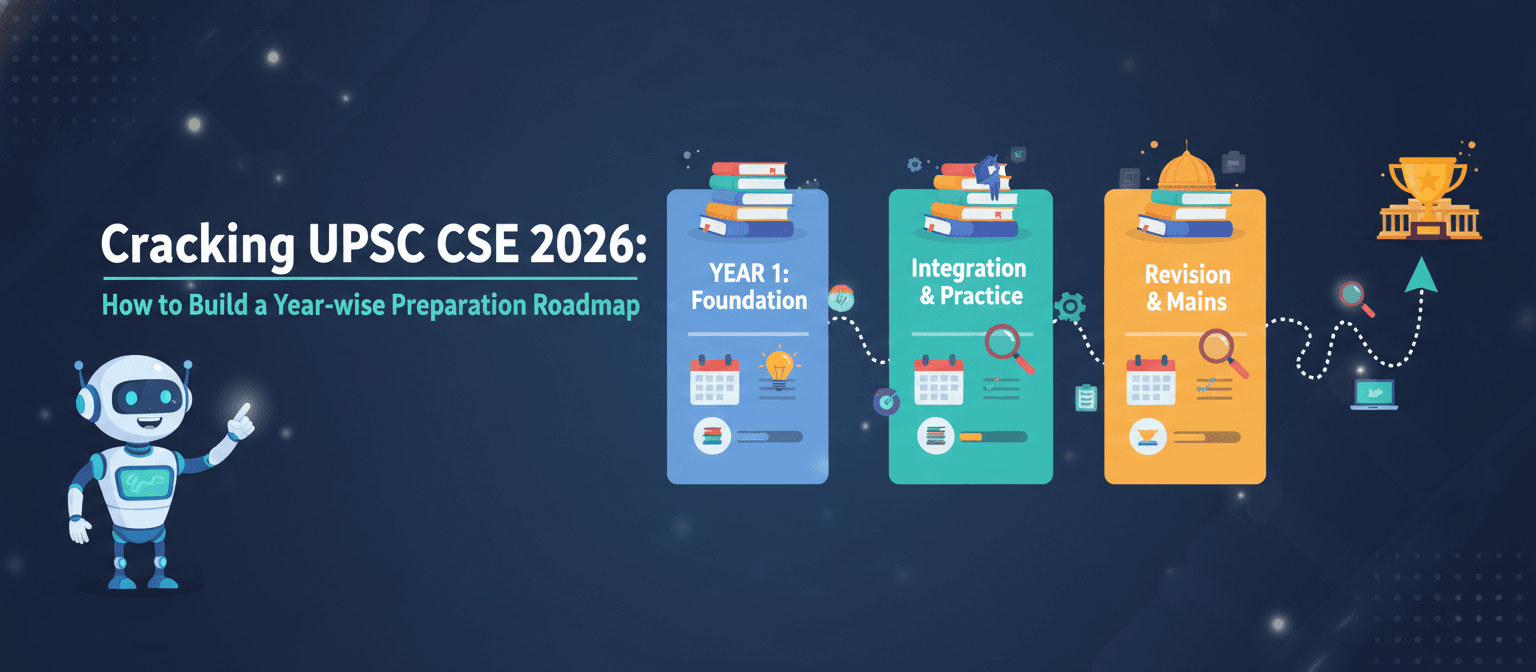
- The Big Picture: Year-wise Preparation Philosophy
- Phase 1 – Foundation Building (Month 0–6)
- Phase 2 – Integrated GS + Optional Phase (Month 7–14)
- Phase 3 – Prelims Domination Strategy (Last 3–4 Months)
- Phase 4 – Mains Answer Writing Mastery
- Phase 5 – Interview & Personality Test Preparation
- Daily, Weekly, and Monthly Time-Management Frameworks
- Optional Subject Strategy (What Actually Works)
- PYQ-Driven Planning: What the Last 25 Years Reveal
- Common Mistakes Aspirants Make (and Smart Corrections)
- Visual Learning System for UPSC
- Frequently Asked Questions (FAQs)
- Final Takeaway & Action Plan
1. UPSC CSE: Understanding the Exam as a System
Most aspirants treat Prelims, Mains, and Interview as three separate exams. UPSC does not.
UPSC CSE is a single filtering system, where:
- Prelims tests breadth + elimination skills
- Mains tests depth + organisation of thought
- Interview tests clarity, balance, and personality consistency
Golden Rule: Anything you study should ideally serve at least two stages of the exam.
For example:
- Polity concepts help in Prelims MCQs + GS-II answers + Interview opinions
- Current affairs examples improve Mains answers + Interview articulation
Visual Requirement: Flowchart showing one syllabus feeding three stages.
2. The Big Picture: Year-wise Preparation Philosophy
The biggest myth
“First prepare for Prelims, then think about Mains.”
This approach creates shallow understanding and panic after Prelims.
The correct approach
Prepare foundation + Mains-oriented notes first, then sharpen them for Prelims.
Ideal Timeline (for a serious aspirant)
| Phase | Duration | Core Objective | Output |
|---|---|---|---|
| Foundation | 0–6 months | Conceptual clarity | Syllabus-mapped notes |
| Integrated GS | 6–8 months | Depth + optional | Mains-ready content |
| Prelims Sprint | 3–4 months | Accuracy + speed | 90+ attempts confidence |
| Mains Phase | 3 months | Answer writing | Structured answers |
| Interview | 2–3 months | Personality alignment | Board readiness |
3. Phase 1 – Foundation Building (Month 0–6)
What this phase is REALLY about
- Building conceptual clarity
- Understanding syllabus language
- Creating a base that never collapses
Core Sources (Non-negotiable)
NCERTs (Class VI–XII):
- History (Ancient to Modern)
- Geography (Physical + Human)
- Polity
- Economy
- Environment & Ecology
How to read NCERTs properly
- First reading: Understand the story
- Second reading: Map chapters to syllabus keywords
- Third reading: Tag relevant PYQs in margins
Mistake many aspirants make: Reading NCERTs without linking them to PYQs, which creates passive knowledge.
Visual Requirement: Annotated NCERT page with PYQ notes.
Daily Schedule (Foundation Phase)
| Time Slot | Activity |
|---|---|
| 6–8 AM | Static subject reading |
| 9–11 AM | NCERT revision + note-making |
| 2–4 PM | Optional subject |
| 6–7 PM | Current affairs |
| 9–9:30 PM | Quick revision |
Rule: No test-series obsession yet.
4. Phase 2 – Integrated GS + Optional Phase (Month 7–14)
This is the most decisive phase of preparation.
What changes here
- Static + current affairs integration
- Optional subject completion
- Beginning of answer writing
Current Affairs Strategy
- Monthly issues, not daily news
- Focus on why + implications + way forward
Visual Requirement: Static–current linkage mind map.
5. Phase 3 – Prelims Domination Strategy (Last 3–4 Months)
How Prelims has evolved
- Fewer factual questions
- More statement-based and analytical MCQs
- Heavy focus on elimination
Weekly Framework
- 3 days: Static revision
- 2 days: Mixed MCQs
- 1 day: Full-length test
- 1 day: Test analysis
Insider Tip: Analyse wrong options more deeply than correct ones.
6. Phase 4 – Mains Answer Writing Mastery
What UPSC rewards in Mains
- Relevance
- Structure
- Examples and diagrams
Universal Answer Structure
- Introduction: Contextual, not generic
- Body: Multi-dimensional points
- Conclusion: Forward-looking
Visual Requirement: Annotated model answer.
7. Phase 5 – Interview & Personality Test Preparation
The Interview is not about brilliance, it is about balance.
Focus areas
- DAF-based questions
- Opinion consistency
- Ethical clarity
8. Daily, Weekly, and Monthly Time-Management Frameworks
Daily Non-negotiables
- One revision slot
- One answer-writing practice
- One current linkage
Monthly Review Checklist
- Syllabus completion percentage
- Test score trends
- Weak area correction
Visual Requirement: Monthly planner infographic.
9. Optional Subject Strategy (What Actually Works)
What coaching institutes often get wrong
- Treating optional as isolated
- Overloading notes
Correct strategy
- Finish optional early
- Integrate optional examples into GS answers
10. PYQ-Driven Planning: What the Last 25 Years Reveal
Key Insight: 60–70% questions are from repeated themes, not repeated questions.
Maintain a PYQ-topic tracker.
11. Common Mistakes Aspirants Make (and Smart Corrections)
| Mistake | Correction |
|---|---|
| Too many sources | One source, multiple revisions |
| Late answer writing | Start by Month 3–4 |
| Ignoring burnout | Planned breaks |
12. Visual Learning System for UPSC
- Mind maps for revision
- Tables for comparison
- Flowcharts for processes
13. Frequently Asked Questions (FAQs)
Q1. Can I prepare Prelims and Mains together?
Yes, same content, different outputs.
Q2. How many hours should I study?
Quality beats quantity. Six focused hours outperform ten distracted ones.
Q3. When should answer writing start?
By Month 3 or 4.
Q4. Is coaching necessary?
No. Structure is necessary.
Q5. How many revisions are ideal?
At least five to six.
14. Final Takeaway & Action Plan
UPSC is not cracked by luck, shortcuts, or intelligence alone.
It is cracked by:
- Clarity of direction
- Consistency of effort
- Courage to ignore noise
A roadmap does not guarantee selection, but not having one guarantees confusion.
Use PrepAiro’s AI-powered tools to:
- Convert PYQs into revision trackers
- Generate answer frameworks instantly
- Track syllabus completion intelligently
Prepare smart. Prepare once. Prepare right.
This post builds on the same idea. Read the companion article here: UPSC Prelims 2026 Answer Key: AI-Verified Solutions + Expected Cutoff Calculator + Free PDF Download [Available in Hindi]
