British Reforms in India: Acts & Policies (1765-1947)
6 min read
Apr 27, 2026
Introduction
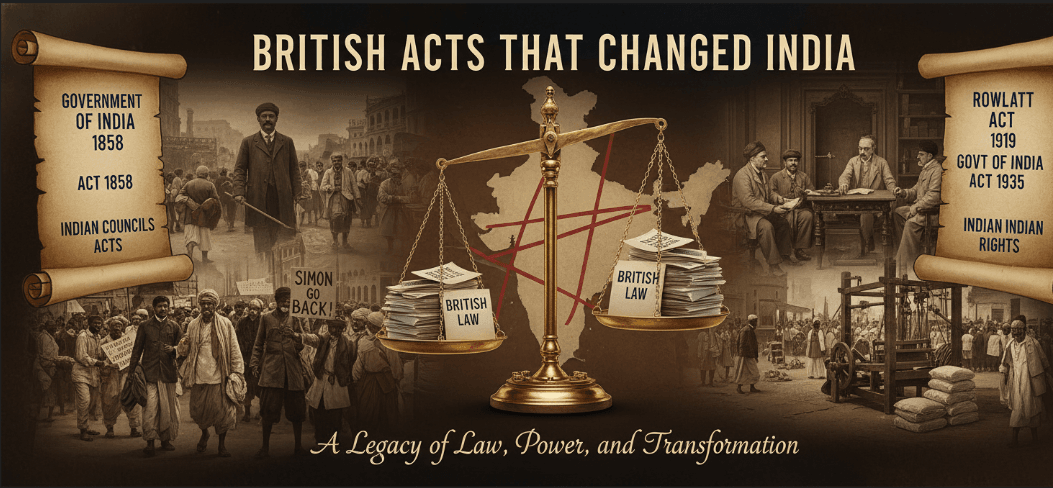
The expansion of British rule in India was accompanied by a gradual transformation of administrative and political institutions. As the East India Company expanded its territorial control after the eighteenth century, the British Parliament increasingly intervened to regulate its activities and governance. Through a series of legislative Acts, the British government attempted to control corruption, strengthen administration, and organise the governance of its growing Indian territories.
These Acts progressively transformed India from a region administered by a trading corporation into a centrally governed colonial state. They introduced administrative reforms, legislative institutions, and systems of civil service that shaped the political structure of colonial India.
Early Parliamentary Control over the East India Company
Regulating Act, 1773
The Regulating Act of 1773 was the first major attempt by the British Parliament to regulate the affairs of the East India Company and bring its administration under supervision.
Key provisions:
- Governor of Bengal became Governor-General of Bengal
- Warren Hastings appointed as the first Governor-General
- Presidencies of Bombay and Madras made subordinate to Bengal
- Establishment of the Supreme Court at Calcutta (1774)
- Creation of a four-member Executive Council
Significance:
- Beginning of parliamentary control over Company administration
- First step toward centralised governance in India
Pitt’s India Act, 1784
The Pitt’s India Act of 1784 strengthened British government control over the Company’s political affairs.
Key provisions:
- Creation of a Board of Control in Britain
- Establishment of a dual system of governance
- Crown supervised political administration
- Company retained authority over commercial matters
Significance:
- Marked the effective beginning of Crown supervision
- Strengthened administrative control over Indian territories
Expansion of Administrative Reforms
Charter Act, 1813
The Charter Act of 1813 ended the commercial monopoly of the East India Company over Indian trade.
Key provisions:
- Abolition of the Company’s trade monopoly
- British merchants allowed to trade freely in India
- Christian missionaries permitted to operate in India
- Annual allocation for education
Significance:
- Opened India to British trade and economic influence
- Beginning of government involvement in education
Charter Act, 1833
The Charter Act of 1833 transformed the East India Company into a purely administrative body.
Key provisions:
- Governor-General of Bengal became Governor-General of India
- Lord William Bentinck became the first Governor-General of India
- Company’s commercial activities abolished
- Central legislative authority established
Significance:
- Created administrative centralisation
- Marked the end of the Company as a trading organisation
Charter Act, 1853
The Charter Act of 1853 introduced further administrative reforms before the end of Company rule.
Key provisions:
- Separation of executive and legislative functions
- Expansion of the Governor-General’s Council
- Introduction of competitive examinations for civil services
Significance:
- Beginning of the modern civil service system
Transition to Crown Rule
Government of India Act, 1858
Following the Revolt of 1857, the British government abolished the East India Company and assumed direct control of India.
Key provisions:
- Company rule abolished
- Authority transferred to the British Crown
- Office of Secretary of State for India created
- Governor-General designated as Viceroy
Significance:
- Beginning of direct British Crown rule in India
Growth of Legislative Institutions
Indian Councils Act, 1861
The Indian Councils Act of 1861 marked the beginning of Indian participation in legislative governance.
Key provisions:
- Creation of legislative councils
- Nomination of Indians as members
- Introduction of the portfolio system
- Restoration of legislative powers to provinces
Significance:
- Beginning of representative institutions
Indian Councils Act, 1892
The Indian Councils Act of 1892 expanded legislative participation and discussion.
Key provisions:
- Increase in council members
- Introduction of indirect elections
- Members allowed to discuss budget matters
Significance:
- Expanded political participation
Indian Councils Act, 1909 (Morley–Minto Reforms)
The Morley–Minto Reforms expanded representation in legislative councils.
Key provisions:
- Introduction of separate electorates for Muslims
- Expansion of central and provincial legislative councils
- Indians appointed to the Viceroy’s Executive Council
Significance:
- Institutionalised communal representation
Constitutional Reforms
Government of India Act, 1919
The Government of India Act of 1919 introduced limited self-governance in provinces.
Key provisions:
- Introduction of Dyarchy
- Division of subjects into Reserved and Transferred
- Expansion of legislative councils
- Introduction of direct elections
Significance:
- Beginning of provincial self-government
Government of India Act, 1935
The Government of India Act of 1935 was the most extensive constitutional reform of British rule.
Key provisions:
- Proposal for All-India Federation
- Introduction of Provincial Autonomy
- Abolition of dyarchy in provinces
- Expansion of electoral franchise
Significance:
- Provided the framework for provincial governance
Major British Acts: Quick Overview
| Act | Key Feature |
|---|---|
| Regulating Act (1773) | Parliamentary regulation of Company |
| Pitt’s India Act (1784) | Dual control system |
| Charter Act (1813) | End of trade monopoly |
| Charter Act (1833) | Centralised administration |
| Charter Act (1853) | Civil service reforms |
| Government of India Act (1858) | Crown rule begins |
| Indian Councils Act (1861) | Legislative councils |
| Indian Councils Act (1892) | Budget discussions |
| Morley–Minto Reforms (1909) | Separate electorates |
| Government of India Act (1919) | Dyarchy |
| Government of India Act (1935) | Provincial autonomy |
Conclusion
The British Acts passed between the late eighteenth and early twentieth centuries gradually reshaped the political and administrative structure of India. Beginning with parliamentary regulation of the East India Company and culminating in large constitutional reforms, these Acts introduced centralised administration, civil services, and legislative institutions.
Although these reforms were designed to strengthen colonial governance, they also created political institutions and processes that later became important foundations for modern constitutional development in India.
