The Grameen Credit Score: Can Data Replace Collateral in India's Rural Credit Revolution?
8 min read
Mar 31, 2026
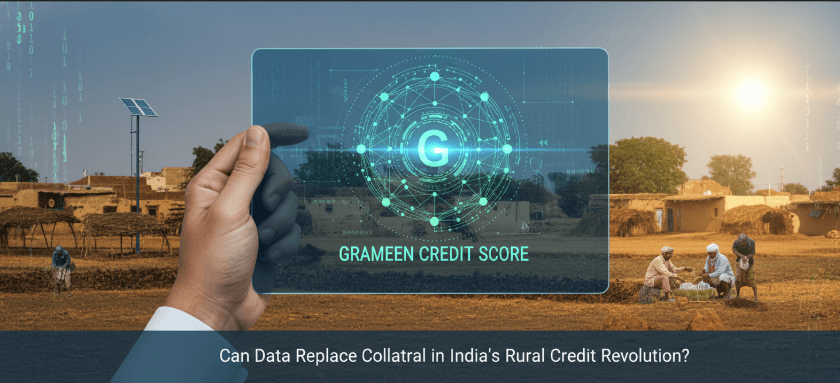
A UPSC-focused deep dive into one of India's most transformative financial policy shifts
"For centuries, the Indian farmer walked into a moneylender's house with nothing but his land title and his desperation. Today, his UPI transaction history might be worth more than both."
Introduction: The Weight of a Ledger
Imagine a woman in rural Rajasthan. She runs a small tailoring unit, repays her SHG loans on time every month, receives her PM-KISAN instalment via DBT, and pays her electricity bill digitally. Yet when she walks into a bank to apply for a ₹50,000 business loan, she is turned away — because she has no formal credit history.
This paradox has defined India's rural credit landscape for decades. Nearly 160 million individuals remain "credit invisible" — not because they are financially irresponsible, but because the existing system was never designed to see them.
The Grameen Credit Score (GCS), introduced in the Union Budget 2025–26, is India's most ambitious attempt to fix this. It is not merely a new financial instrument. It is a philosophical rupture — a shift from collateral-based exclusion to data-driven inclusion.
Background: Why Rural Credit Has Always Failed India
The Colonial Legacy of Collateral
India's formal banking system inherited a colonial-era framework that privileged landed property as the primary measure of creditworthiness. The zamindari system entrenched a model where land ownership was the gateway to capital — a model that persists, in spirit, even today.
The result: informal moneylenders continue to dominate rural credit. According to NABARD data (December 2025), while 58.3% of rural households now have access to formal credit, 20–30% still rely on informal borrowing — often at interest rates of 24–48% per annum.
The Limits of Microfinance and SHG Models
Self-Help Groups (SHGs) and microfinance institutions (MFIs) partially bridged this gap. But they too operate within a system that cannot scale credit beyond a threshold without formal credit assessment. A woman who has successfully repaid five SHG cycles still cannot access a ₹2 lakh term loan from a PSB without a guarantor or collateral.
This is the structural gap the GCS seeks to address.
What Is the Grameen Credit Score?
The GCS is a rural-specific credit scoring framework developed by Public Sector Banks (PSBs) in collaboration with Credit Information Companies (CICs) such as CIBIL and Experian. Unlike conventional CIBIL scores — which require a prior loan or credit card history — the GCS is built on alternative, non-traditional data sources:
| Data Type | Source |
|---|---|
| Digital payment behaviour | UPI transaction records |
| Government benefit receipts | DBT, PM-KISAN, MGNREGA payments |
| Self-Help Group repayment history | SHG-Bank linkage records |
| Utility payment records | Electricity, telecom bills |
| Field-level verification | India Post network |
| Agricultural activity | Soil Health Cards, Kisan Credit Card usage |
This makes the GCS a cash-flow and behaviour-based credit model, rather than an asset-based one — a fundamental reimagining of what it means to be creditworthy in rural India.
The Regulatory Architecture: RBI's Role
The GCS does not exist in isolation. It is embedded within a larger regulatory transformation driven by the Reserve Bank of India.
Real-Time Credit Reporting
The RBI mandated 15-day credit reporting in January 2025, with a further push to weekly reporting by July 2026. This means a rural borrower's credit profile can be updated in near real-time — a quantum leap from the earlier quarterly or annual reporting cycles that made credit scores stale and unreliable for dynamic rural livelihoods.
Priority Sector Lending (PSL) Revision
In April 2025, the RBI revised PSL norms to increase the loan limit for women and SHGs to ₹2 lakh, creating a direct incentive for banks to adopt GCS as the assessment tool for this expanded lending bracket.
Data Quality Index (DQI)
To prevent the garbage-in-garbage-out problem, the RBI introduced a Data Quality Index (DQI) — ensuring that the alternative data feeding into GCS is accurate, standardised, and auditable across institutions.
The India Post Advantage: A Sleeper Variable
One of the most underappreciated elements of the GCS architecture is the role of India Post. With over 1.65 lakh post offices — more than 90% in rural areas — India Post serves as the field-level verification and last-mile data collection arm for the GCS.
This is a masterstroke of institutional design. In areas where digital infrastructure is patchy and bank branches are distant, postmen and Gramin Dak Sevaks (GDS) can verify borrower details, collect field data, and even facilitate credit disbursement through India Post Payments Bank (IPPB). This effectively creates a phygital credit ecosystem — physical reach combined with digital scoring.
GCS vs. Conventional Credit Scores: A Structural Comparison
| Parameter | Conventional CIBIL Score | Grameen Credit Score |
|---|---|---|
| Data basis | Formal loan/credit card history | Alternative behavioural and transactional data |
| Target population | Urban, formally employed | Rural, informal sector workers |
| Collateral requirement | Often required | Minimised/eliminated |
| Income model | Stable, salaried income assumed | Seasonal, irregular income accommodated |
| Verification | Digital/automated | Phygital (India Post + digital) |
| Update frequency | Quarterly (pre-2025) | Weekly (by July 2026) |
Transformative Potential: What GCS Could Unlock
1. Credit Democratisation at Scale
India's formal credit-to-GDP ratio remains significantly below its potential, partly because rural credit is underpenetrated. GCS, if adopted uniformly, could bring millions of first-time borrowers into the formal system — increasing consumption, investment, and economic resilience in rural clusters.
2. Women's Financial Empowerment
Women constitute the majority of SHG members and are the primary beneficiaries of DBT schemes. GCS implicitly rewards behaviour that women disproportionately exhibit — consistent small repayments, digital utility payments, welfare benefit receipts. This is not incidental; it is a design choice with transformative gender implications.
3. Agricultural Investment and Productivity
Access to affordable credit at the right time — before the Kharif sowing season, for instance — can significantly improve input quality, crop yield, and farmer income. GCS enables timely, purpose-aligned credit that MGNREGA or PM-KISAN cannot provide.
4. Formalisation of the Rural Economy
As GCS incentivises digital transactions (since UPI records feed the score), it nudges rural economies toward formalisation — expanding the tax base, improving data quality for policy, and reducing the power of informal moneylenders over time.
Critical Limitations: The Honest Reckoning
No transformative policy is without fault lines. A nuanced UPSC answer — or a credible blog — must engage honestly with the limitations.
1. The Digital Divide
GCS assumes digital transaction behaviour. But in regions with low smartphone penetration, poor internet connectivity, and digital illiteracy — particularly in states like Bihar, Jharkhand, and parts of Odisha — alternative data is thin or non-existent. The score may simply replicate existing exclusions in a digital wrapper.
2. Seasonal Income Misreads
Agricultural income is inherently seasonal. A farmer who spends heavily during sowing and earns during harvest may appear financially erratic to an algorithm calibrated for monthly income patterns. Without careful seasonal calibration, GCS could penalise the very people it is meant to serve.
3. Data Privacy and Consent
GCS aggregates data across multiple government and private databases. The Digital Personal Data Protection (DPDP) Act, 2023 provides a framework, but implementation gaps remain. Rural borrowers may not fully understand what data is being used, how it is scored, or how to contest errors — raising serious informed consent questions.
4. Institutional Resistance
PSBs have historically been reluctant to lend to rural borrowers without collateral, partly due to Non-Performing Asset (NPA) pressures and partly due to institutional risk aversion. Mandating GCS adoption does not automatically translate into a cultural shift in bank branches toward rural lending.
5. First-Generation Errors and Redressal
Any new scoring model will produce errors — false negatives (creditworthy people denied) and false positives (risky borrowers approved). The absence of a clear, accessible grievance redressal mechanism for rural borrowers denied on GCS grounds is a significant policy gap.
Connecting the Dots: UPSC Linkages
The GCS is a gift for UPSC aspirants because it connects to virtually every major theme of the syllabus:
GS Paper II — Governance & Social Justice
- Financial inclusion as a constitutional goal (Articles 38, 39, 46)
- Role of RBI as a regulatory institution
- SHG-Bank linkage as a welfare delivery mechanism
- Digital India and its rural gaps
GS Paper III — Economy
- Priority Sector Lending norms
- Rural credit market structure
- Formalisation of the informal economy
- Agricultural finance and Kisan Credit Card
- Banking sector reforms and NPA management
GS Paper IV — Ethics
- Data ethics and informed consent in AI-driven credit scoring
- Equity vs. efficiency in financial policy design
- Governance and integrity in financial institutions
Essay Paper
- "Data is the new collateral but access to data is still unequal"
- "Financial inclusion without digital inclusion is an illusion"
- "The state's duty to the credit-invisible"
A Comparative Lens: Global Precedents
India is not alone in this experiment. Global parallels offer useful insights:
- Kenya's M-Pesa & M-Shwari: Mobile money transaction history used for micro-loans a pioneering model that GCS echoes in design philosophy.
- China's Rural Credit Scoring (Rongzi Bao): Used agricultural output data and rural cooperative records for credit assessment showed promise but also raised surveillance concerns.
- Bangladesh's BRAC: Community-level credit assessment by field workers the India Post model draws inspiration from this.
The difference is scale. India's GCS, if it works, would be the largest alternative credit scoring exercise for rural populations in human history.
Conclusion: A Paradigm Shift, Not Just a Policy
The Grameen Credit Score represents something deeper than a new financial instrument. It is an acknowledgement — long overdue — that poverty is not a proxy for risk, and that the rural poor are not unbanked because they are unreliable, but because the system was never designed to see their reliability.
The shift from collateral to character — measured now through data — is a civilisational correction. It will not be without friction, error, or exploitation. But the direction is right.
As the RBI moves toward weekly credit reporting and banks begin piloting GCS adoption, the next two years will be critical. Aspirants, policymakers, and citizens alike should watch this space closely — because the story of the Grameen Credit Score is, ultimately, the story of whether India's formal economy can finally make room for the 160 million people it has long pretended don't exist.
Key Terms Glossary (For Quick Revision)
| Term | Meaning |
|---|---|
| GCS | Grameen Credit Score — rural-specific alternative credit scoring framework |
| CIC | Credit Information Company (e.g., CIBIL, Experian) |
| PSL | Priority Sector Lending — RBI-mandated lending to priority sectors |
| DBT | Direct Benefit Transfer — government subsidies credited directly to accounts |
| DQI | Data Quality Index — RBI tool to ensure accuracy of credit data |
| DPDP Act | Digital Personal Data Protection Act, 2023 |
| IPPB | India Post Payments Bank |
| PLFS | Periodic Labour Force Survey |
| NPA | Non-Performing Asset — bank loan that has stopped generating income |
Suggested Mains Practice Questions
-
"The Grameen Credit Score marks a paradigm shift from collateral-based to data-driven rural credit assessment." Examine its potential and limitations. (250 words)
-
Discuss how financial inclusion and digital inclusion are two sides of the same coin, with reference to India's rural credit ecosystem. (150 words)
-
Critically analyse the role of RBI's regulatory reforms in enabling alternative credit scoring mechanisms in India. (250 words)
Sources: RBI Policy Documents, NABARD Rural Finance Report (Dec 2025), Union Budget 2025–26
Blog written for UPSC CSE 2026 preparation | GS II, GS III, Essay relevance
