Best UPSC App for Working Professionals: Study Smarter in 2-3 Hours/Day
12 min read
Feb 26, 2026
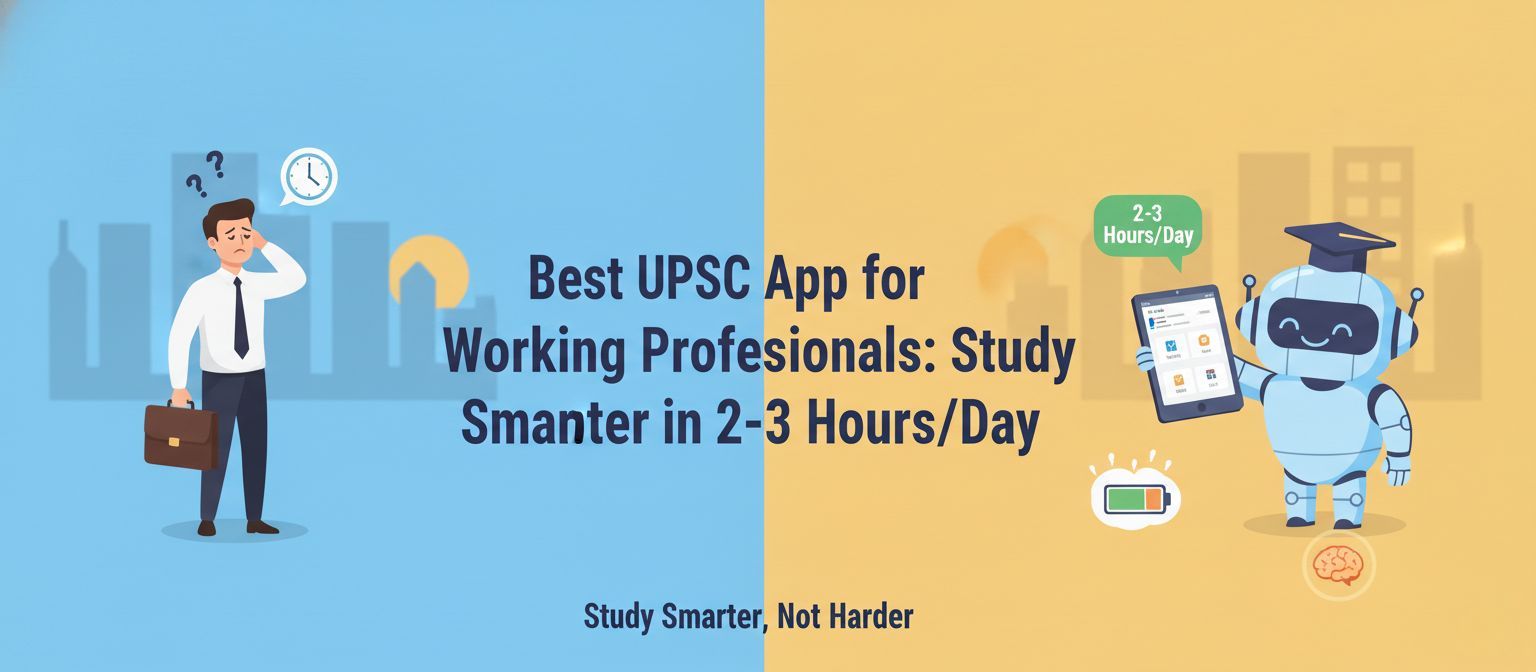
You wake up at 6 AM. Rush through your morning routine. Commute for an hour. Work from 9 AM to 7 PM (or later). Commute back. Reach home by 8:30 PM. Eat dinner. And now, with exhausted eyes and a tired mind, you're supposed to study Constitutional amendments, remember Economic Survey data, and practice answer writing for the world's toughest exam.
Sound familiar?
If you're a working professional aspiring to crack UPSC, you're fighting a battle on two fronts: clearing one of the most demanding competitive exams while holding down a full-time job. Your batchmates from coaching institutes study 8-10 hours daily. You get 2-3 hours at best—and that too after an exhausting workday.
The traditional advice? "Quit your job and focus full-time on UPSC."
But that's not realistic for everyone. You have EMIs, family responsibilities, financial commitments, and honestly—the security of a steady income while preparing for an exam with a success rate of 0.1%.
Here's the truth that most coaching institutes won't tell you: You don't need 10 hours a day. You need the RIGHT 2-3 hours with the RIGHT tools.
And that's exactly what this guide is about—how working professionals can crack UPSC using smart, time-efficient preparation strategies powered by adaptive learning technology.
The Reality Check: What Working Professionals Face in UPSC Preparation
Let's start by acknowledging the challenges honestly. You're not competing against the syllabus alone—you're competing against time.
Time Constraints (The Obvious Challenge)
Full-time students: 8-10 hours of focused study daily
Working professionals: 2-3 hours on weekdays, maybe 5-6 on weekends
That's a 60-70% time deficit right off the bat. And those 2-3 hours come after an exhausting workday when cognitive capacity is depleted.
Mental Fatigue & Inconsistency
After 8-9 hours of work, you face decision fatigue, reduced focus, and lower retention. Study patterns become erratic—3 hours Monday, 0 hours Tuesday (office crisis), guilt-driven 30 minutes Friday. Result: knowledge gaps and mounting anxiety.
Information Overload
With limited time, aspirants compensate by buying 10 test series, joining 8 Telegram groups, downloading 50 PDFs. Paradoxically, more resources = less clarity. Precious study time gets wasted deciding what to study instead of actually studying.
Social and Career Pressure
You're not just preparing for an exam—you're justifying your choice to colleagues, family, and friends while managing office expectations and personal life simultaneously.
Why Traditional UPSC Preparation Methods Don't Work for Working Professionals
Most UPSC strategies are designed for full-time students. Here's why they fail working aspirants:
Classroom coaching: Runs 9 AM-1 PM when you're at work. Weekend batches are overcrowded, recorded lectures pile up unfinished.
Voluminous textbooks: Reading entire Laxmikant, Spectrum, NCERTs takes 6 months with 2-3 hours daily. You forget early chapters by the time you finish.
Current affairs overload: Daily newspapers (1.5 hours) + monthly magazines + PIB releases can consume your entire study time, leaving nothing for static subjects.
Answer writing demands: Toppers say "write 5-10 answers daily." Reality: 1 answer = 30 minutes. That's your entire available time with zero time for reading or revision.
Impossible revision cycles: Standard advice is "revise 3-4 times before exam." But when? If you're constantly studying new topics, revision never happens. Come December, you remember only 30% of earlier material.
What Working Professionals Actually Need: The 5 Non-Negotiables
After analyzing hundreds of successful working professional UPSC candidates (including several IAS/IPS officers who prepared while working), five common patterns emerge:
1. Hyper-Efficient Content Consumption
Every minute must deliver maximum value. No fluff, no tangents, no "nice-to-know" information. Only high-yield, exam-relevant content that matches current UPSC trends.
2. Adaptive Learning Technology
Your preparation must adapt to YOU:
- Skipping topics you already know well
- Focusing on weak areas identified through testing
- Adjusting difficulty based on your performance
- Personalizing content to your optional subject and answer writing style
One-size-fits-all doesn't work when you have 1/3rd the time.
3. Micro-Learning Modules
You can't study for 3 straight hours after work—your brain won't allow it. You need:
- 15-minute learning chunks that can fit into commute time
- 30-minute focused sessions for post-dinner study
- 60-minute deep dives for weekend mornings
Content must be modular, not sequential—so you can start anywhere without feeling lost.
4. Integrated Current Affairs
Current affairs can't be a separate vertical eating up 50% of your time. It must be:
- Auto-filtered for UPSC relevance (ignore celebrity news, focus on governance)
- Linked to static topics (e.g., every Environment news tagged to GS Paper III)
- Summarized with Mains angles (not just news reporting, but analytical frameworks)
Target: 20-30 minutes daily for current affairs, not 90 minutes.
5. Progress Visibility and Motivation
You need constant feedback on whether you're on track:
- Syllabus coverage percentage
- Topic-wise strength/weakness mapping
- Performance trends over time
- Comparison with peer benchmarks
Why? Because working professionals can't afford to discover gaps 2 months before Prelims.
How Smart UPSC Apps Change the Game for Working Professionals
This is where technology becomes your secret weapon. The right UPSC app doesn't replace your preparation—it multiplies your effectiveness within constrained time.
The Core Advantages of App-Based Learning
1. Portability = Hidden Study Hours
Found time opportunities:
- Morning commute (30-45 minutes): Listen to audio summaries, read current affairs
- Lunch break (20 minutes): Quick MCQ practice
- Evening commute (30-45 minutes): Watch concept videos
- Waiting times (doctor's office, queue, etc.): Flashcard revision
Total recovered time: 2-3 extra hours per day that were previously "dead time."
2. Personalization = No Wasted Effort
AI-powered apps learn your patterns:
- Topics you grasp quickly → fewer practice questions needed
- Topics you struggle with → more examples, simpler explanations, repeated testing
- Your answer writing weaknesses → targeted improvement modules
Impact: Instead of studying everything equally (inefficient), you study smartly (effective).
3. Structured Learning = Reduced Decision Fatigue
The app decides for you:
- What to study today (based on your schedule and syllabus coverage)
- Which current affairs are UPSC-relevant
- When to revise previously studied topics
- Which PYQs to practice next
You save 30 minutes daily just by not deciding what to study. Over a year, that's 180 hours recovered—enough to revise the entire syllabus once.
4. Bite-Sized Content = Sustainable Learning
Traditional books demand 2-3 hour commitments. Apps offer:
- 5-minute explainers: Core concept in digestible format
- 15-minute deep dives: Comprehensive topic coverage with examples
- 30-minute practice sessions: MCQs or answer writing with instant feedback
You can study for 20 minutes and feel accomplished, rather than opening Laxmikant, reading 5 pages, getting sleepy, and feeling guilty.
5. 24/7 Doubt Resolution = No Blockages
Stuck on a concept at 11 PM? Can't wait for next week's coaching class. AI tutor answers instantly:
- Clarifies conceptual doubts
- Provides additional examples
- Links to related PYQs
- Suggests revision materials
No more 3-day gaps waiting for someone to clarify a doubt while you move ahead with confusion.
Key Features Working Professionals Should Look for in a UPSC App
Not all UPSC apps are created equal. Here's what actually matters for working aspirants:
Must-Have Features
| Feature | Why It Matters for Working Professionals | Red Flag If Missing |
|---|---|---|
| Daily Digest (15-20 min) | Curated current affairs + PYQ connection in minimal time | You spend 90 min daily on newspapers |
| Offline Access | Download content for commute (no internet needed) | Data costs add up; commute time wasted |
| Progress Dashboard | See exactly where you stand in syllabus coverage | Flying blind until mock tests |
| AI-Powered Study Plan | Adapts to your pace and available time | Generic plans that assume 8 hrs/day |
| Integrated PYQ Practice | Every topic links to relevant previous year questions | Disconnected theory and practice |
| Answer Writing Module | Write, submit, get AI evaluation in 24 hours | Manual evaluation takes 7-10 days |
| Revision Scheduler | Automated reminders based on forgetting curve | You forget topics and never realize it |
| Multi-Device Sync | Start on phone, continue on laptop/tablet | Lose progress or can't switch devices |
| Audio Summaries | Listen during commute/gym/cooking | Only text-based content |
| Concept Clarity Tests | Quick quizzes to check understanding before moving on | False confidence about "completed" topics |
Nice-to-Have (But Important) Features
- Community doubt forum (but moderated, not chaotic Telegram groups)
- Peer comparison (anonymized - to gauge where you stand)
- Optional subject support (if your app covers your optional)
- Interview prep module (for those who clear Mains)
- Motivational milestones (celebrating small wins keeps morale up)
Features You Can Ignore (Marketing Gimmicks)
- ❌ "10,000+ hours of video content" (you'll never watch it all)
- ❌ "Taught by 50+ toppers" (consistency matters more than celebrity faculty)
- ❌ "Live doubt sessions every day" (you can't attend if you're working)
- ❌ "100% syllabus coverage" (every app claims this; what matters is HOW)
The 2-3 Hour Daily Strategy That Actually Works
Let's design a realistic study schedule for working professionals using smart app-based learning:
Weekday Schedule (Total: 2.5-3 hours)
Morning Routine (30-40 minutes)
Before work or during commute
-
6:00-6:20 AM: Daily Current Affairs Digest on app (20 min)
Curated news with Mains angles, linked to GS Papers -
Commute (20 min): Audio summary of yesterday's studied topic
Revision in "dead time"
Lunch Break (20 minutes)
12:30-12:50 PM at office
- Prelims MCQ Practice: 20 questions with explanations (20 min)
Keeps you in touch with factual accuracy
Evening Commute (30 minutes)
7:00-7:30 PM
- Watch concept video or read topic summary on app (30 min)
New topic learning during transit
Post-Dinner Focused Session (60-90 minutes)
9:30-11:00 PM
- 20 minutes: Revise morning's current affairs with PYQ connections
- 40 minutes: Deep study of one topic (app's structured content)
- 20 minutes: Answer writing practice (1 answer, 250 words)
- 10 minutes: Quick revision quiz + tomorrow's study plan check
Result: 2.5-3 hours of high-quality, structured study with ZERO decision fatigue.
Weekend Schedule (Total: 10-12 hours over Sat-Sun)
Saturday
-
Morning (3 hours):
- 90 minutes: Deep dive into complex topic (e.g., Budget Analysis, International Relations)
- 60 minutes: Answer writing practice (3-4 answers)
- 30 minutes: Self-evaluation using app's AI feedback
-
Afternoon (2 hours):
- Full-length Prelims mock test (2 hours)
-
Evening (2 hours):
- Mock test analysis on app (identifies weak topics)
- Topic-wise revision based on identified gaps
Sunday
-
Morning (3 hours):
- Weekly current affairs compilation (60 minutes)
- Revision of last week's studied topics (90 minutes)
- Flashcard practice for facts/dates/names (30 minutes)
-
Afternoon (1.5 hours):
- Optional subject study or ethics case studies
-
Evening (1 hour):
- Week ahead planning on app
- Scheduling non-negotiable study blocks
Weekly Total: 22-25 hours (sustainable for working professionals)
Real Success Story: Bank Employee Cracked UPSC in 2nd Attempt
Rajesh M. cleared UPSC CSE 2023 (AIR 312) while working as Assistant Manager in a public sector bank.
Challenge: Office 10 AM-8 PM (often late), no coaching access, failed Prelims 2022 with traditional methods.
Strategy Shift for 2nd Attempt:
"In my first attempt, I'd reach home exhausted, force myself to read for 2 hours, and fall asleep retaining nothing. App-based learning changed everything."
What worked:
- Morning: 20-min daily digest during breakfast
- Commute: 90 min daily (audio lectures + MCQs)
- Lunch: 15-min revision quizzes
- Post-dinner: 90 min focused study (guided by app's AI plan)
- Weekends: 5-6 hours + 1 full mock test
Results: Prelims jumped from 88/200 (failed) to 118/200 (cleared). Mains: 862. Interview: 178. Final: AIR 312.
His advice: "Don't match full-time students hour-for-hour. The app helped me study 3 hours like they study 8 hours—every minute perfectly utilized."
PrepAiro's Working Professional-Specific Features
Let's examine how PrepAiro specifically addresses the challenges faced by working aspirants:
1. Adaptive Daily Study Plans
Unlike rigid schedules, PrepAiro's AI asks:
- How many hours can you study today?
- Which subjects feel stronger/weaker?
- Are you in foundation phase or revision mode?
Output: A personalized daily plan that fits YOUR schedule, not a generic 8-hour timeline.
Example:
"You have 2 hours today. Based on your progress, focus on: (1) Current Affairs - 20 min, (2) Indian Polity - Constitutional Bodies - 60 min, (3) PYQ Practice on Polity - 30 min, (4) Revision - Electoral Reforms - 10 min."
2. Bite-Sized Learning Modules
Every topic broken into:
- Quick Read (5 min): Core concept
- Detailed Study (15 min): Exam perspective with examples
- Deep Dive (30 min): Comprehensive coverage with PYQs
You choose based on available time. Have only 15 minutes? Complete the Quick Read. Have an hour? Go for Deep Dive.
3. Smart Current Affairs Integration
PrepAiro's AI filters 100+ daily news items down to 15-20 UPSC-relevant stories:
- Automatically tagged to GS Papers
- Connected to static syllabus topics
- Mains angles provided
- PYQ linkages shown
Time saved: 60-70 minutes daily (no need to read full newspapers)
4. Commute-Friendly Audio Content
- Audio summaries of every major topic
- Podcast-style current affairs briefings
- PYQ explanation audios
- Revision capsules in audio format
Use case: 1-hour commute = complete topic coverage without reading
5. AI Tutor Available 24/7
Doubt at 11 PM while studying? Don't wait for coaching class.
Ask Airo (PrepAiro's AI tutor):
- "Explain the difference between Money Bill and Finance Bill"
- "What are the components of M1 money supply?"
- "Why was Article 356 controversial in recent case?"
Instant response with UPSC-specific context, source citations (Laxmikant/NCERT), and related PYQs.
6. Weekend Deep Dive Sessions
Structured weekend modules for working professionals:
- Saturday: Full mock test + analysis
- Sunday: Weekly revision + answer writing practice
Guided by app so you don't waste time planning.
7. Progress Analytics Dashboard
Real-time visibility:
- Syllabus coverage: 62% complete (38% remaining)
- Weak topics: Constitution Amendments, Balance of Payments
- Strong topics: Ancient History, Ethics
- Study streak: 23 days consistent
- Peer comparison: Top 15% among working professionals
Psychological benefit: You KNOW you're making progress, reducing anxiety.
The Hidden Advantage: Consistency Over Intensity
Surprising truth: Consistency beats intensity in UPSC preparation.
Scenario A (Intense but erratic): 6 hours Monday, 0 Tuesday-Wednesday, 8 Thursday, 1 Friday, 14 weekend = 29 hours but inconsistent retention
Scenario B (Consistent moderate): 2.5 hours Mon-Fri, 6 Saturday, 5 Sunday = 23.5 hours, highly consistent
After 6 months: Scenario A has massive knowledge gaps and high stress. Scenario B has solid foundation and sustainable pace.
The app's role: Maintains consistency through reminders, bite-sized content, and daily momentum.
Common Mistakes Working Professionals Make (and How to Avoid Them)
Mistake #1: Trying to match full-time students
❌ "Others study 10 hours, I must find 10 hours too"
✅ "I have 2-3 hours. How do I make it equivalent in effectiveness?" Use technology to multiply efficiency.
Mistake #2: Ignoring small time blocks
❌ "Only 20 minutes, not worth studying"
✅ "20 minutes = one topic or 10 MCQs" Keep app ready; every 15-minute block is valuable.
Mistake #3: Delaying until "perfect" conditions
❌ "I'll start when my project ends / transfer happens"
✅ "I start with whatever time I have TODAY" Begin with 1 hour daily; app adapts to your pace.
Mistake #4: Neglecting revision
❌ Keep studying new topics, assuming you'll remember
✅ 40% new topics, 60% revision App's algorithm auto-schedules revision.
Mistake #5: Not tracking progress
❌ Study blindly, panic at mock test scores
✅ Weekly analytics showing exactly where you stand
Is It Really Possible? Success Rate Analysis
Data reality check: According to UPSC statistics:
- Total working professional candidates: ~35-40% of total applicants
- Working professionals who clear Prelims: ~28%
- Working professionals in final list: ~22-25%
Interpretation: Working professionals have a slightly lower success rate, but not dramatically so. The gap is closing with better preparation tools.
Why the gap is narrowing:
- Technology democratization: Apps provide coach-level guidance at fraction of cost
- Time efficiency: Smart tools multiply effectiveness of limited hours
- Information access: No longer dependent on expensive coaching or city location
- Peer learning: Online communities provide support system
Key insight: The determining factor isn't TIME—it's quality of preparation per hour. Working professionals who use adaptive learning tools are closing the gap rapidly.
Quick Comparison: Traditional vs App-Based Preparation for Working Professionals
| Aspect | Traditional Preparation | Smart App-Based Preparation |
|---|---|---|
| Study Material | 15+ physical books, 5kg bag | Entire syllabus on phone (offline) |
| Current Affairs | 90 min daily newspaper reading | 20 min curated digest |
| Doubt Resolution | Wait days for coaching class | Instant AI tutor 24/7 |
| Revision | Self-planned (often missed) | Auto-scheduled by algorithm |
| Progress Tracking | Mock tests every 2 months | Real-time analytics daily |
| Commute Time | Wasted or podcast listening | Structured topic learning |
| Study Plan | Generic or DIY | AI-personalized to your pace |
| Answer Writing | Manual evaluation (slow) | AI evaluation in 24 hours |
| Cost | ₹1.5-2 lakhs (coaching + materials) | ₹15,000-30,000 annually |
| Flexibility | Fixed schedule | Study anytime, anywhere |
| Motivation | Coaching peer pressure | App streaks, milestones, analytics |
FAQs: UPSC Preparation for Working Professionals
Q1: Can I really clear UPSC while working full-time?
A: Yes, absolutely. Approximately 22-25% of UPSC successful candidates are working professionals. The key is smart preparation, not just hard preparation. With 2-3 hours daily of focused, app-guided study, you can cover the syllabus in 12-15 months.
Q2: Should I quit my job to prepare for UPSC?
A: Not necessarily. Quit only if:
- You've given 2-3 serious attempts while working and narrowly missed
- Financial situation allows 1-2 years without income
- You're confident about clearing in next attempt
Otherwise, prepare while working using efficient methods. Many clear in first/second attempt without quitting.
Q3: How many hours should working professionals study daily?
A: Minimum 2 hours on weekdays, 5-6 hours on weekends. Total: 20-25 hours weekly. This is sustainable and sufficient if you're using structured, personalized learning tools.
Q4: Which is better—coaching or app-based preparation for working professionals?
A: App-based preparation is often better for working professionals because:
- Time flexibility (study at 11 PM if needed)
- Location independence (office, home, commute)
- Personalized pace (don't miss classes if office extends)
- Cost-effective (1/5th the cost of premium coaching)
Coaching works only if you can attend regularly—which most working professionals cannot.
Q5: How do I manage office work and UPSC preparation together?
A:
- Use commute time (audio content)
- Utilize lunch breaks (MCQ practice)
- Set non-negotiable study blocks (9:30-11 PM)
- Weekend deep study (Saturday mock test, Sunday revision)
- Say no to social commitments strategically
- Use app's daily digest to save time
Q6: When should I start preparing while working?
A: Start at least 12-15 months before Prelims. If you're in March 2026, target Prelims 2027 (May 2027). This gives you adequate time without burnout.
Q7: Can I prepare for UPSC without coaching using just an app?
A: Yes. Many working professionals successfully clear UPSC with self-study using apps. Ensure your app has:
- Complete syllabus coverage
- PYQ integration
- Answer writing evaluation
- Current affairs
- Progress tracking
Coaching is helpful but not mandatory if your app is comprehensive.
Q8: How important is optional subject for working professionals?
A: Very important. Choose optional based on:
- Your graduation background (less preparation needed)
- Interest and scoring potential
- Availability of resources
Use app's optional subject module if available, or combine app for GS + coaching for optional.
Q9: What's the success rate of working professionals in UPSC?
A: Working professionals constitute 35-40% of applicants and 22-25% of successful candidates. Success rate is slightly lower than full-time students but the gap is narrowing with better preparation tools.
Q10: How do I stay motivated during long preparation while working?
A:
- Set micro-milestones (complete one GS Paper in 6 weeks)
- Track progress visually (app's dashboard)
- Join working professional UPSC communities
- Celebrate small wins (streak of 30 days study)
- Remember your "why" (write it down, read weekly)
- Take strategic breaks (not guilt-driven breaks)
The 6-Month Quick Start Plan for Working Professionals
Months 1-2: Foundation
Focus: NCERT condensed summaries via app. Daily: 1.5 hours NCERTs + 30 min current affairs. Weekend: 4 hours study + 2 hours MCQs.
Months 3-4: Building
Focus: Standard books (Laxmikant, Economy). Daily: 2 hours new topics + 30 min revision + 30 min CA. Weekend: 5 hours + 1 mock test.
Months 5-6: Practice
Focus: PYQ practice + answer writing. Daily: 1 hour revision + 1 hour PYQs + 30 min CA + 30 min answers. Weekend: 3 hours Mains + 2 hours Prelims mock + 2 hours revision.
After 6 months: Complete one full syllabus round, ready for intensive Prelims prep.
Final Word: Work Smart, Not Just Hard
The myth that UPSC requires quitting everything and studying 12 hours daily is just that—a myth. It's a comforting narrative for those who have the luxury of time, but it's not the only path.
The reality in 2026: Technology has leveled the playing field. A working professional with PrepAiro's AI-powered adaptive learning can match—and often surpass—a full-time student with scattered preparation.
Your competitive advantage as a working professional:
- Discipline: You already manage time under pressure
- Focus: You value every study minute (no time for distractions)
- Maturity: Better answer writing perspective from real-world experience
- Stability: No financial pressure, can attempt multiple times if needed
The only thing missing was the right tool. You now know what to look for.
Take the First Step Today
You don't need to quit your job tomorrow. You don't need to clear your calendar for the next 2 years. You just need to start with 2 hours today.
Download an app that understands working professionals. Set up your personalized study plan. Study for 2 hours. Repeat tomorrow.
In 12 months, you'll either be steps closer to becoming an IAS officer, or you'll be exactly where you are today—wondering if you should have started.
👉 Download PrepAiro Now | Start Your Smart UPSC Journey
🎯 Free Trial for Working Professionals | No Credit Card Required
📱 Available on iOS & Android | Study Offline, Sync Across Devices
Remember: Every IAS officer you see today started as an aspirant juggling multiple responsibilities. The only difference? They started. They stayed consistent. They worked smart.
Your turn starts now.
Additional SEO FAQ Schema
Q: What is the best UPSC app for working professionals in 2026?
A: The best UPSC app for working professionals should offer adaptive learning, bite-sized content, offline access, 24/7 AI doubt solving, integrated current affairs, and personalized study plans that fit 2-3 hours daily schedules—features that maximize efficiency for time-constrained aspirants.
Q: How many hours do working professionals need to study for UPSC daily?
A: Working professionals need minimum 2-3 hours on weekdays and 5-6 hours on weekends, totaling 20-25 hours weekly. With smart, app-based learning, this is sufficient for comprehensive UPSC preparation within 12-15 months.
Q: Can you clear UPSC while doing a full-time job?
A: Yes, approximately 22-25% of UPSC successful candidates prepare while working full-time. Success depends on using time-efficient preparation methods, adaptive learning technology, and maintaining consistent study schedules rather than matching full-time students' hours.
Q: Which preparation method is better for working professionals—coaching or apps?
A: For working professionals, app-based preparation often works better due to flexibility in timing, location independence, personalized pace, and lower cost. Apps allow studying during commutes, lunch breaks, and late evenings when traditional coaching classes aren't feasible.
Q: How long does it take for a working professional to prepare for UPSC?
A: Working professionals typically need 12-18 months for comprehensive UPSC preparation with 2-3 hours daily study. This timeline includes foundation building, syllabus coverage, revision cycles, answer writing practice, and mock test analysis using structured app-based learning.
Q: What are the biggest challenges for working professionals in UPSC preparation?
A: Key challenges include limited study time (2-3 hours vs 8-10 hours for full-time students), mental fatigue after work, inconsistent study patterns, information overload, and lack of structured guidance—all addressable through adaptive learning technology and smart time management.
